
The Legend of Zelda: Majora's Mask
Main game
4.41 average rating based on 3917 ratings
- Developers
- Nintendo EAD Software Development Group No.3
- Publishers
- Gradiente, Nintendo
- Franchises
- The Legend of Zelda
- Series
- The Legend of Zelda, The Legend of Zelda: Ocarina of Time
- Event
- Nintendo Space World '99
- Platforms
- 64DD, Nintendo 64, Wii, Wii U
- Genres
- Adventure, Puzzle
- Themes
- Action, Fantasy, Horror, Open world
Release Dates
User Stats
How Long Is The Legend of Zelda: Majora's Mask?
Related Content


Greeting the morning
This review is for the Nintendo 64 version
Most people know the story of how Majora's Mask was put together in a year by reusing Ocarina of Time's assets, and it's one of the reasons why it will forever live in the shadow of that game. While it may be easy to dismiss it as an oddball spinoff to Ocarina of Time, I've always fallen into the camp that consider Majora's Mask to be the better game.
I vividly remember the leadup to this game's release, with magazines like Planet 64 touting screenshots of what was then called Zelda Gaiden. My imagination ran wild with the weird Alice in Wonderland-esque premise that they previewed. My hype for this game was sky high, and I consumed every bit of media I could find about it. None of that prepared me for the world full of metaphors for regret, doubt, tragedy and forgiveness that I would encounter.
Since then I've played Majora's Mask many times, my most recent playthrough prior to now being back when Majora's Mask 3D was released. For this playthrough, I played through the original game on an emulator, even though I do own Majora's Mask 3D. I think the changes to …
Most people know the story of how Majora's Mask was put together in a year by reusing Ocarina of Time's assets, and it's one of the reasons why it will forever live in the shadow of that game. While it may be easy to dismiss it as an oddball spinoff to Ocarina of Time, I've always fallen into the camp that consider Majora's Mask to be the better game.
I vividly remember the leadup to this game's release, with magazines like Planet 64 touting screenshots of what was then called Zelda Gaiden. My imagination ran wild with the weird Alice in Wonderland-esque premise that they previewed. My hype for this game was sky high, and I consumed every bit of media I could find about it. None of that prepared me for the world full of metaphors for regret, doubt, tragedy and forgiveness that I would encounter.
Since then I've played Majora's Mask many times, my most recent playthrough prior to now being back when Majora's Mask 3D was released. For this playthrough, I played through the original game on an emulator, even though I do own Majora's Mask 3D. I think the changes to the game's boss fights, along with the control changes for Link's Zora and Deku forms, are enough of a downgrade to make me think of it as a lesser version. I went out of my way to complete the Bomber's Notebook and collect all of the masks, and had a blast at every step of the way. I certainly did miss the 60fps and camera control from Ocarina of Time's unofficial PC port, but even that wasn't enough to put it over Majora's Mask for me.
The central gimmick of Majora's Mask is that it takes place within a three-day time span that ends with the moon falling and destroying the land of Termina. As a player, you can use the Ocarina of Time to reverse, slow down or fast forward through time. Most of the game's NPCs are given much more depth than ever before, with their own schedules and stories that unfold within this timespan.
It is within these stories that Majora's Mask thrives, with several great character arcs that you could completely miss if you don't go out of your way to interact with them. There is a mother searching for her missing child. A father disappointed in his wayward son. A pair of sisters just trying to make ends meet. Two lovers desperately trying to reunite. All happening as an impending apocalypse looms over them.
Plenty of stories play around with the idea of an apocalypse. By this point, Final Fantasy VII was already old news. But by putting players in direct control of resetting the clock to prevent said annihilation, it makes the tension feel much more real than in any other video game apocalypse narrative. On top of that, the excellently written NPCs--most of which have routines, goals, fears and a LOT of unfinished baggage--make the stakes abundantly clear.
The time limit is the most divisive gameplay aspect of Majora's Mask. I've read people describe it as irritating and stressful, but I find it to be one of the most interesting mechanics in the entire franchise. Time serves as a new dimension that you can explore, and I absolutely love it. What it does require from the player is the ability to plan and manage time in order to have enough space for the activities that you want to complete in any given loop.
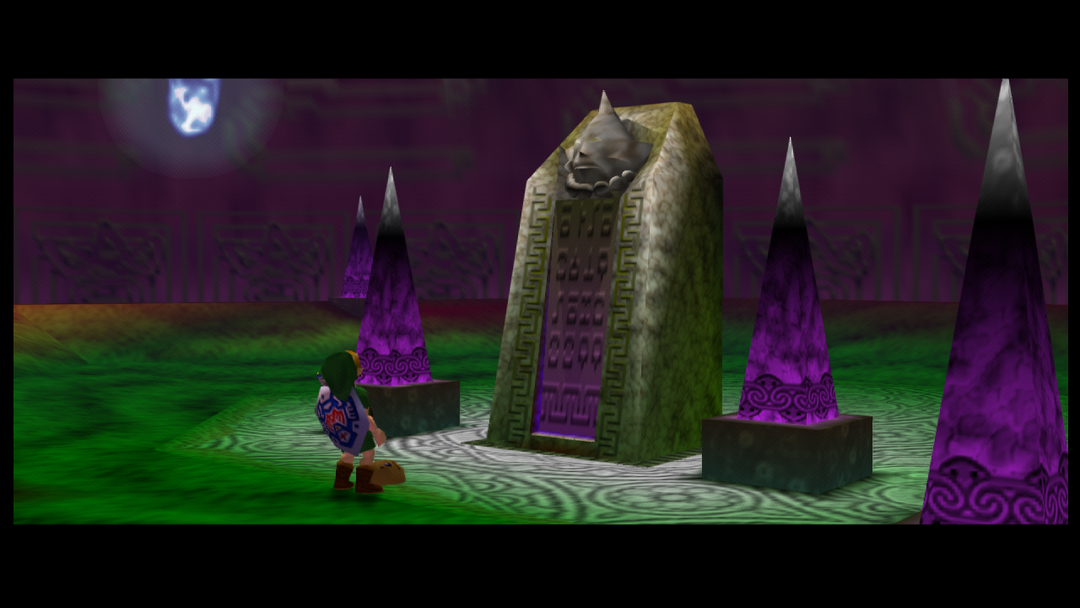
There is a lessened focus on dungeons, with there being only four to Ocarina of Time's nine (Or 12, depending on how you count). These four dungeons are generally larger and more complex, however. Some may disagree, but I also think they are mostly of higher quality as well. Stone Tower Temple in particular deserves attention for being one of the best Zelda dungeons ever.
Despite the smaller number of dungeons, I still eagerly poured many more hours into Majora's Mask than Ocarina of Time in this marathon. That is because Majora's Mask has a greater focus on side stories that you can interact with to fill out the Bomber's Notebook, a pseudo-quest log, and to complete your collection of masks.
At first, Majora's Mask will not give you nearly enough direction to tackle these side quests. This all changes once you acquire the Mask of Truth, which you can use to interact with Gossip Stones that give you hints. I kept a spreadsheet with every hint that I found, which gave me a variety of leads to prevent myself from feeling lost. The only time that I needed to consult a walkthrough was to find the
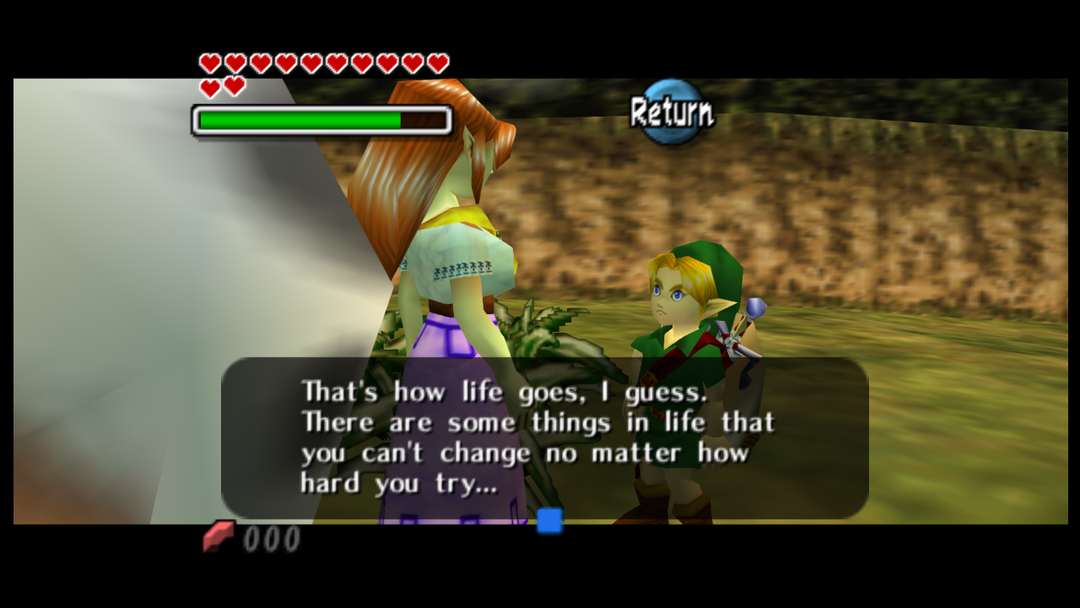
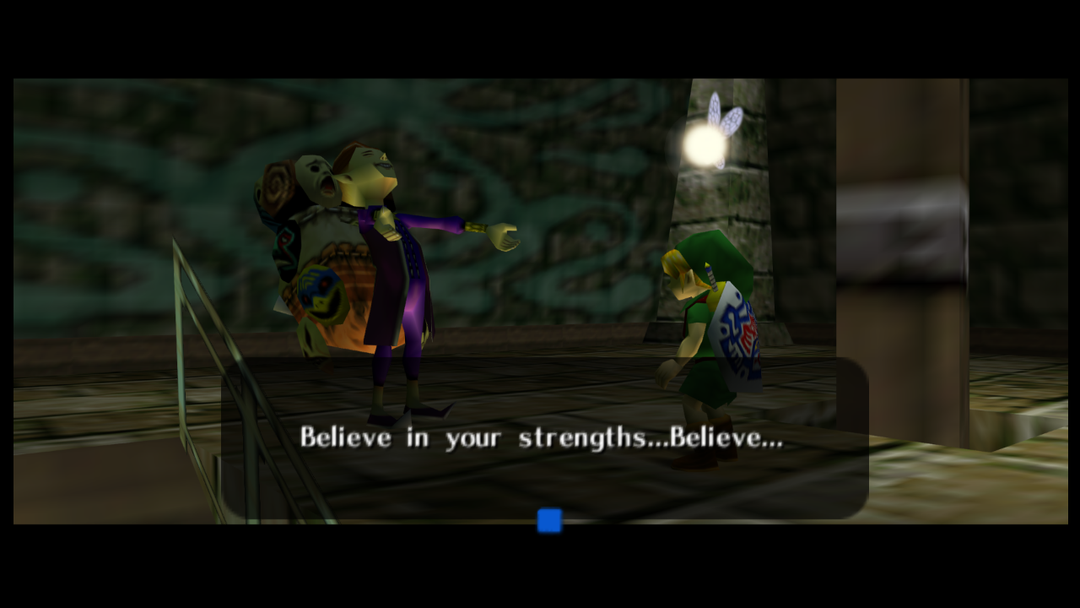
I could really go on about Majora's Mask all day if I were to get into more specifics, but I need to move on to the next Zelda game(s). To sum it up, Majora's Mask is still an incredibly good cross section of art, music, gameplay and narrative. Termina is a world that embodies the fear of tomorrow in all its forms. On the surface, it may appear a bit nihilistic to put all these characters in a scramble to get their ducks in order before their existence comes to an end. But I also find it to be incredibly hopeful, bringing greater significance to the small moments of love, friendship and family that these characters cling to as they brace for an uncertain future. Anyway, here's a bunch of screenshots.




Octjillery's review of The Legend of Zelda: Majora's Mask
I don't really know how to rate this because of how I experienced it. I almost just want to make this a status instead, but we'll see how I feel about the actual rating as I write this up.
I like the Zelda franchise well enough, but it's more peripheral than anything. The only game in the series that I've actually played through is Ocarina of Time. I've dabbled in a few others (the OG on NES as a kid, Oracle of Ages, Twilight Princess on Wii, one or two on DS/3DS, I think) over the years, and it's just never been my thing, especially the top-down older games. I'm not totally against action-adventure as a genre or anything like that, but it's one that I'm more picky about, I guess, and Zelda games just never clicked for me.
My other half (@joystickler) and I are long distance, so we try to play games or watch something together several times a week. We'll play Mario Kart on Switch or goof around in the classic system apps on NSO, watch a video or show while on the phone, etc. Several weeks back, he asked if I wanted to play through Majora's …
I don't really know how to rate this because of how I experienced it. I almost just want to make this a status instead, but we'll see how I feel about the actual rating as I write this up.
I like the Zelda franchise well enough, but it's more peripheral than anything. The only game in the series that I've actually played through is Ocarina of Time. I've dabbled in a few others (the OG on NES as a kid, Oracle of Ages, Twilight Princess on Wii, one or two on DS/3DS, I think) over the years, and it's just never been my thing, especially the top-down older games. I'm not totally against action-adventure as a genre or anything like that, but it's one that I'm more picky about, I guess, and Zelda games just never clicked for me.
My other half (@joystickler) and I are long distance, so we try to play games or watch something together several times a week. We'll play Mario Kart on Switch or goof around in the classic system apps on NSO, watch a video or show while on the phone, etc. Several weeks back, he asked if I wanted to play through Majora's Mask on the N64 app since I never had. I didn't really have any interest in being the one to play it, for the reasons stated above, so I suggested he could and I'd spectate. He thought I'd be bored just watching him play, but I grew up watching my brother play games that I would otherwise not have gotten into myself, so I convinced him to go for it. He got to play through a game that he loves, I got to spend time on the phone with the person I love while he shared all kinds of fun trivia, and I finally got to see what all the fuss is about.
The game employs a much darker mood than OoT, and is more emotionally driven. While I still think I'd pick OoT over MM as a whole, I definitely appreciated the focus on other characters over the hero in this case, and the shift to a less common atmospheric experience in gaming at the time. The balance between saving the world at large and taking on quests to help individuals isn't a new concept, especially for us JRPG fans, but the presentation here is quite unique. I don't have the nostalgia working for me like many do, so while I don't view the Anju/Kafei sidequest as the greatest video game romance of all time like I keep seeing around the internet, I can appreciate the juxtaposition of "happier" events with the otherwise dismal ones throughout the game. Pretty much all of the masks that Link acquires are at the expense of a life, so the game does a great job of perpetuating that balance throughout.
I really enjoyed the mask concept itself. While I sometimes find having to change equipment in this way tedious, I wasn't the one having to manually do so, and just got to enjoy the effects. The Zora/Mikau mask was absolutely my favorite. A fantastic design, cool abilities, and visually appealing swimming. I now also have context for Fierce Deity Link, though my boyfriend didn't use him during the final battle, as he said it makes it too easy.
There were some fantastic character and boss designs, which is unsurprising for anyone with even vague familiarity with the series. Odolwa was my favorite boss, and the Majora forms and fights were excellent. Gomess is def runner up, because I love the spooky stuff.
I'm generally very unlikely to play anything with a time crunch, tedious time travel elements (especially when it requires trial and error and/or just kind of winging it), etc. I'm honestly insanely picky about time travel in media in general because it tends to just stress me out and frustrate me. That's part of what has kept me from going anywhere near this game over the years. My boyfriend has played the game enough times to know what he's doing, so that made experiencing the various quests and overall story a much more pleasant experience than I ever would have had on my own, using a guide or not.
There's probably a lot more that I could say, and I should have written this up weeks ago when we finished it...but my general thoughts are that, while this will never really be a favorite of mine for a variety of reasons, I'm really glad that I've finally gotten to experience it, and I had a great time doing so with my other half.

The first and last survival horror Zelda entry
This review is for the Nintendo 64 version
What makes a game survival horror is the need for resource management that forces the player to make cost vs benefit decisions constantly. This creates stress/tension that adds weight to every decision you make. In Resident Evil, this boils down to "Do I deal with this zombie now, or do I move past to save on my resources, but leave the zombie as a potential hazard for later?" Both of these decisions have weight and consequences. To kill the zombie, it takes ammo. If in the fight you take damage, that costs healing supplies. If you try to avoid the zombie entirely, you risk taking damage now and later, which could cost you double the healing supply in the long run. There's no clear superior decision here. While Resident Evil has multiple resources for you to juggle and weigh, Majora's Mask has one primary resource. Time. Everything in Majora's Mask cost you time.
Need to heal? You can farm, buy or collect heart pieces, but it costs time. Need more rupees to buy some supplies or that item for a quest? Costs you time. There's a tough platforming challenging you are struggling with, that costs you time. Time and time. …
What makes a game survival horror is the need for resource management that forces the player to make cost vs benefit decisions constantly. This creates stress/tension that adds weight to every decision you make. In Resident Evil, this boils down to "Do I deal with this zombie now, or do I move past to save on my resources, but leave the zombie as a potential hazard for later?" Both of these decisions have weight and consequences. To kill the zombie, it takes ammo. If in the fight you take damage, that costs healing supplies. If you try to avoid the zombie entirely, you risk taking damage now and later, which could cost you double the healing supply in the long run. There's no clear superior decision here. While Resident Evil has multiple resources for you to juggle and weigh, Majora's Mask has one primary resource. Time. Everything in Majora's Mask cost you time.
Need to heal? You can farm, buy or collect heart pieces, but it costs time. Need more rupees to buy some supplies or that item for a quest? Costs you time. There's a tough platforming challenging you are struggling with, that costs you time. Time and time. This design leads to the most stressful Zelda game to play. Bar none. While Ocarina of Time did include optional time challenges, like later games in the series, ALL of Majora's Mask's challenges are defined by the limited resource of time. Sure you can always reset a cycle and try again, but that costs you time in real life, since you need to start from scratch.
It's this survival horror aspect that has made this game a bit polarizing. I say a bit, because plenty of people readily call this game brilliant (I am one of these people if that wasn't already clear). But if you're willing to engage with this game on its own turns, you will experience some of the best design the Zelda team has ever made. Leading to a small world, that feels more alive than all of BOTW or TOTK. The Zelda series, in my opinion, has yet to top the quality and depth of Clock Town. It's unrealistic to expect every town in BOTW to feel as alive as Clock Town, but damn would that result in the best Zelda game, and perhaps best video game ever made. In fact, I would argue that none of the towns in either BOTW nor TOTK reach the depth or liveliness of Clock Town. Only really Oblivion with it's Radiant AI design of NPCs (which was certainly flawed and janky) comes close. It makes sense, given the narrow scope and time restraints around the making of Majora's Mask, so much focus was placed on Clock Town as a hub. Thus the game was clearly built around this one town.
That said, nothing in Ocarina of Time even comes close to Clock Town. There are memorable moments in each town, but they function more as quest hubs (just like all of BOTW and TOTK towns/cities) rather than a lived in ecosystem. It was these time restraints that resulted in the brilliance of Majora's Mask.
By forcing the 3 day cycle, it allowed the devs to create the illusion of intelligence and agency from the town folks, since their movements could be meticulously plotted. It's fantastic having so many NPCs with their own goals and motivations and having Link there along for the ride. Majora's Mask is about the side content and it is exceptionally well done. It's not perfect, mind you. Plenty of heart pieces/challenges can be quite tedious to get. Especially since the time cycles not only put pressure on you to complete tasks, but also forces you to wait around for certain events to occur. This is the biggest flaw in the game, but it's really not a big deal.
You can move forward to either 6pm or 6am. But sometimes an event will occur at 4PM, which means starting at 6 am and waiting until 4. And for some of the more epic quest lines, such as Kafei and Anju's, if you fail at the end, you need to start all over from the beginning. I overall think the pros outweigh the cons here, and this waiting around was likely due to hardware or time limitations. So I'm willing to overlook this given how much the devs got right. The 3DS version does fix this problem by allowing you to jump to a specific time, but honestly I don't think that change outweighs the negatives of the other changes made for the 3DS version. So I still prefer the original version.
Another issue people like to point out is the number of dungeons. Here it's only 5, if you include the final challenges on the Moon. There are mini-dungeons that often act as preludes for the major dungeons, but in general this Zelda has the fewest dungeons. I don't mind this because the quality of the dungeons are among the highest in any Zelda game. The Swamp Dungeon is certainly the simplest, given it's the first, but after the swamp, the last 3 dungeons all have a major gimmick that defines both how you navigate and engage with the dungeon. The Mountain Dungeon has a central spire that you need to raise and lower to progress. The Great Bay Temple has the direction of water flow and finally the Stone Temple has you flip the temple upside-down. Which goes to show you, that inverting the layout of a map is almost always both an efficient and clever design decision.
The game does give you plenty of time to tackle any of these dungeons in the 3 day cycle, made easier with the ability to slow down time to give you triple the amount of time. That said, it can still be stressful, just seeing a timer tick down. The Great Bay and Stone temple in particular are quite complex. Both require you to think abstractly and proactively since you will see objects and rooms you can't access until you either change the water flow or flip the dungeon, respectively. My only real gripe with the dungeon design is with the stray fairy challenge in the Stone Dungeon.
Overall, the design of dungeons and side quests are fantastic. The atmosphere and tone are oppressive, but with a bitter sweet optimism that permeates throughout the game. Easily the weirdest sequel ever made in video game history and it's a pity Nintendo doesn't take bold risks like this anymore. Given, the budget here was clearly shoestring level, since it was made with a one year imposed deadline using the OOT game engine and assets. So the risks were quite low for this Yet, in spite of those extreme limitations, what we got is the best story, exceptional design and one of the most memorable games ever made. Not for everyone, but if you don't mind being challenged while playing a video game, this is an easy recommend. Not cozy. Firmly stressful. Totally memorable.

Zelda's Take on a Roguelike-like Formula
The whole concept of playing the game in a continuous 3 day cycle that ends in failure (almost) every time and makes you turn back time to prevent the end of the world is such a cool concept that is married almost flawlessly with the gameplay and story.
From a gameplay standpoint, each area is created with so much vision and each 72 minute segment feels like the perfect amount of time to keep you on your toes but not rushing you to the point of frustration (for the most part). And the feeling when you get to another bird statue checkpoint exactly when you needed to get there before the time resets is immaculate. The dungeons were all good imo but not nearly as engaging or interesting as the puzzles in Ocarina of Time. A lot of the frustrating aspects of Ocarina were thankfully remedied in this game, though; nothing particularly stood out as a really bad moment of game design. The gameplay highs of Ocarina were not fully achieved here, but the gameplay lows were also not achieved.
The themes, tone, and story, however, were all FAR superior to those of Ocarina! The bizarre, looming presence of imminent …
The whole concept of playing the game in a continuous 3 day cycle that ends in failure (almost) every time and makes you turn back time to prevent the end of the world is such a cool concept that is married almost flawlessly with the gameplay and story.
From a gameplay standpoint, each area is created with so much vision and each 72 minute segment feels like the perfect amount of time to keep you on your toes but not rushing you to the point of frustration (for the most part). And the feeling when you get to another bird statue checkpoint exactly when you needed to get there before the time resets is immaculate. The dungeons were all good imo but not nearly as engaging or interesting as the puzzles in Ocarina of Time. A lot of the frustrating aspects of Ocarina were thankfully remedied in this game, though; nothing particularly stood out as a really bad moment of game design. The gameplay highs of Ocarina were not fully achieved here, but the gameplay lows were also not achieved.
The themes, tone, and story, however, were all FAR superior to those of Ocarina! The bizarre, looming presence of imminent destruction is portrayed in this game in a way unlike any other game I've experienced and I loved it so much. The first time when you look up into the sky and see the moon's terrifying face looking down at Clock Town is a standout moment of the game, and is just so eerie and really sets the tone of what kind of ride you're in for. And the main stories all had to do with death in some way and this game has some really interesting ways of portraying those themes. Taking a mask from a deceased hero's face and transforming into their likeness-- weird, creepy, HOW IS THIS IN A KIDS' GAME? But I love it. I didn't have time to do as many of the side quests as I wanted, but from the ones I did do, their stories were also weird and melancholy and fitted perfectly with the wider narrative of this impending doom. The music also fits in with the tone of the game perfectly!
So yeah in short, this game was really great! I think I enjoyed it more than Ocarina. Even though the puzzles weren't as complex and the bosses definitely weren't as good, a lot of the jankier parts of Ocarina are smoothed out here and the story and tone are wayyyy more interesting in this entry.

Mazinkaiser's review of The Legend of Zelda: Majora's Mask
Time management adds an entirely new feeling to everything; it may take a little while to be aware of what exactly is going on each day but there's no penalty for repeating days as long as time doesn't run out. Focuses more on side quests over main game compared to Ocarina of Time, creating a much more open game filled with many more choices and hidden rewards.
The tone is a bit darker (and sometimes eerie and frightening?) than previous Legend of Zelda games; this helps it to stand out but doesn't get intensely gritty or violent. The tone revolves around death without basking in gore or violence, and profits well from the result.
Most of the items make their return with Young Link being able to use all of them; there aren't any new items but some carry different purposes such as the Light Arrows taking the place of the Mirror Shield in activating sun switches. The masks that grant different powers are varied and carry their useful strengths and weaknesses that encourage switching between them. A couple of the side masks seem somewhat useless but they all have their purpose in the game, even if that purpose is …
Time management adds an entirely new feeling to everything; it may take a little while to be aware of what exactly is going on each day but there's no penalty for repeating days as long as time doesn't run out. Focuses more on side quests over main game compared to Ocarina of Time, creating a much more open game filled with many more choices and hidden rewards.
The tone is a bit darker (and sometimes eerie and frightening?) than previous Legend of Zelda games; this helps it to stand out but doesn't get intensely gritty or violent. The tone revolves around death without basking in gore or violence, and profits well from the result.
Most of the items make their return with Young Link being able to use all of them; there aren't any new items but some carry different purposes such as the Light Arrows taking the place of the Mirror Shield in activating sun switches. The masks that grant different powers are varied and carry their useful strengths and weaknesses that encourage switching between them. A couple of the side masks seem somewhat useless but they all have their purpose in the game, even if that purpose is just a Piece of Heart.
There are fewer dungeons in this game but it seems that a lot of effort was put into the implementation of these dungeons; the Stone Tower by far is one of the most creative levels ever placed in a Legend of Zelda game. Some may feel pushed to rush through dungeons because of time constraints but the slowing of time and well-placed warps prevent any overt frustration.
There are a couple of complaints- The quests can be nearly impossible to find if one does not consistently observe the world every hour of the day, ESPECIALLY Clock Town. Time also passes slowly, even with the normal time (1 minute = 1 hour). It would be very much preferred to make a song of faster time instead of just skipping six hours a day with the Song of Double Time.
Other than that, this game is a solid entry in the Legend of Zelda franchise and one of the best I've played. The tone, the replayable three-day loop, and the mask system help it to stand out without alienating too many fans of the original in terms of dungeon crawling and even improves upon it with a number of enticing side quests.
giopep's review of The Legend of Zelda: Majora's Mask
This review is for the Nintendo 64 version
Things that came to mind while playing Majora’s Mask for the first time, in 2024, on Switch:
- the 3D camera from those years really aged poorly;
- I am playing a Nintendo 64 game and I can clearly see what’s on screen (from this it should be clear that I had a PAL N64);
- what a bizarre and fascinating Zelda game, so focused on having you play with the characters and their storyline, with that time loop that is really clunky in some aspects but overall is incredibly fun, and with those amazing dungeons (particularly the last two);
- I may be overreaching but in this game I can kinda see them already experimenting with the immersive sim playstile that is at the base of the two Zeldas on Switch;
- it’s really horror-ish, between the moon, all the creepy moments and that mask dude with the Shigeru Miyamoto serial killer vibe.

Schizo64's review of The Legend of Zelda: Majora's Mask
A little weak compared to Oot but damn what a great narrative, the side quests are amazing and loved the whole dark atmosphere, and I say weak because MM has only 4 temples while Ocarina has 6 but idk, it´s a masterpiece as well.
My true Zelda love
This review is for the Nintendo 64 version
There is definitely some nostalgia bleeding thru to this review but I have to profess my love for this game nonetheless.
I love the harrowing themes in this game. I know many complain about the time mechanic, but to me, it just adds depth to the game. It can be confusing at first, but once you are familiar with it and have the ability to slow down the progression of time, I really think most can come to appreciate the mechanic.
The time mechanic allows Termina to change in real time throughout the day rather than just day/night and it adds a lot of life to the world and side quests. Majora's Mask, in my opinion, has by far the most memorable side quests of any Zelda game and that's due to harrowing and haunting themes that allow you to connect with these characters as they live their final days on earth out in repeat. But also because many of the quests require you to complete multiple steps over multiple days and multiple times of day. They're just really engaging.
Past that I enjoy the mask mechanic and I find the rest of the game to play very similar to …
There is definitely some nostalgia bleeding thru to this review but I have to profess my love for this game nonetheless.
I love the harrowing themes in this game. I know many complain about the time mechanic, but to me, it just adds depth to the game. It can be confusing at first, but once you are familiar with it and have the ability to slow down the progression of time, I really think most can come to appreciate the mechanic.
The time mechanic allows Termina to change in real time throughout the day rather than just day/night and it adds a lot of life to the world and side quests. Majora's Mask, in my opinion, has by far the most memorable side quests of any Zelda game and that's due to harrowing and haunting themes that allow you to connect with these characters as they live their final days on earth out in repeat. But also because many of the quests require you to complete multiple steps over multiple days and multiple times of day. They're just really engaging.
Past that I enjoy the mask mechanic and I find the rest of the game to play very similar to OoT and Wind Waker, my other favourite 3D Zeldas. Altogether, Majora's Mask still holds up as an amazing action-adventure and Zelda game.

Close, but no
In many aspects, this game is 5 stars. But the 3-day soft time limit system killed an otherwise fantastic exploration/adventure game for me.

Everything I hoped Ocarina had is right here!
This game was amazing. What ever Ocarina failed at, Majora did in a near perfect way.
-Handholding? No more! This game relies on the player's ability to figure their shit out on their own (sometimes to a fault, but I prefer it that way.)
-Treating exploration as a waste of time that's just in the way of the main questline? Hell no! Sidequests are what this game is all about! There are so many heart pieces, so many npc:s to get to know, so many strories just within the walls of the small Clock town, and many more out there in the world outside. Nobody tells you to get on with it and go do something "more useful", and that was so liberating after listening to Navi's incessant badgering for all of Ocarina.
-The stories of Ocarina and Majora are very different. Not only in that they have different things happening in them, but in the way they're told. While Ocarina had a good story in it, it never really made me care very much, or feel very strongly. It was a grand epic story, about a hero and his destiny. You were saving the world because it was your …
This game was amazing. What ever Ocarina failed at, Majora did in a near perfect way.
-Handholding? No more! This game relies on the player's ability to figure their shit out on their own (sometimes to a fault, but I prefer it that way.)
-Treating exploration as a waste of time that's just in the way of the main questline? Hell no! Sidequests are what this game is all about! There are so many heart pieces, so many npc:s to get to know, so many strories just within the walls of the small Clock town, and many more out there in the world outside. Nobody tells you to get on with it and go do something "more useful", and that was so liberating after listening to Navi's incessant badgering for all of Ocarina.
-The stories of Ocarina and Majora are very different. Not only in that they have different things happening in them, but in the way they're told. While Ocarina had a good story in it, it never really made me care very much, or feel very strongly. It was a grand epic story, about a hero and his destiny. You were saving the world because it was your job. In Majora the storytelling is much more emotionally driven. Perhaps because it's more personal, and relies so heavily on your interactions with the npc:s (who also feel infinitely more alive in this game than in Ocarina, where most characters were pretty two dimensional). These interactions are optional, so your will to help the individual people strengthens your will to save all of Termina. This game expects you to want to play it, and I like that.
BONUS: Ocarina's soudtrack was perfect for Ocarina, but boy, did I miss the original Zelda theme that plays in Termina field in Majora's Mask.
All in all, this game was amazing, but not without it's flaws. There is a lot of waiting, and the time mechanic in itself takes a little time to get used to. However when you learn how to use it, it becomes a natural part of the experience, and you forget you ever had trouble with it. I wouldn't recommend this as a first Zelda, but for anybody who's played a few, absolutely!

A Personal and Existential Masterpiece
This review is for the Nintendo 64 version
Majora’s Mask has become my favorite Zelda game, surpassing even Ocarina of Time. It takes everything that made Ocarina great and refines it: more polished mechanics, more memorable and challenging boss fights, and dungeons that feel more thematically and mechanically cohesive. All of this is wrapped in a darker, more mature, and emotionally complex story that elevates the entire experience.
One of the game’s most defining elements is its three-day gameplay loop. This structure is incredibly effective at transmitting a constant sense of urgency and dread. At times, this pressure can feel overwhelming, even uncomfortable, but that discomfort is intentional. It aligns perfectly with the narrative and tone of the game. The world is ending, the clock is always ticking, and you are painfully aware that there is never enough time to save everyone. Rather than being a gimmick, the loop becomes the core of the game’s identity.
The treatment of NPCs represents a massive leap forward from Ocarina of Time. Clock Town feels truly alive. Its inhabitants are not just quest dispensers but believable people with routines, fears, hopes, and conflicts. Watching how their lives unfold across the three-day cycle is one of the most engaging aspects of the …
Majora’s Mask has become my favorite Zelda game, surpassing even Ocarina of Time. It takes everything that made Ocarina great and refines it: more polished mechanics, more memorable and challenging boss fights, and dungeons that feel more thematically and mechanically cohesive. All of this is wrapped in a darker, more mature, and emotionally complex story that elevates the entire experience.
One of the game’s most defining elements is its three-day gameplay loop. This structure is incredibly effective at transmitting a constant sense of urgency and dread. At times, this pressure can feel overwhelming, even uncomfortable, but that discomfort is intentional. It aligns perfectly with the narrative and tone of the game. The world is ending, the clock is always ticking, and you are painfully aware that there is never enough time to save everyone. Rather than being a gimmick, the loop becomes the core of the game’s identity.
The treatment of NPCs represents a massive leap forward from Ocarina of Time. Clock Town feels truly alive. Its inhabitants are not just quest dispensers but believable people with routines, fears, hopes, and conflicts. Watching how their lives unfold across the three-day cycle is one of the most engaging aspects of the game. Talking to the same characters at different times and seeing what has changed makes the world feel dynamic and deeply human. Their stories often carry more emotional weight than the main plot itself.
On a thematic level, Majora’s Mask strongly mirrors real life. It reminds me of how humans continue with their daily routines while ignoring—or suppressing—the countless ways life as we know it could suddenly end: nuclear war, climate collapse, natural disasters. Despite this looming uncertainty, we still wake up, go to work, make plans, and try to find meaning. The game captures this quiet denial and fragile normalcy in a way few games ever have.
On a personal level, the game resonates deeply with me as an introverted person with few close friends. Its exploration of loneliness, isolation, connection, solidarity, and community feels honest and raw. The message it conveys encourages making the extra effort to nurture relationships, to show up for others even when it’s difficult, and to act according to one’s values rather than seeking approval or personal comfort. Link embodies this quiet moral strength—doing what is right, even when no one notices, even when it brings no reward.
Ultimately, Majora’s Mask is not just a great Zelda game; it is a reflection on time, loss, responsibility, and empathy. It dares to be uncomfortable, melancholic, and deeply human, and that is precisely why it stands above the rest for me.

The Legend of Zelda: Majora's Mask
This review is for the Nintendo 64 version
Majora's Mask is my absolute favourite Zelda game of all time. But that's not necessarily because it's the best in general. This game just feels perfectly tailored to me. Everything unique and unconventional compared to the other zeldas makes it all the more perfect for me. I love this game for so many things I can't quite name them all. The game starts with the boy Link from ocarina of time searching for navi. He encounters the Horrorkid, who steals his horse and turns him into a Deku. Completely lost and even robbed of his true form, Link finds himself in Termina, a faraway land. I like it when Zelda games sometimes don't take place in Hyrule and that's also the case in Majora's Mask. The main town in Termina is called Clocktown. It's the main town where you spend most of your time. The town is very lively for most of the game and you'll find lots of different characters. When you arrive in Clocktown, you are approached directly by the ominous mask dealer, who can directly assess Link and can even tell you about the Horrorkid himself. The Horror Kid has stolen Majora's powerful mask from the mask …
Majora's Mask is my absolute favourite Zelda game of all time. But that's not necessarily because it's the best in general. This game just feels perfectly tailored to me. Everything unique and unconventional compared to the other zeldas makes it all the more perfect for me. I love this game for so many things I can't quite name them all. The game starts with the boy Link from ocarina of time searching for navi. He encounters the Horrorkid, who steals his horse and turns him into a Deku. Completely lost and even robbed of his true form, Link finds himself in Termina, a faraway land. I like it when Zelda games sometimes don't take place in Hyrule and that's also the case in Majora's Mask. The main town in Termina is called Clocktown. It's the main town where you spend most of your time. The town is very lively for most of the game and you'll find lots of different characters. When you arrive in Clocktown, you are approached directly by the ominous mask dealer, who can directly assess Link and can even tell you about the Horrorkid himself. The Horror Kid has stolen Majora's powerful mask from the mask dealer and is now planning to do evil things with it. We are given the task of taking the mask from the Horror Kid and giving it to the Mask Dealer so that he can turn Link back into a Hylian in return. After the conversation, we leave the clock tower and are confronted with a countdown. You have 72 hours to get the mask back. From now on, you will be notified every 12 in-game hours with this countdown about how much time you have left. You spend the next few hours as Deku link talking to people in the village and collecting clues about the horror kid. You soon realise that the moon is very close to the earth, with a disturbing grimace. The villagers also notice this, who are worried because the moon is getting closer and closer and want to evacuate the village, but also don't want to cancel the upcoming festival. They suddenly realise exactly what the countdown stands for. You don't just have 72 hours because the mask dealer will move on afterwards, but because the damn moon will crash into the earth by then! In the last few hours before the collapse, you go to the clock tower and meet the Horrorkid, from whom you can take the ocarina. Link remembers the Hymn of Time and plays. The song has a significantly different function here than in OoT, because here you can use it to turn back time to the last 72 hours before the moon collapsed. The mask merchant notices that you have regained the ocarina and teaches you the Song of Healing so that Link can transform back. This gives Link a mask with which he can transform back to Deku and back again and again. This is where the prologue ends and the real game begins.
So far I've only summarised the prologue and haven't even talked about why I think it's so good. Firstly, there's the obvious point of the game's atmosphere, because this game lives from its atmosphere. The constant pressure from the coutdown, this creepy moon that looms ever closer. The city full of people that becomes emptier and emptier as the moon approaches. All of the characters and their shrill and strange characteristics. Everything makes this so special and it becomes like a strange fever dream of Link. With all the characters sharing the same models as those from OoT, despite being completely different people from far away lands, it makes it even stranger. The NPCs are also one of Majora's Mask's greatest strengths. This game is well timed and each NPC has their own daily routine intertwined with the various quests. This makes time management important, because as soon as you miss an important event for a quest on the first night, for example, you have to reset the time completely, which is also penalised with the loss of Rupees and consumables. But I think the time management is fun, because it strengthens the atmosphere and you get a lot of songs with which you can control the time better. What also makes the game so special is the fact that you can play Link in the form of different Terminas races. Deku, gorons and zoras all have different abilities that Link can utilise and, depending on the form, he is also perceived differently by NPCs. I enjoy the different forms so much that I think it's a shame that you can't play the other races in any other Zelda yet. All the other masks are also nice gimmicks, but they are only useful for one quest at a time and are no longer needed afterwards. There are only 4 dungeons in Majoras Mask and for many people the dungeons themselves are the biggest criticism of the game, but I find the number completely acceptable and I also like the dungeons. The bosses in particular either have interesting designs or their gameplay is a lot of fun. To reach the final you also have to complete a kind of boss rush, as you have to defeat all the bosses within a time cycle. The final fight against the mask Majora is a bit disappointing, but it doesn't make the fight any less disturbing and strange.
This game is characterised by an incredibly good atmosphere, charming characters, outstanding questlines, an interesting time mechanic and the various masks that Link has at his disposal. All this makes the game so fantastic for me. Of course, there are still so many things I haven't mentioned, especially the little things, but you have to discover them for yourself as you play. I can only recommend this game to everyone, as it is not only one of my favourite zeldas, but also one of my favourite games ever.

My Favorite Video Game
This review is for the Nintendo 3DS version

The Legend Of Zelda: Majora's Mask is not only my favorite Zelda game. But my favorite video game of all time. The game takes everything from Ocarina Of Time and flips it over its head in a very bizarre way. The game has extremely dark undertones. Something odd for Nintendo. They made a game about over the top weird characters accepting the fact that they are going to die.
Collecting masks is the main highlight. Skull Kid is an amazing villain. Not as good as Ganondorf though.
The game's 3-day time system is amazing. And the soundtrack is amazing.
A Masterpiece. Can't wait to play it more in the future
"Time...cruel and fearful...
A swamp, where one is about to be executed for a crime he did not commit...
A sea, where a fallen musician can only lament his failure...
A mountain, where a leader is powerless to save his people...
A valley, where the ghosts of the past still fight a war that has long since ended...
A town...caught between it all...where the end begins...
And one boy...a hero...with all the time in the world...and no time at all..to save this world...
This is Majora's Mask."
5/5

SailorStar's review of The Legend of Zelda: Majora's Mask
Because I loved the hell out of Ocarina, I was really surprised to discover that I couldn't stand Majora's Mask. The intensely dark game just encountered death, sadness and despair at every turn, and I found it very hard to enjoy. The high-pressure time constraint also made it very stressful for me, and when it was re-released on 3DS I couldn't even make it to the halfway mark before I realised I was hating it.
A curious exception to the LoZ chain which I otherwise adore!
The Greatest Zelda Game... no the Greatest Video Game... no the Greatest Work of Art ever made
This review is for the Nintendo 64 version
I didn't beat this game when I first attempted to play it at age 4. I totally bounced off. It was scary, and difficult, unlike Ocarina of time and Mario 64 which I enjoyed much more. This game carried something too profound for my innocent childish brain to comprehend. I would return to beat the game when I was 8, then again when I was 12, then again at 18, 19, 20, 21, 22... and I have beated it every year of my life since then, because it truly is something special.
Even after all those playthroughs I still find somthing new in it's insane depth every time. Majora's mask is a product of it's development. The devs were stressed because they were under a time crunch, so they made a game about stress, greaving, the end of the world, and acceptance. These themes are communicated better than I've ever seen in any other work of art.
The alien abduction story, Anju and Kafei, all the mask characters, the tragedy of the skull kid and the mask salesmen. The simple, but prfound questions asked by the moon children. All that not to even mention the 3 best dungeons in the …
I didn't beat this game when I first attempted to play it at age 4. I totally bounced off. It was scary, and difficult, unlike Ocarina of time and Mario 64 which I enjoyed much more. This game carried something too profound for my innocent childish brain to comprehend. I would return to beat the game when I was 8, then again when I was 12, then again at 18, 19, 20, 21, 22... and I have beated it every year of my life since then, because it truly is something special.
Even after all those playthroughs I still find somthing new in it's insane depth every time. Majora's mask is a product of it's development. The devs were stressed because they were under a time crunch, so they made a game about stress, greaving, the end of the world, and acceptance. These themes are communicated better than I've ever seen in any other work of art.
The alien abduction story, Anju and Kafei, all the mask characters, the tragedy of the skull kid and the mask salesmen. The simple, but prfound questions asked by the moon children. All that not to even mention the 3 best dungeons in the whole franchise are in this game and a 4th that is also great.
Everyone should play this game knowing as little as possible about it. GO. Play it now.
P.S. please play the original version not that terrible remake that ruined the entire thing. The good version is available on N64, Gamecube, Wii, and on Switch online.

This game is beautiful. I love the side quests and interactions. I love the weirdos and the funny moments. I love learning and embracing Termina and its inhabitants. I haven't experienced another game quite like Majora's Mask. Playing with a renewed mindset gave me another level of appreciation for the game that I didn't have on my prior playthroughs. I see it as a game about healing and moving on despite experiencing trauma. I'm glad I replayed it.

The real PC port is finally here. 2Ship2Harkinian. https://github.com/HarbourMasters/2ship2harkinian/releases/tag/1.0.0

Started replaying the N64 version recently via the MiSTer FPGA core, on my CRT TV with an N64-style USB controller, so about as authentic as I can get without plugging in the real deal. Unfortunately, I am remembering why this was always my least favorite of the 3D Zeldas. Don't get me wrong, it still has some of the fundamentals I love from Ocarina of Time, remixed in interesting ways with more challenge for OoT veterans. The dungeons are all at least decent, the atmosphere is interesting, the main town is nicely put together with characters on a schedule, etc.
It's not really that I am annoyed by the time limit as many people are—I am an Outer Wilds fan, after all, and if you chat to that scarecrow early on you know how to minimize the time pressure. More that I really don't like playing as the other races (only done Deku and Goron so far this time but I also remember disliking the Zora part when I last played this on the 3DS remake) particularly when they have you do a lot of platforming-style stuff that I find really annoying and awkward. I have also been focusing …
Started replaying the N64 version recently via the MiSTer FPGA core, on my CRT TV with an N64-style USB controller, so about as authentic as I can get without plugging in the real deal. Unfortunately, I am remembering why this was always my least favorite of the 3D Zeldas. Don't get me wrong, it still has some of the fundamentals I love from Ocarina of Time, remixed in interesting ways with more challenge for OoT veterans. The dungeons are all at least decent, the atmosphere is interesting, the main town is nicely put together with characters on a schedule, etc.
It's not really that I am annoyed by the time limit as many people are—I am an Outer Wilds fan, after all, and if you chat to that scarecrow early on you know how to minimize the time pressure. More that I really don't like playing as the other races (only done Deku and Goron so far this time but I also remember disliking the Zora part when I last played this on the 3DS remake) particularly when they have you do a lot of platforming-style stuff that I find really annoying and awkward. I have also been focusing more on side content this time since it's what people say is so great about the game, and yes there are good little moments, but I don't find most of it up to this point that interesting from a story or gameplay perspective. But I also am not much of a Zelda side content person in general until you get to BOTW and TOTK, so IDK.
I have seen quite a few comparisons between this and TOTK lately, as people feel this is a more interesting sequel. It is definitely a more ambitious reimagining, but to me, in this game it's the fact that it's like OoT that makes me like it, and I don't really like the new ideas that much; whereas in TOTK it's the new stuff that excited me and made me like it even more than its predecessor. In a series of great games, it is good but not one of the ones I really love or that really speaks to me.

Very underrated. My personal favourite zelda game. The dark theme just has so much impact on the game and the fact that you have to worry about a moon crashing down onto the world adds a lot more pressure. Sure the dungeons are a bit on the bland side and the Great Bay temple is horrible but the game as a whole is incredible. All the masks and other side quests are so charming and unique. And termina just has so many cool places to explore.


I watched and enjoyed this little documentary about the guy who did the English translation for Majora's Mask. Just kinda a fun story about working on something you love. Also there's some Zelda insight for all my "Link-heads" out there.

Yesterday, I started playing this game for the first time. I've always been drawn to it by its plot, characters and world, but I never got myself to actually playing it. I've only gotten to the first save, when you
Since I'm playing the N64 version, I do have to mention that the controls and the camera are generally bad and are really messing me up a little, but I try to not pay attention to it, cause it's all that they could do back then.
Last thing I wanna mention is the music. I haven't started to actually interact with the characters that much, so I focused on the music, story and environment. The music fits so well with the world, and it's simply delightful to hear. My favorite track so far has to be …
Yesterday, I started playing this game for the first time. I've always been drawn to it by its plot, characters and world, but I never got myself to actually playing it. I've only gotten to the first save, when you
Since I'm playing the N64 version, I do have to mention that the controls and the camera are generally bad and are really messing me up a little, but I try to not pay attention to it, cause it's all that they could do back then.
Last thing I wanna mention is the music. I haven't started to actually interact with the characters that much, so I focused on the music, story and environment. The music fits so well with the world, and it's simply delightful to hear. My favorite track so far has to be the Astronomy Tower music. It's out of this world for me, and it fuses so well with the world. It creates a beautiful atmosphere.
I hope I keep getting surprised with this game, so I can keep falling in love with it.

So here's the thing.
I assumed that when the moon crashes i automatically go back in time as if i manually played the song.
After doing the forest temple and going through the hell of getting the reward.
I learned that, that is not the case and nothing i did was saved -.-


If you don't think Astral Observatory is the best song ever created don't even talk to me