Steam Curator
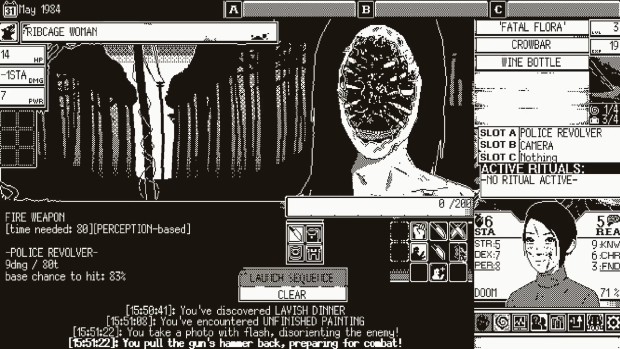
World of Horror cites two inspirations in its store description—neither of them are video games. The ghoulish illustrations influenced by horror mangaka Junji Ito are apparent: our setting is Japan, our aesthetic is anime, and many of the enemy designs are transparent homages to Ito’s body horror.
It’s the Lovecraft influence where things get a little more abstract: there are tentacled old gods waiting for you on the other side of each roguelite-run, sure; but there’s also a game-wide commitment to the weird and unknown.
I’ve never really played anything like World of Horror before. It’s a hodgepodge of a few identifiable genres like visual novel and 80s computer adventure, but it combines them in interesting ways to fit something resembling a modern roguelite framework—albeit one with some quirks of its own.
That ambiguity in structure intensifies the wonderful discomfort of playing it. World of Horror’s simple adventuring and horror mystery systems are elevated thanks to a beautiful 1 bit aesthetic, tons of replayability, and it’s endless capacity to deliver short and long term horror gameplay.
If your first hour or so is anything like mine, you’ll be whelmed by World of Horror. The actual gameplay itself doesn’t put its best foot forward. Your first run will take you five to ten minutes: there were clear opportunities for alternate endings, a few moments definitely had me spooked, but I definitely felt like a passenger more than a participant in the horrors.
That feeling didn’t last. Above all else, World of Horror is masterful about how it packages itself; not just its aesthetic, but in the ways it frames, reframes, and squeezes a whole lot of juice from the same simple scenarios.
Each rogue-run is not a mystery to be solved, but a sequence of mysteries to be solved; all with a shared character, inventory, health, and an insta-lose doomsday bar at the top that lords over everything. Complete a mystery, recoup back at home base, then pick the next mystery. Repeat four more times and, if you didn’t die or max out the your ‘lose-the-game-Cthulu-bar’, you’ll get a final event sequence that acts as a stat check for everything you’ve done so far and (hopefully) a good ending.
It’s why doing an individual mystery in isolation at the start was so underwhelming: it’s not the mysteries that are an investigation thrill, it’s the game itself. The knowledge you take with you run-to-run lets you play each mystery just a little safer or push for their alternate endings that may open up more possibilities for subsequent mysteries. The combat against the fishman boss in the mermaid mystery can be instantly skipped if you bring a torch, will that change how you sequence it? There’s this entire macro-strategy layer that becomes richer the more you play World of Horror, revealing gameplay options that have existed the whole time but were obscured by your own ignorance.
It’s an intoxicating system, one where the acquisition of more knowledge and strategy would be a sufficient reward of its own, but it also comes bundled with a whole slew of rogue staples like modifiers, new characters, and new events that unlock on successful runs.
Those individual pieces are a little modest without the framework they’re supported in. Despite how much I do love it: the game can be a little bean-county before its more compelling aspects begin to reveal themselves. The actual mid-mystery challenge is a balance of resources: you’ve got a stamina and reason number that are effectively two different health bars for two different damage types, you’ve got your base stats, your funds and inventory, and the doomsday bar.
Most of the ‘gameplay’ is exchanging some of these numbers for other ones. Want to rest up and recover those health bars? That’ll push your doomsday bar forward because of the lost time. Want to share a recent experience with police so they can make that area safer? That experience will be taken literally off of your progress to the next level.
It’s the kind of simple number comparison that most games do their hardest to obscure but World of Horror lays bare. That’s definitely the ‘80’s computer game’ influence making itself known, and also an element it plays up in its UI.
The default viewing option has the entire game played from the inside of a computer-border. Even if you disable that border, you’ll still be beholden to an intentionally scrunched interface that hides away important options within submenus and takes a bit to get used to—like the fact that the ‘attack ghost’ button is a different button in a different menu from the ‘attack’ button.
World of Horror doesn’t just emulate a retro computer visual styling, but also brings back the retro computer feel of having that ‘onboarding’ period where you’re not just learning how to play the game, but also literally how to interface with it. The traditional rules of interface design and user experience are upset here. You’ll never be quickly gliding through these menus as much as you are just clumsily overcoming them… both an homage to its decades old design trends and one of the many effective ways that World of Horror makes you ever so slightly uncomfortable.
That discomfort pales in comparison to the monstrosities themselves. If the Lovecraft influence is responsible for the level of unknown to be overcome, then the Ito influence is responsible for the stuff you’re literally looking at on screen.
The randomized event driven structure doesn’t allow for the same suspense build-up and payoff that a conventional horror game gets. In its place, the bad guys need to be visually and immediately horrifying. And they are.
The rank and file of the enemies you run into fall under Junji Ito’s grounded horror style: humanoid enemies with lacerations they shouldn't be surviving, or faces that just aren’t quite right. There’s this horror in the mundanity of it, of a teacher who's just asking for some help carrying things but her eyes are open just slightly too much for comfort.
The pixel art on display is beautiful in its horror, and treats the uncanny valley as a perfect place to rest and produce fine work.
Not unlike the enemies you’ll be looking at on screen, World of Horror is, in itself, a body horror. It is a stitching of pieces that don’t belong together, dug up from varying decades, continents, and mediums. It’s a wonder that the resulting game is the furthest thing from a monstrosity: it balances its inspirations in a way that’s created something entirely focused on its vision.
Its mix of ‘horrifying to look at’ Ito influence with ‘horrifying to think about’ Lovecraft influence allow for short term scares and long term dread, as well as a complete commitment to its uncanny vibe in its visuals, its interface, and even the actual gameplay loop itself. Couple that effective horror with massive variety, replay value, and strategy, and you get a roguelite puzzle-box that rewards you for every secret you uncover and every stone you unturn. Had its style and stories been overlaid onto more traditional gameplay, had it had an obvious videogame analogue (cited in the store description or otherwise), it would be a lesser game for it.
Lovecraft has a pretty famous quote deriding the same mythological antagonists finding their way into horror stories. “Horrors, I believe, should be original—the use of common myths and legends being a weakening influence.” World of Horror doesn’t apply that to its enemy choice, but to its very structure. By that metric, it might be one of the best Lovecraftian games ever made.