Growing up, I was never a stealth gamer. I found them more frustrating than enjoyable. Now that I’m older and probably a little better at games, I’m going back to try genres I skipped over. I tried to get into Thief 2, but it didn’t hook me, then I heard that Splinter Cell Chaos Theory was also lauded as a pinnacle of the stealth genre. It was relatively cheap on Steam, so I gave it a try. Unfortunately for some reason this game wouldn’t allow me to take screenshots like most normal Steam games. I still like to have pictures in my review, so I’m borrowing some from the Internet.
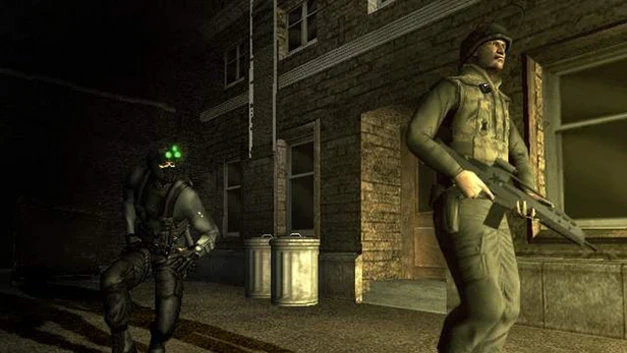
This game was much easier to pick up for me compared to Thief 2. I think that was helped by the more modern graphics, 3rd person perspective, which I always gravitate towards, and the fact Sam Fisher has a lot more options for interacting with foes than the thief Garrett does. The stealth mechanics are top notch in Chaos Theory. There was a bit of a learning curve at the start for me. I had to unlearn years of having Eagle Eye vision and enemy awareness bars. There’s no playable tutorial, just videos to watch, so I mostly bumbled around the 1st level. By the 3rd or 4th level I figured out the rhythm the game was setting and really started to enjoy it.

The game goes for a realistic approach in that there aren’t a lot of HUD elements floating around enemies, and you don’t have a minimap with view cones on it. There’s two bars you have to pay attention to. Your sound bar and your light bar. The light bar is self-explanatory, darkness good/brightness bad. You can shoot out or switch off lights to create dark patches. Your pistol is equipped with a localized EMP device than can temporarily disable lights, along with cameras and laser wires. More often than not, my bullets were used against lightbulbs more than people. The sound meter has a little more nuance to it that I really liked. You can see the sound you generate from acts like walking, climbing, running, shooting, but the meter also tracks the ambient noise of the world. If you are next to a noisy generator, you can be a little louder, move a little hastier, because that generator whine will mask your sounds. Find yourself in a quiet museum hallway, you’ve got to take it slow & quiet. The mouse scroll wheel is used to control your speed, it’s a handy feature. The flooring material matters as well. Carpet carries less sound than concrete. I feel like modern games with stealth mechanics often ignore ambient noise. It doesn’t matter if there’s an artillery shelling going on, if you are louder than the arbitrary limit, everyone hears you.

If I had to compare this to a modern game, I’d say it’s closest to the new Hitman series. Sam has a certain weightiness to his movements and there’s a lot of similar ideas at play. Sam is the video game epitome of “Slow is smooth, smooth is fast.” He doesn’t twitch around or speed through reloading a magazine, he moves with purpose. There’re also certain areas that allow you unique traversal options, like climbing across a pipe, shimmying down a wall. Something I’ve not seen in other games, is Sam can do the splits in hallways that get him above all the guards. This move again shows his purposeful movements, he doesn’t just zip up there, you watch him size it up and build momentum to do it. I spent most of my time crouch walking though, which led to some close calls. I would sit there silently in the dark as a guard passed mere feet from me, hoping he just kept on moving along. There was a few times where the enemy AI seemed off. There’s one mission that involves you dodging a tank, and it seemed to operate on RNG as to whether it saw you or not.
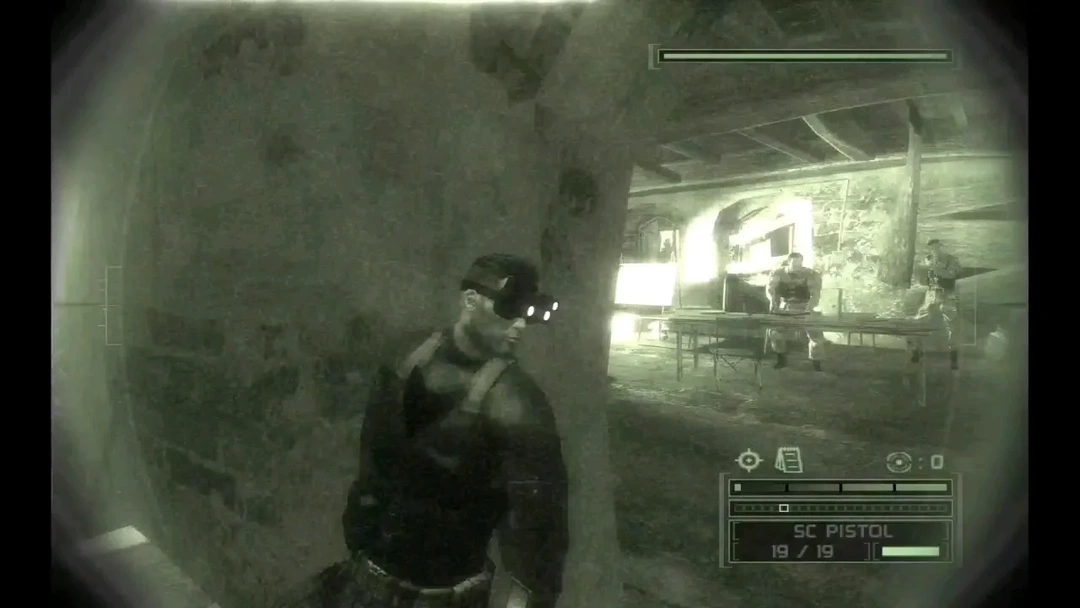
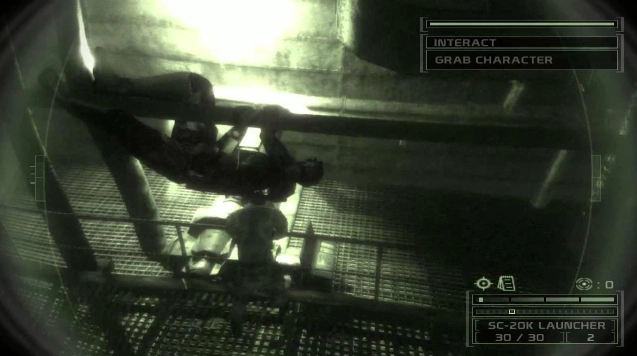
In one of the training videos, Sam mentions “these guards aren’t my enemies. They’re just guys with wives and kids.” and I took that to heart. There were only a few times at the end where I chose violence because the game sorta forced my hand. Times like that don’t happen often in this game, but the Bathhouse shootout and the final run to the end do press you to act urgently. You can tell in these sections this game isn’t meant to be played as an action game. Sam doesn’t take much punishment and he's not super accurate with his rifle. He breaks into places to gather intel, rarely to assassinate people. My preferred method was to sneak up on guards and take them captive. Doing this allows you to interrogate them. They can give you useful intel, like troop count, alternate entry locations, and passcodes for doors. Once they give up the goods, I knock them out and hide them in a dark corner of the room.

There’s a varied selection of gadgets at Sam’s disposal, but I used very few of them. The silenced pistol, EMP attachment, and the knife got me through most of the game, along with Sam’s signature goggles. The NVG mode got the most use, which I think is expected. The thermal mode was good for scoping out large rooms and the Electric mode helped occasionally to locate a camera I could hear but not see. While the “Bweeeeee” start-up sound Sam’s goggles make is iconic, it did start to grate on me after a while. There’s an assault rifle that comes with some non-lethal options. That came in handy in a few scenarios where I couldn’t get around to strongarm a guy. There’s also launchable cameras, smoke and explosive grenades that I didn’t use at all.
Sam Fisher is often considered a contemporary of Solid Snake. I think I prefer Sam as a character, but that may be an East vs West thing. It also doesn’t hurt that he’s voiced by the commanding, yet smooth voice of Michael Ironsides. Admittedly, I did feel a disconnect between Sam’s voice and his appearance. He looks like a generic mid-2000s video game hero; sort of a Nathan Drake, slim, dark haired, pretty boy. His voice makes me imagine a stockier dude who’s a little grizzled. I do like that Sam is supposed to be an older guy, we don’t get many old guy protagonists. It gives Sam a quiet assuredness to him, he doesn’t have to continuously prove how badass he is, we both know he is. He’s doing his job and trying to enjoy it with a sense of humor. It’s not over the top either, to me, and fits with the type of humor I’d expect from a career military guy. You can tell he loves his work as a lot of the humor shows up during the guard interrogations. The “Pick a number between one and 10” bit was my favorite. He’s also in constant communication with his handlers and the generational humor between him and Grimm got a chuckle from me every time. “You mean I’m doing it for the Gipper?” “The what?” “Never mind Grimm. You’re right, I am old.” And Sam is not just a ‘good soldier’. Your main handler Lambert, who does his best Allstate impression, is very mission focused, but when Sam comes across wounded American pilots he defies Lambert to drag them to safety. The final bad guy tries to harry carry himself, Sam saves him, but as he removes the knife, he handles it respectfully. They didn’t have to add that in, but it’s a nice little character moment.
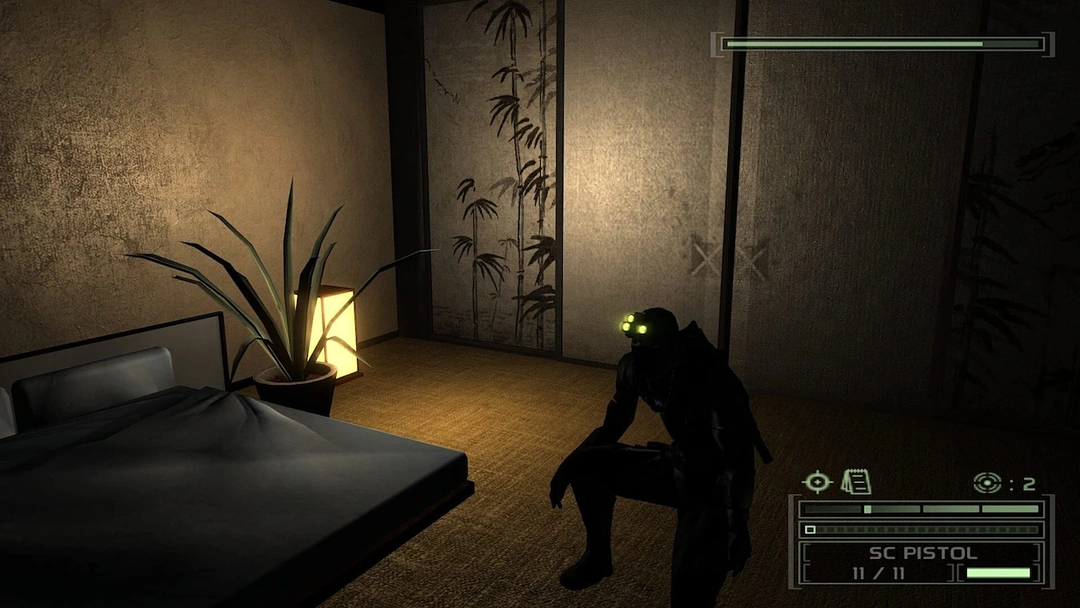
Maybe this was a gripping story back in the Bush era, but playing now, the story’s kinda meh. You are playing this game for the unique locations and the stealth gameplay, not for the “Tom Clancy” story. It takes a little bit for the story to get off the ground, and it’s over fairly quick. The first half of the game is about a Panamanian rebel who has abducted an American computer coder that you have to go rescue. There’s also a concurrent story running about the international relations between Japan, China, and the Koreas. We learn a PMC ran by one of Sam’s old friends hired the rebels to get the code, which he then sells to someone in the Far East, I think. Sam’s friend, Shetland, is underdeveloped. Sam gets an emotional moment where he decides whether to kill Shetland, but it doesn’t matter much to us who barely know him. After an American ship is seemingly sunk by a North Korean missile, the Korean War heats back up, which I didn’t expect that in this story. The finale reveals it was a Japanese admiral who was secretly orchestrating the whole thing, reheating the Korean War, waging information warfare on both his home country and the USA. This is all in an attempt to return Japan to it’s pre-WWII days of power & imperial rule. This Japanese plot only lasts for one level, when I expected it to be the beginning of a 3rd act. Overall, the story felt like it was all over the place and didn’t really sink into anything. I was also surprised that this game about cyber espionage and information warfare called back to WWII and the Korean War.

The scattered story does mean you get to play through some interesting levels. The standout everyone remembers is the Bank. It does make the best use of all the different stealth options and bank heists are inherently fun. You sneak around several office buildings, each with unique layouts and I think those are where Sam’s set of skills shine the best. There’s also New York apartment, cargo ship, and underground bunker you sneak around. The more cubical level designs help the stealth gameplay. You can approach rooms from a safe entryway and scan for guards. Guards have a set path they follow in a room and when they do get spooked, most won’t wander outside of their room. It makes each room a puzzle you have to figure out.

All in all, this game hooked me, and I will join those who sing it’s praise as one of the bests in the stealth gaming pantheon. Sam is a great character, proved by the fact UbiSoft trots him out for their other Tom Clancy games. When you master the gameplay mechanics, this game can start to bop. I’m hesitant to try any of the other Splinter Cell games, as most seem to say they have diminishing returns. This game did make me nostalgic for Rainbow Six Vegas, a game I did play in my youth.


