Caveat 1: These are my thoughts for the Definitive Edition, and I’m not sure about the differences between it and the original release.
Caveat 2: TLDR at the end if you can’t be bothered (seriously I wouldn’t blame you).
Last year I played Yakuza 0. It was my very first experience with the franchise, and with the game being touted by so many as the best of the bunch, I was really hyped to both play it and dive into the rest of the saga afterwards. It ended up being my only complete Yakuza incursion. My experience was somewhat underwhelming. I wrote about it at length on this sub, but in a nutshell the game felt like a contradiction for me: great yet very long and cutscene-heavy story; punchy yet repetitive combat; interesting yet overly silly substories that (to me) felt at odds with the main narrative; awesome looking yet somewhat shallow world. In the end, I certainly had a decent time with Yakuza 0, but I exited with the notion that the game isn’t stellar enough to justify its lengthy runtime. I preface with this because, while I was playing Sleeping Dogs, I came to the realisation that it was giving me everything I had hoped Yakuza 0 would have. And I couldn’t shake off that sensation throughout my entire playthrough. Even though they are, in their essence, two very different games with very different goals, this was the vibe I had wanted from the Yakuza world all along. And to my surprise, the more I played, the more I kept finding it in SD’s Hong Kong.
I had a few people recommend me this game over the years, and I do see critics singing its praises in hindsight, but I’m still slightly confused as to how under-hyped it was upon release. I’ve read the expression ‘GTA clone’ thrown about quite often when referring to it, and if all you see when you look at SD dogs is an appropriation of the GTA formula, I can understand that inclination. But calling SD a 'GTA clone’ simply because they share the same outline does very little to inform opinion, especially when looking at the things SD does differently - and often better - than the GTA III-V era. And just to be clear, this is coming from someone who loved every main GTA release from III onwards.
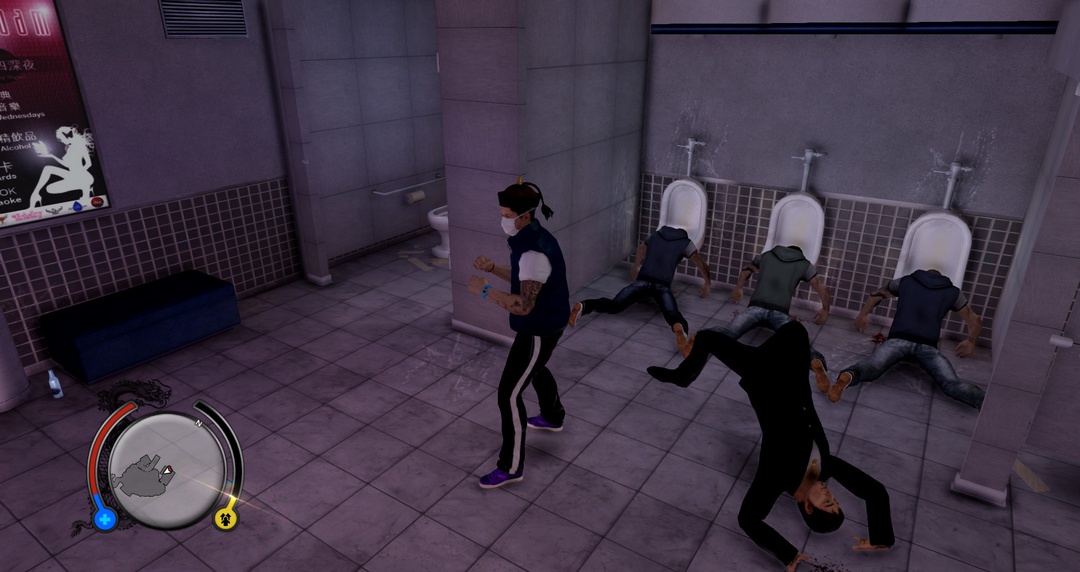
Let’s start with the obvious difference between the two, and easily SD’s most standout feature. The melee combat in every GTA entry is a secondary means of engagement and serviceable at best. In SD, it is not only a central element but also absolutely fantastic. It doesn’t boast a complex system, but the fluidity, the pacing, the impact, the immersive learning curve, the combo variety, the meaningful upgrades, the weapons, the environmental attacks, and the indicators easily turn melee combat into one of the best iterations I have experienced so far. And that we spend so much time of our playthrough engaged with the melee mechanics when compared to the (clearly less impressive, but still satisfying) shooting ones is the cherry on top. This was one of the aspects I couldn’t help but compare with Yakuza 0. There, even though I felt combat was punchy enough and environmentally great, I also felt it became incredibly repetitive and almost a chore after a while, especially because often you couldn’t take more than 5 steps without finding another group of thugs. In SD it was the opposite: not only do you have a lot less exposure to it (it’s a much bigger world, with much wider streets, and where you can spend a considerable amount of time driving), I actively looked for combat opportunities, simply because they felt so good. 10 years later, it still feels unique and refreshing and, honestly, I’m hard pressed to find a melee system I enjoyed more in an open world setting. Here, I’d like to mention fluidity of movement as well, which is transversal to everything you do in the game, not just combat. The vaulting, climbing and jumping mechanics are impressively implemented and crucial to give SD a strong, thematically fitting action vibe - in fact, the action chasing scenes are some of the best parts in the game. Even if you didn’t like anything else about it, SD would be worth experiencing just for the combat and movement alone. I’d probably say it takes a bit to learn how to best explore melee gameplay, but it’s nonetheless wonderful stuff.
The second most impressive achievement in the Sleeping Dogs experience is its open world design. This is another area where it draws a lot of comparisons to the GTA universe, but once again I don’t think these tell the whole story. Yes they are both sandboxes, but their design choices are quite different. When I look at the SD world I see more personality and charm than I’ve ever seen in a GTA game which, in this case, ultimately stems from a different focus and implementation. In this sense, a comparison with Yakuza makes a lot more sense, but personally, and even though I really liked their aesthetics, I think this Hong Kong still beats Kamurocho and Sotenbori both in style (marginally) and in substance (especially). SD offers a very believable, well realised modern-day open world bursting with charisma and immersive environments. Markets, skyscrapers, neon lights, sirens, seagulls, environmental shop music, weather effects, population density, NPC behaviour, it all meshes together beautifully for a truly vibrant visual and audio depiction of a stylised city. The map isn’t big by today’s standards but it feels big, meaning the game does a great job of not only selling the illusion of scale, but also packing it with either personality, colour or danger. I think the world design could’ve used more - and more obvious - environmental indicators to help you navigate without the need of a mini-map (though I appreciate the ones they did include). But as it stands, this version of Hong Kong has quickly become one of my personal favourites in an open world setting, so much so that I tried to spend as much time in it as possible by doing every side quest, partaking in every activity and hunting down every collectible, something I rarely have an interest for in any game.
The story comes with a slight drop in quality towards the end, and I dislike the way the game randomly name drops people we’re already supposed to know but haven’t yet been introduced to. However, the narrative is another aspect of SD that resonates with me quite a bit, not in its overly explored vendetta topic, but in its presentation. There are a few lighthearted moments, breaks and side activities that you can go through for a bit of a palate cleanse, but at its core this is a serious story meant to be taken seriously, with a ton of mature themes thrown in for good measure. Wei Shen’s past and present are constantly intertwined through trauma, and the nightmares he is constantly bombarded with highlight the internal struggle, doubt and confusion he experiences as he lives a double life. Here, again, I think the comparisons with the stories in the GTA franchise are misguided: of course this is also a crime story, but that’s pretty much where the similarities end since a) the feel in almost all GTA narratives is, by their own satirical inclination, comedic, and b) not one of them explores the nature of duality that comes with undercover police work. The latter is particularly important because not only is it SD’s whole ethos, it also gives you two very different avenues to explore in-game.
SD’s gritty visuals, pitch-perfect voice work (Tom Wilkinson’s voice can do no wrong, it seems), gut-wrenching brutality, and no-holds-barred interactions serve as means of delivery for the game’s tone, both in and out of the main quest line. Here, I noticed, rises another area in which I prefer SD’s approach over Yakuza’s. This is 100% my personal preference and I know a lot of people (maybe even most) would rather play a game that takes the opposite route, but I had a hard time reconciling Y0’s extreme drama of the main narrative with the silliness of its substories. In SD, however, I felt every bit of side content in the base game (and there’s a lot) blended in perfectly with its main story without once feeling at odds, thematically or otherwise, essentially trading a good chunk of humour for widespread grounded storytelling. It certainly won’t be everyone’s cup of tea, but in SD’s version of Hong Kong, I wouldn’t have it any other way.
One final thing I’d like to go into a bit of detail with is the driving. I’ve seen it described as floaty or unsatisfying, but I didn’t have that experience at all. I actually loved almost everything about it: the drifting, how differently vehicles control, the shooting, the spot-on indicators, pushing vehicles to make them crash, the police chases, jumping from your moving car to an adjacent one… I mean I’d have a hard time coming up with something to criticise here, especially because I feel this is exactly the sort of arcade driving experience a game like this needs. Though there were a couple of camera issues (and some boats can go to hell with how hard they were to control), I had an overall great time using vehicles (especially bikes) to go from A to B or to just drive around and aimlessly explore. And once more, this is another area in which the comparisons with the GTA saga make little sense. Sure, you can drive a variety of vehicles in both, but GTA games, especially the later entries, have a much wider, less concentrated space to drive in on account of their backdrops (the Hong Kong roads are a lot narrower), and have progressively adopted a less arcadey feel to their mechanics when compared to SD. Like most everything else it absolutely comes down to personal preference, but again it just makes the ‘GTA clone’ descriptor a bit useless.
These four central aspects - melee combat and movement, world, story devices, driving - are the pillars which I consider SD to excel in and proudly stand on. The brilliance of this game isn’t in the fact that it is flawless - I already mentioned some of its issues, but from the lack of a streamlined loading system to the missed opportunities for robust disguise mechanics when doing police work, there are several things to criticise. The brilliance of this game is that it nails its most fundamental aspects in all the right ways, and as such, it succeeds in becoming a landmark in open world games. I kept bringing up both GTA and Yakuza throughout this review not because I don’t like them (especially GTA which is one of my favourite franchises), but because it felt somewhat difficult to talk about this game without mentioning them: one because it kept being used to slap on SD the seemingly demeaning ‘clone’ label, and the other because I couldn’t help but to mentally revisit my experience with it while I ‘was’ in Hong Kong, thinking all the while that this was the exact vibe I had hoped the Yakuza world would’ve given me. But Sleeping Dogs is, as much as any other open world game, its own entity. And after spending 35 hours with it, I can confidently say United Front Games has delivered one of my very favourite sandbox experiences to date. 9.5/10


 there are 3 dlcs in the game, one included in the base game and 2 are playable from the main menu as standalone dlcs. they all take about an hour each to beat excluding the side content. My favorite is the zodiac tournament, it's so goofy and epic and intentionally cliché.
 Now, i 100% completed the game with all achievements and that took a lot of time. It is so time consuming, there is just a few interesting side things to do, all the rest is just brainless. i'm dead aside. The hardest achievement to get is 'pure gold', to get 30 gold stats, which are extremely time consuming and general and repetitive. If you have time to waste, go ahead and complete the game, it's not hard just long and that's what she said.


