
Castlevania: Portrait of Ruin
Main game
3.91 average rating based on 530 ratings
- Developers
- Konami
- Publishers
- Konami
- Franchises
- Castlevania
- Series
- Castlevania
- Event
- Konami E3 2006 Press Conference
- Platforms
- Nintendo DS
- Genres
- Adventure, Platform, Role-playing (RPG)
- Themes
- Action, Fantasy, Horror
Release Dates
User Stats
How Long Is Castlevania: Portrait of Ruin?
Related Content


So Much Replay Value!
This review is for the Nintendo DS version
I really love all of the 2D Castlevania games that were influenced heavily by Symphony of the Night. Turning Castlevania into an RPG was such an amazing idea and all of the games are at least good. I am glad to say that Portrait of Ruin is one of the best games of this variety!
You play as Jonathan and Charolette as they traverse Dracula's castle and see why it has risen again. Jonathan is your typical Castlevania protagonist. He's really good at using weapons to plow through enemies and can use some magic to help him along the way. Charlotte is a good complement to him because she is much better at using magic. You can switch between the two protagonists at any time and you can even have both of them on the screen, fighting together.
The dual protagonist situation is great because it leads to conversation potential and diversity in enemies. Many enemies are extremely resistant to magical or physical attacks. You need to use the right character/attack to defeat these enemies.
The main gimmick of Portrait of Ruin (other than having 2 protagonists) is that there are paintings (none of which were actually portraits) that you …
I really love all of the 2D Castlevania games that were influenced heavily by Symphony of the Night. Turning Castlevania into an RPG was such an amazing idea and all of the games are at least good. I am glad to say that Portrait of Ruin is one of the best games of this variety!
You play as Jonathan and Charolette as they traverse Dracula's castle and see why it has risen again. Jonathan is your typical Castlevania protagonist. He's really good at using weapons to plow through enemies and can use some magic to help him along the way. Charlotte is a good complement to him because she is much better at using magic. You can switch between the two protagonists at any time and you can even have both of them on the screen, fighting together.
The dual protagonist situation is great because it leads to conversation potential and diversity in enemies. Many enemies are extremely resistant to magical or physical attacks. You need to use the right character/attack to defeat these enemies.
The main gimmick of Portrait of Ruin (other than having 2 protagonists) is that there are paintings (none of which were actually portraits) that you can go into. Inside each of these paintings is a mini castle space. These range from a Victorian era city to a circus. I really like the range in settings and enemies that these painting worlds allow.
Another positive for Portrait of Ruin is that the difficulty has been ramped up. Some of the Castlevania games (SOTN) are way too easy. I am happy to say that some of the late game enemies are actually fun to fight and the bosses will lead to your death before you master them.
My biggest negative is that Portrait of Ruin feels a lot more linear than the other games and the feeling of exploration is slightly diminished. The paintings are all extremely linear and they take up space that could have fit into the castle. This is one of the smallest castles in the series.
Overall, Portrait of Ruin is a must play for anyone who is a fan of the Castlevania series and you will get more of the satisfying 2D RPG combat that you know and love. There is really no reason to skip this game if you love the series. Furthermore, it does enough to differentiate itself from the others that it doesn't get boring or feel like it doesn't have a reason to exist.
Finally, you can replay the game as multiple different characters. This leads to a completely different dynamic in the subsequent playthroughs and adds a ton of replay value to the game!

fishmountains's review of Castlevania: Portrait of Ruin
This review is for the Nintendo DS version
A really excellent game. Easily on the list of must-haves for the NDS. The controls were smooth, there were zillions of options, the game was huge, lots of creativity went into the making of this game. As a Castlevania veteran I found this game to be the right amount of challenging.

CASTLEVANIA PORTRAIT OF RUIN REVIEW: (NDS)
This review is for the Nintendo DS version
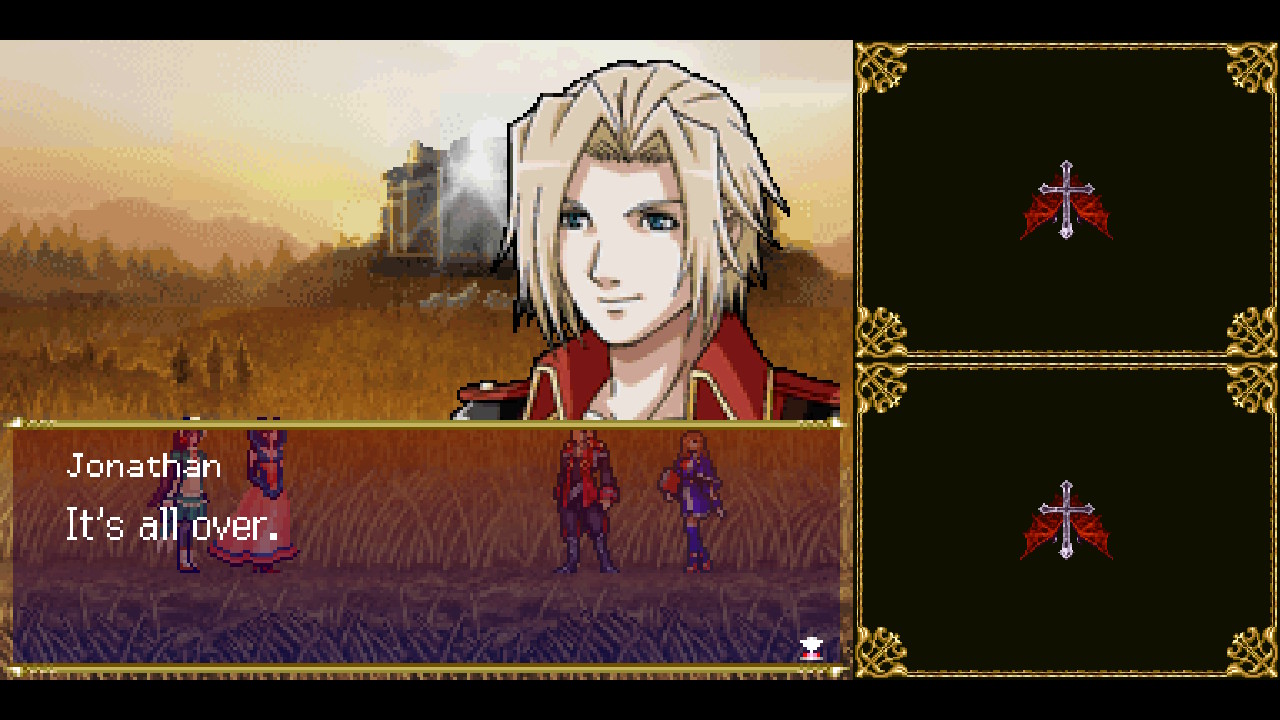
Castlevania Portrait of ruin is a 2006 platform and adventure game.Konami, the producer and distributor of the game, have done a great job.The story of the game is as follows.Before the start of the game, two sisters, Stella and Loretta, go to Dracula's castle to find their father, Eric Lecarde. After passing through the castle, the two arrive at Brauner's lair, where they defeat their father. When he sees the two sisters, Brauner grabs them and makes them vampires.At at the beginning of the game, Jonathan and Charlotte encounter Vincent at the gates of the castle, who serves as a merchant. Upon entering the castle, Jonathan and Charlotte first encounter an enigmatic blue figure, whom they identify as the enemy. After the figure transforms into a humanoid man, he explains that he was recently killed and created a magical barrier to keep himself conscious while still within the confines of the castle.He introduces himself as "the wind". Shortly after meeting Wind, Jonathan and Charlotte find one of Brauner's magical portraits. Unable to destroy him from the outside, the two travel to the world inside.Soon, they find brauner en channe, a Dullahan. Shortly after their defeat, one of the vampire sisters …
Read MoreCastlevania Portrait of ruin is a 2006 platform and adventure game.Konami, the producer and distributor of the game, have done a great job.The story of the game is as follows.Before the start of the game, two sisters, Stella and Loretta, go to Dracula's castle to find their father, Eric Lecarde. After passing through the castle, the two arrive at Brauner's lair, where they defeat their father. When he sees the two sisters, Brauner grabs them and makes them vampires.At at the beginning of the game, Jonathan and Charlotte encounter Vincent at the gates of the castle, who serves as a merchant. Upon entering the castle, Jonathan and Charlotte first encounter an enigmatic blue figure, whom they identify as the enemy. After the figure transforms into a humanoid man, he explains that he was recently killed and created a magical barrier to keep himself conscious while still within the confines of the castle.He introduces himself as "the wind". Shortly after meeting Wind, Jonathan and Charlotte find one of Brauner's magical portraits. Unable to destroy him from the outside, the two travel to the world inside.Soon, they find brauner en channe, a Dullahan. Shortly after their defeat, one of the vampire sisters appears and downplays their efforts, saying that their control has been reduced only to a small degree. Later, entering the second portrait, they find Brauner and the two twins; brauner laughs at the idea of reviving Dracula, as he has failed so much to control humanity, but admits that his power is too great to ignore. Both sisters want to kill two people, but Brauner sees the death of Dracula's servant as a greater threat, since he could control them much easier than he could. While exploring the castle, Charlotte and Jonathan encounter death, who pretends that Dracula has already revived. When he is informed that Dracula is still dead and another vampire controls the castle, he gets the idea of a hand other than Dracula running Castlevania. Yet, when he sees that the statements are true, he is seriously disturbed and immediately leaves to look for a way to destroy Brauner and revive Dracula. Jonathan and Charlotte encounter Stella at the foot of the Tower of Death and, after being promptly defeated, she loses her locket while fleeing with her sister. Opening the locket, Charlotte finds a photo of the windy twins, and both decide to interrogate her. Wind confesses his real name, Eric Lecarde, and that the Twins are his children.Later, Jonathan and Charlotte face death, who wants to separate himself from Brauner and does not want to fight. Nevertheless, he engages them, but is defeated and escapes. When Jonathan and Charlotte reach the towering Tower of the Master's Castle, they find Dracula's throne room closed and conclude that Brauner has delayed Dracula's revival in order to siphon off his power. After searching the castle, Jonathan and Charlotte receive the Sanctuary spell, a magical attack that dispels Curses and allows the dead to rest in peace. During the battle with the twins, the sisters are freed from their vampirism by Charlotte's magic. This allows them to regain their sanity, and they then offer to perform a ritual that allows Jonathan to use the full power of the vampire Killer whip.After Jonathan passes the test and defeats the memory of Whip, a being bearing the likeness of Richter Belmont, the vampire Killer is warned against overusing him, as he drains the life force of a person who does not have all the power of Belmont, and eventually kills the user, like Jonathan's father. After the Twins are defeated, they open a passage leading to a large warehouse containing a portrait, which leads to Brauner's studio.The two confront Brauner and defeat him. When confronted about his actions, he admits that justice is not on his side, but refuses to admit that he is on the heroes. Death suddenly comes from above and kills brauner with one swing of his scythe. This move destroys the painting that seals the throne room, and Jonathan and Charlotte then go to war with Dracula. Before fighting with Dracula, death enters the room and goes to his master, and together they attack the heroes.During the battle, death and Dracula unite in a stronger form, but in the end they are defeated by Jonathan and Charlotte. When it collapses, everyone flees from the castle and sees from afar how the walls collapsed. Later, the Twins, Jonathan and Charlotte, are visited in the fields outside the castle by the ghost of Eric, who gives the Twins some advice and thanks Charlotte and Jonathan for destroying the curse before his spirit finally disappears from existence. As the four leave, they forget about Vincent, who comically tries to get their attention while chasing them.The gameplay is as follows.in this game consisting of 19 episodes, you are trying to kill the creatures and pass the episode.The music of the game is beautiful.If you are not too obsessed with graphics and you like retro games, this game is for you.My rating for the game: 10/10 (y) Good games to everyone 🙂
Read Less
Aleosha's review of Castlevania: Portrait of Ruin
I tried to play it many years ago, I think still on the original NDS.
The two-character mechanic is fun. The second character can take out smaller, annoying enemies or cast spells while you fight.
What I didn’t remember is that the game leaned heavily into 3D backgrounds—or maybe I simply didn’t notice them on the tiny screen.
The theme of this game is paintings. So, besides the usual Dracula's Castle, we also have painted worlds we enter, each the size of a castle itself. There’s a European city, Egypt, and so on.
I was enjoying the game until the "Nation of Fools" painting. Castlevania can get quite confusing by itself, but with the world at 90 degrees, it becomes simply annoying.
Legion, the ball of bodies, makes a comeback—waste not, want not. It was giving me a lot of trouble until I discovered the Heaven’s Sword, which wasted it in seconds.
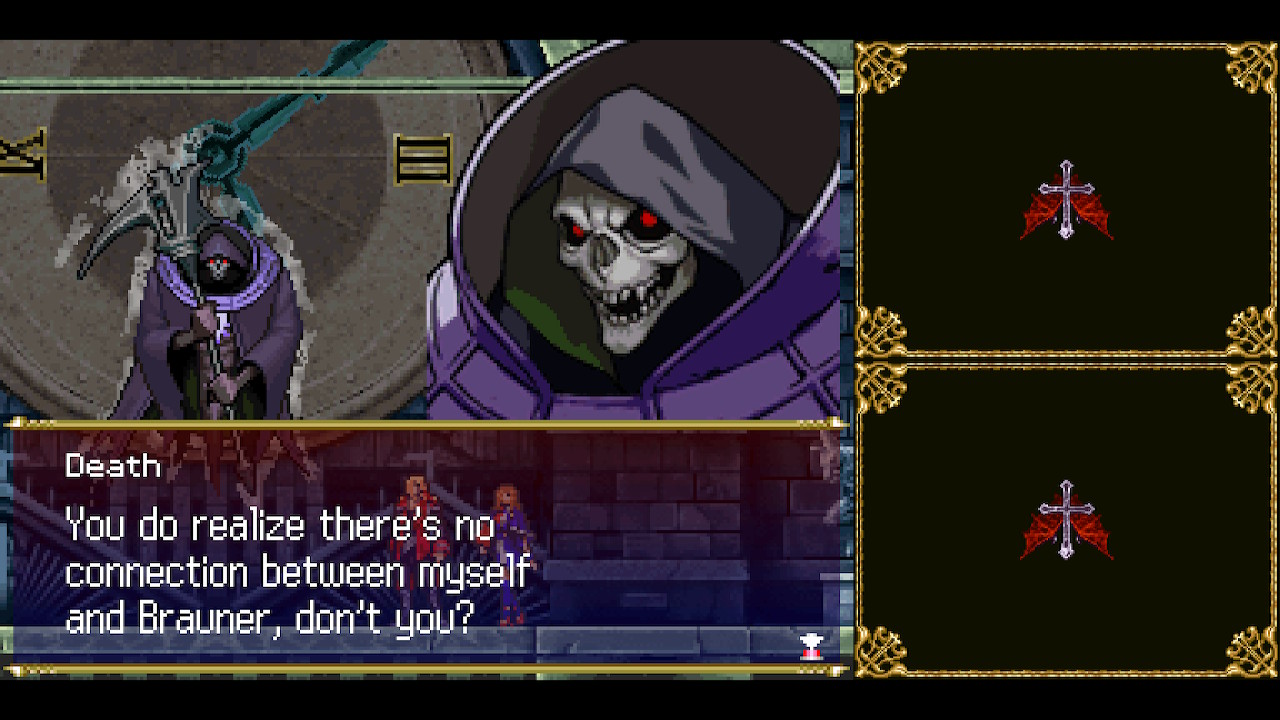
Stella was also a lot of trouble for me in her second phase until I got the Nebula whip that, unlike most whips in Castlevania, actually aims. Also, I just love this entrance sequence:Death was the first boss that gave me a real pause. The spinning scythe …
I tried to play it many years ago, I think still on the original NDS.
The two-character mechanic is fun. The second character can take out smaller, annoying enemies or cast spells while you fight.
What I didn’t remember is that the game leaned heavily into 3D backgrounds—or maybe I simply didn’t notice them on the tiny screen.
The theme of this game is paintings. So, besides the usual Dracula's Castle, we also have painted worlds we enter, each the size of a castle itself. There’s a European city, Egypt, and so on.
I was enjoying the game until the "Nation of Fools" painting. Castlevania can get quite confusing by itself, but with the world at 90 degrees, it becomes simply annoying.
Legion, the ball of bodies, makes a comeback—waste not, want not. It was giving me a lot of trouble until I discovered the Heaven’s Sword, which wasted it in seconds.
Stella was also a lot of trouble for me in her second phase until I got the Nebula whip that, unlike most whips in Castlevania, actually aims. Also, I just love this entrance sequence:Death was the first boss that gave me a real pause. The spinning scythe homes in on you, and the horizontal swipe has a lead: if Death starts telegraphing and you jump, it can still follow and hit you in mid-air. It’s also not very clear what the boss is resistant to when it switches colors. But after wasting a few potions, I managed to beat it.
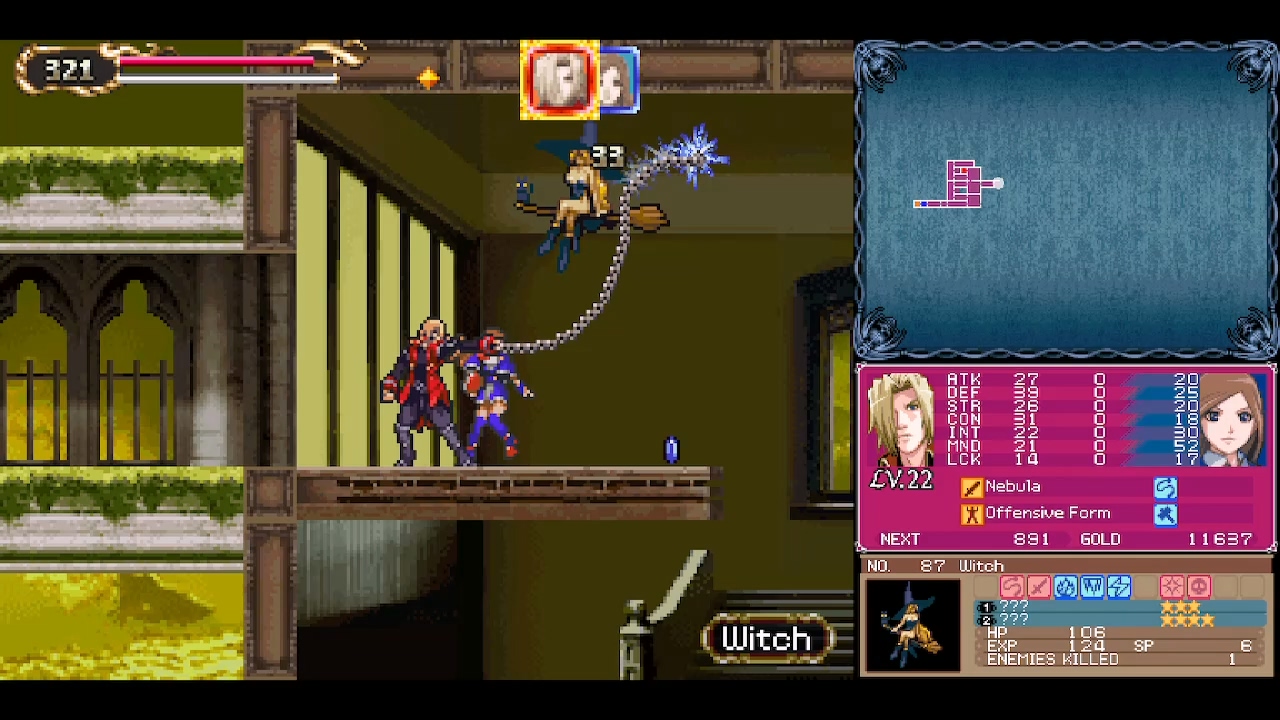
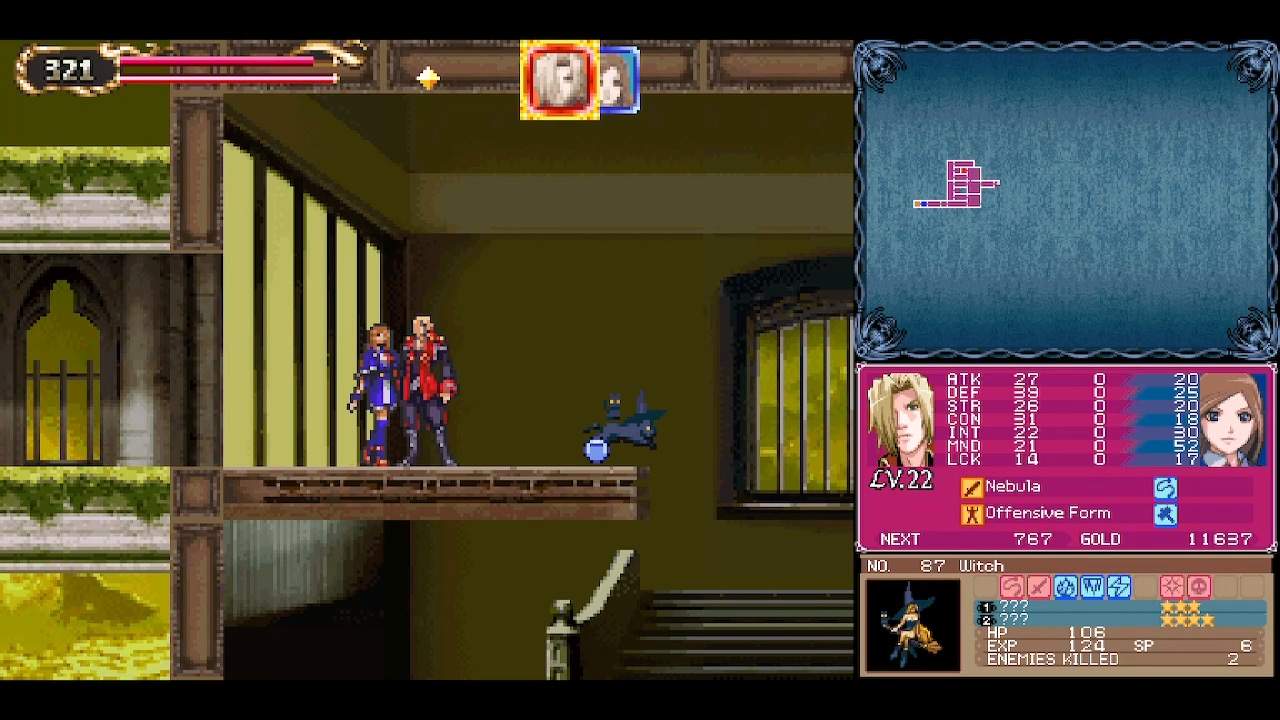
I forgot how much I love the witches' design in Castlevania. There’s a cat familiar sitting on her broom, and when she’s defeated, she turns into a cat with a witch hat, and the familiar is still sitting on her back. So much detail and love.
Of course, there’s a False Ending—it’s Castlevania, after all. The path to the True Ending in this game is slightly more obvious than in others, though. Or maybe I’ve just played enough Castlevania by this point.
First, you obtain a spell that cures vampirism, and you even get to practice it on the monk shopkeeper. Then, during the battle with Loretta and her sister, you distract them long enough to cast it.
I also beat them to get the False Ending. They aren’t hard. Funny thing is, the spell is called “Sanctuary,” so it’s not very obvious from its name that it cures vampirism. I picked it up completely by chance, not even remembering where.
By that time, I think the developers ran out of budget, since they just dump 4 paintings (portals) on you. Go clear those, then come back.
The first “painting” isn’t bad at all. You get the Owl Transformation spell, which lets you fly around. No more platforming. The boss, Frankenstein’s Monster, is also okay.
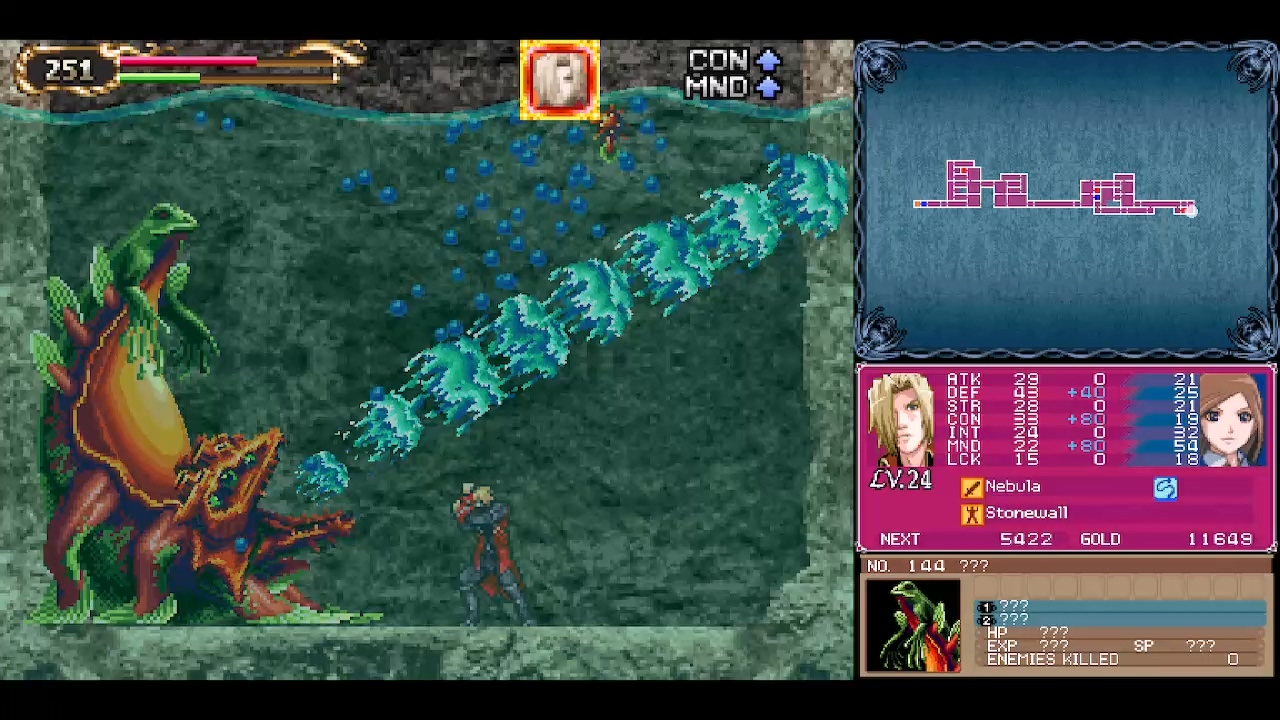
The second painting is a rehash of the Carnival theme, and again, it’s a pain for the eyes. At least as an owl, you can fly past most of the traps. The boss, Medusa, looks amazing but is annoying as hell: she deals tons of damage and has a tricky hitbox. I managed to beat her without a guide in the end, using the Minotaur and a meteorite spell, but you have to be super precise. Stand just below her head so the tails don’t touch you—they multihit and can kill you almost instantly.
The other two bosses, Werewolf and Mummy (I’m telling you, they ran out of fresh ideas), are easy in comparison, as they can be team-tagged from two sides.
With the owl form, the game unexpectedly becomes indirect control: most enemies can’t hit you and instead attack your partner. But since damaging him only consumes mana, which regenerates, it’s a great deal.
I usually prefer two-handed swords in Castlevania games for their reach, overhead pattern, and damage. But in this installment, I ended up using Heaven Sword for most of the game, switching to Flame Whip and Vampire Slayer in the later stages.
After beating the four paintings, you just have a set of bosses left. First, there’s the optional "Memory of the Whip," which is Richter from Super Castlevania. He can kill you in 5-6 hits, his whip is super quick and has very good range. I ended up stocking potions and kiting him from a distance. He basically runs into your weapon, and then you can backdash. With his whip, I overpowered Brauner without bothering with his painting magic. It’s impressive how Brauner draws a pattern on a canvas, then the same pattern covers the screen, damaging you—but I don’t have patience for that.
Then there’s the Dracula and Death duo. Honestly, I think they’re one of the toughest bosses I’ve faced in a Castlevania game. Death hovers above Dracula, making it difficult to jump over him. He hits you while you try to dodge the usual fireballs, can only be hit with a double jump, and is generally a pain in the ass. Some of Dracula's attacks even one-shot you.
I’m not sure if it’s the need for double jumps or just the intensity of the fight, but I felt that the controls were very sluggish, like there was lag every time I pressed a button. Maybe it’s the Dominus Collection or just me. At least the game itself didn’t lag like Order of Ecclesia when I played it on the original console.
Or maybe the developers intended you to attempt this fight only after finishing all the quests. But with quests like “kill 1500 enemies with the Javelin skill,” no thanks!
If it weren’t for the two inverted paintings and the frustrating final fight, I’d say the game was fantastic. But all in all—I'm not sure.

Stroke of inspiration for the 'Vanias
Castlevania: Portrait of Ruin is the second game of the Nintendo DS 'trilogy'. When it came out, I remember the overall feeling being a bit less enthused than before since this was just one more familiar experience to add to the series. Playing it now (on the Dominus Collection), I got to say it's a lot more.
Main things are again the same in Portrait of Ruin: the game's a 2D RPG set in the Dracula's castle. There's a lot of familiar enemies and items again but other than that, the game does a lot to break the mold. For starters, you play with two characters that you switch between at a press of a button. As expected. having two characters brings some new powerups, skills and puzzles to the mix too. The playable characters, fighter Jonathan Morris and sorceress Charlotte Aulin, don't play too differently but are enough apart from each other to feel distinct. The main difference is that Jonathan equips weapons and armor and uses subweapons whereas Charlotte casts spells and equips tomes and robes/dresses and whatnot.
Where the areas felt a bit too common in Dawn of Sorrow, the areas in Portrait of Ruin shake things …
Castlevania: Portrait of Ruin is the second game of the Nintendo DS 'trilogy'. When it came out, I remember the overall feeling being a bit less enthused than before since this was just one more familiar experience to add to the series. Playing it now (on the Dominus Collection), I got to say it's a lot more.
Main things are again the same in Portrait of Ruin: the game's a 2D RPG set in the Dracula's castle. There's a lot of familiar enemies and items again but other than that, the game does a lot to break the mold. For starters, you play with two characters that you switch between at a press of a button. As expected. having two characters brings some new powerups, skills and puzzles to the mix too. The playable characters, fighter Jonathan Morris and sorceress Charlotte Aulin, don't play too differently but are enough apart from each other to feel distinct. The main difference is that Jonathan equips weapons and armor and uses subweapons whereas Charlotte casts spells and equips tomes and robes/dresses and whatnot.
Where the areas felt a bit too common in Dawn of Sorrow, the areas in Portrait of Ruin shake things up nicely. A big part of the game takes place in paintings which opens up a great opportunity to introduce fresh environments. The game reuses the environments noticeably but what's there is still really refreshing when compared to the previous entries. For example, there's a cool area set in a twisted carnival as well as one taking place inside a Egyptian pyramid. The enemies are, again, often reused from earlier entries but there's still tons of new funny baddies to slay.
In terms of story, it's typical Castlevania stuff albeit with a weird goofy tone. The characters feel a bit like silly caricatures, Jonatahan especially with his tacky "No problemo" cathcphrase. The story itself revolves around defeating a vampire lord Brauner who has taken Dracula's castle into his hands and Jonathan Morris finding about how he can use the legendary Vampire Killer whip. The story kinda takes a backseat to the gameplay but overall is not too bad in the grand scheme of things. What's cool, though, is that the story is continuation of Castlevania Bloodlines of all things.
In general, I feel the flow and difficulty are a lot better in Portrait of Ruin than in any game in the series since Symphony of the Night. The difficulty keeps you on your toes constantly, which is a quite rare thing post-SotN. The enemies might do a tad too much damage so hoarding healing items is more crucial than ever but even that is a nice change of pace. As for sense of direction and world design, I always had an idea where to go... except for when finding the spell required for getting the good ending. Even that wasn't really obtuse to get but I had totally forgotten there was one place I could get into after getting a new powerup. Oh yeah, and the game has a lot less grinding since the soul system of Sorrow's is gone and the drop rate from enemies seems to be pretty high.
Music and spritework have been staples of the 2D 'Vanias and Portrait of Ruin doesn't disappoint either. I felt the soundtrack was noticeably more fun than the one in Dawn of Sorrow with some surprising disco influence here and there. The graphics are not too far removed from Dawn of Sorrow in terms of quality but the has slightly better animation, more inspired environments and better use of 3D backgrounds here and there to spice things up.
It seems weird to say that Portrait of Ruins is better in pretty much every regard than Dawn of Sorrow and give it the same rating. I feel, though, that Dawn of Sorrow lives in the low-four-range whereas Portrait of Ruin sits comfortably at the strong-four-echelon. Can the last piece of the puzzle, Castlevania: Order of Ecclesia, reach five stars? I'll know pretty soon. After a small detour to Willamette.

Krauzer's review of Castlevania: Portrait of Ruin
This Castlevania entry is the second entry of the DS Castlevanias and builds on the series’ Metroidvania foundation with a unique dual-character system. The MCs are Jonathan, a whip-wielding descendant of the Belmont line, and Charlotte, a magic-focused spellcaster, switching between them on the fly or using them together for combination attacks. This mechanic adds strategic depth and helps keep combat varied while you explore Dracula’s castle and its magical portrait worlds.
The game stands out for its strong presentation. Sprites are detailed and fluid, the gothic backdrops remain atmospheric, and the soundtrack mixes classic Castlevania themes with new tracks that capture each area’s tone. The portrait mechanic is also clever, transporting you into alternate environments beyond the castle, which keeps exploration fresh in the first half of the game.
On the downside, the level design leans heavily on repetition, especially later on when portraits reuse tile sets and room layouts. The story, set during World War II, introduces intriguing elements like vampire sisters and supernatural conflict, but the writing and character depth are limited. Difficulty is more forgiving than in some earlier entries, which can make the game feel less rewarding to series veterans. Overall, this game is a …
This Castlevania entry is the second entry of the DS Castlevanias and builds on the series’ Metroidvania foundation with a unique dual-character system. The MCs are Jonathan, a whip-wielding descendant of the Belmont line, and Charlotte, a magic-focused spellcaster, switching between them on the fly or using them together for combination attacks. This mechanic adds strategic depth and helps keep combat varied while you explore Dracula’s castle and its magical portrait worlds.
The game stands out for its strong presentation. Sprites are detailed and fluid, the gothic backdrops remain atmospheric, and the soundtrack mixes classic Castlevania themes with new tracks that capture each area’s tone. The portrait mechanic is also clever, transporting you into alternate environments beyond the castle, which keeps exploration fresh in the first half of the game.
On the downside, the level design leans heavily on repetition, especially later on when portraits reuse tile sets and room layouts. The story, set during World War II, introduces intriguing elements like vampire sisters and supernatural conflict, but the writing and character depth are limited. Difficulty is more forgiving than in some earlier entries, which can make the game feel less rewarding to series veterans. Overall, this game is a solid and enjoyable Castlevania entry.
It may not reach the heights of Dawn of Sorrow or the refinement of Order of Ecclesia, but its dual-character system, strong visuals, and excellent soundtrack make it a memorable part of the DS trilogy and a worthwhile experience for fans of the series. This is definitely a must-play for fans of the franchise, and I really enjoyed the unique dual-character mechanic, it is one of the best implementations of the unique console that was the Nintendo DS (and also it's sequel, the Nintendo 3DS).

Honestly had more fun with Sisters mode than I was expecting. They're so strong so it was pretty cathartic breezing through the entire game. The only downside is that their movement is very slow. I like how this mode makes effective use of the DS's touch screen, more so than any of the other modes in the DS era Castlevania games.
What's better than an OP character? Two of them! Richiter mode is super fun, Richter has great mobility, and Maria melts enemies. Final boss was pretty tricky, took me awhile to understand, but I get the hang of it eventually. Portrait of Ruin still suffers from blandness with four portraits that get repeated and the map (the display, not the level design) is a bit tougher to read since it's harder to distinguish doors from everything else.
I liked this game more than I remembered. I remember thinking the 3 DS Castlevania's were about equal, but after replaying Dawn of Sorrow and Portrait of Ruin, I think I like Portrait of Ruin more than Dawn of Sorrow. I think a lot of that has to do with the fact that I got lost way less. The portraits are kind of cool, but I wish there was more diversity instead of 4 designs, and a palette swap for each. Very fun game to play casually, miserable to complete quests or go for any other completion reward. I wish I could figure out how to make notes or pin the map. The dual protagonist gimmick is pretty fun, but it makes me wish they went further with it. This makes me wish there was a proper multiplayer metroidvania. I don't think Harmony of Despair scratches the same itch, but I also haven't played that in years. I'm skipping out on
I liked this game more than I remembered. I remember thinking the 3 DS Castlevania's were about equal, but after replaying Dawn of Sorrow and Portrait of Ruin, I think I like Portrait of Ruin more than Dawn of Sorrow. I think a lot of that has to do with the fact that I got lost way less. The portraits are kind of cool, but I wish there was more diversity instead of 4 designs, and a palette swap for each. Very fun game to play casually, miserable to complete quests or go for any other completion reward. I wish I could figure out how to make notes or pin the map. The dual protagonist gimmick is pretty fun, but it makes me wish they went further with it. This makes me wish there was a proper multiplayer metroidvania. I don't think Harmony of Despair scratches the same itch, but I also haven't played that in years. I'm skipping out on

I believe this is the only one of the 3 Nintendo DS Castlevania games that I have not seen the final credits of. I really should finish it! I am a big fan of the series. Perhaps this one didn't grab me like others in the series have. It may be due to the setting, or the changing settings.
Now that I think back on it I may have gotten rather far in this game in an attempt to finish it. I don't think I got to the end, but I should really check this game out again. If I got rather far already it will be a tough decision to restart like I usually do or continue on with the same savefile.