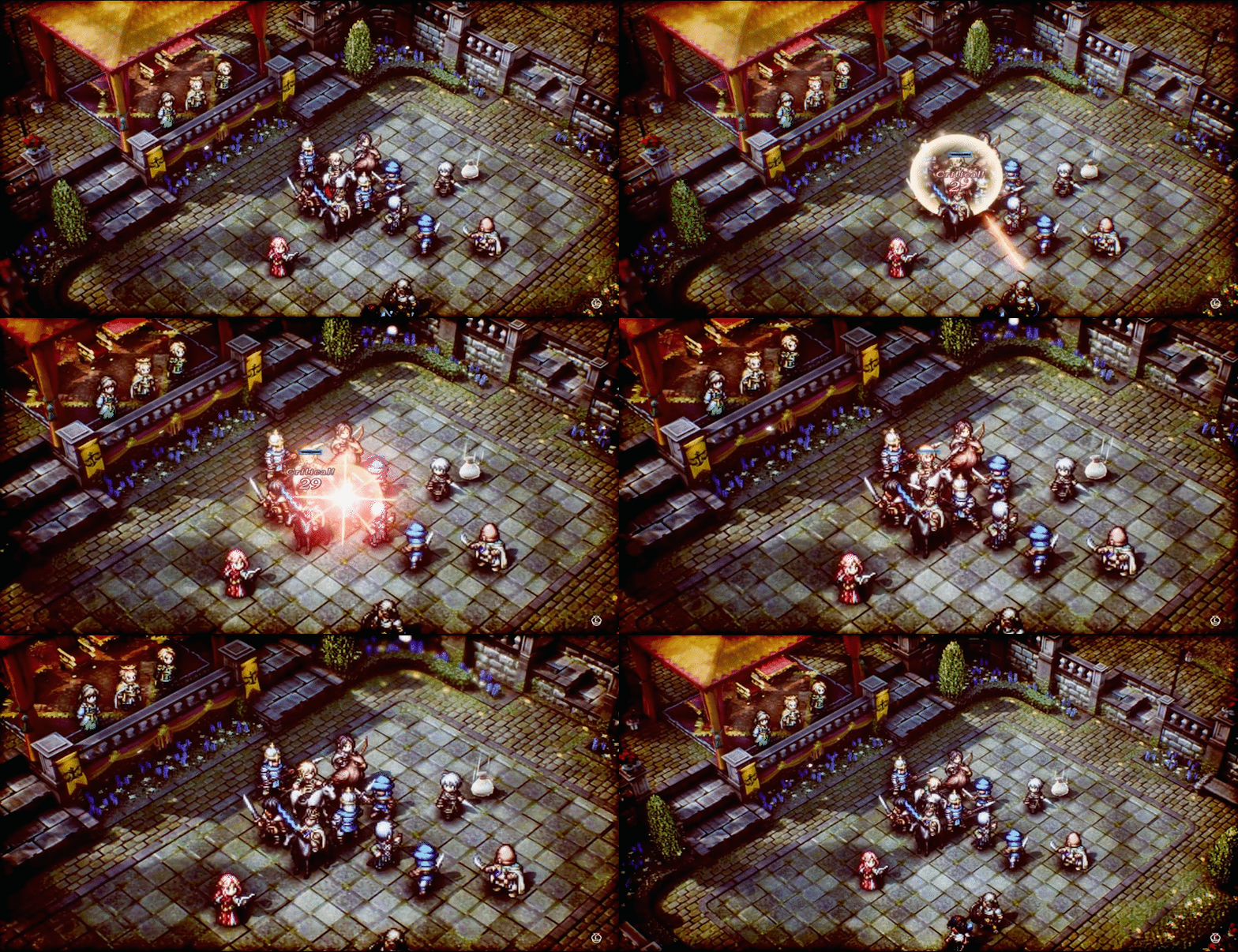
Triangle Strategy is the best traditional strategy JRPG I’ve ever played, with the only real competition being the Brigandine games. It was released about a week after Elden Ring, a major game developed by my favorite studio with assistance from my favorite writer of all time, and the highest praise I can give it is that I played it and finished it with full enjoyment during my playthrough of Elden Ring.
First Impressions:
Created by the same studio as Octopath Traveler, with an almost identical visual style, Triangle Strategy (I’ll call it TS from now on) was clearly a spiritual sequel of sorts, just set in a slightly different sub-genre. After finishing most of that game but getting bored with the endgame, I expected TS to follow in Octopath’s footsteps: a deep and fulfilling character customization/combat system paired with a dull, barely-there story with simplistic characters and no real plot to speak of. After playing the first 3 hour demo, I realized I couldn’t have been more wrong.
The deep and fulfilling combat system was there for sure, more enjoyable than Octopath’s in fact since it actually had enough challenge to it to make player mastery meaningful. But it was the story that was the true surprise. Story-to-gameplay ratio in Octopath is miniscule. The first 3 hours of TS I played involved 2 battles, each about 15 to 30 minutes long, with the entire rest of it cutscenes, exploration, and story decision making. And despite being very dry, it wasn’t boring. The writing is presented with enough expertise to clearly and concisely introduce a huge number of characters immediately without being overwhelming. The second chapter of the game, taking place after a fairly short and simple tutorial battle, takes place at a royal party in which literally about 20 named characters are introduced, and yet I was able to get an impression and remember each and every one of them (their roles and attitudes, if not all of their names).
Getting this huge cast down and memorable is extremely important to TS’s story, because it is a story of widespread political conflict dictated by a small cadre of aristocrats belonging to 3 separate nations, who start the story in an uneasy alliance but are all prepared for war.
I have never played a Japanese fantasy game with a tone like this, characters like this, or a plot like this. The game wears its Game of Thrones inspiration proudly on display. It’s characters are mostly older and measured, rather than the brash optimistic teens common in the genre. They are, nearly the entire cast, serious people with serious goals and fairly reserved personalities. The plot revolves around a complex economic web of trading resources that has each nation coveting and resenting each other for their goods and fleecing each other for what they can get in response. It is because of these very believable economic principles that war seems inevitable, but the people in charge are smart enough to realize that and try to head it off with a series of treaties and alliances beforehand.
This all might sound very dry, and, well, it is. But it is very unique for the genre, and for video games in general, and I found it well written enough to really pique my interest even early in the game.
The characters are a bit dry and simple, as well, but are immediately recognizable for their archetypes and given enough personality that they are charming enough to keep you interested until they begin to develop more deeply later in the game. The main party is comprised of 8 characters, with your protagonist being the young newly appointed head of his noble house, one of the main players in the politics of the river trade kingdom. The others are all members of his household: his primary strategist/advisor, a master-of-arms, a spy/assassin, his mage fiance and her magic tutor. They are also joined by the royal prince, who is your protagonist’s best friend, and his bodyguard.
There are well over a dozen other characters you can recruit over the course of the game, depending on different routes you take through the game or decisions you make, but most of them have no effect on the plot, though they do each have their own personal character arcs. They are simply considered a part of your army, and do not appear in story cutscenes.
Gameplay: Combat and Decisions
The main focal point of gameplay is the grid-based tactical turn based combat, along with the character management and customization between battles that comes with it. The combat is quite good, complex and challenging enough that you really have to strategize and use your abilities to their fullest to win. As someone who constantly whines that turn based rpgs aren’t challenging enough, I frequently had to try missions multiple times and almost always ended each battle with only a few surviving members of my team left.
The characters abilities and styles are handled in a pretty fun way. TS doesn’t use the typical fantasy classes (thief, mage, tank, etc.), each and every character in the game has their own unique set of abilities that gradually build on each other over the course of the game to give them their own play style and tactical niche. Some of them are pretty straightforward: the fiance is a fire mage who blasts foes in large area effect spells from a distance, the man-at-arms uses a shield and taunting abilities to block damage and protect his allies. Others are quite a bit more unusual: the prince’s bodyguard is an archer who rides a giant flying hawk, allowing her to climb to the highest points of the map to fire arrows, the assassin can use stealth abilities in a tactical rpg. My favorites are the truly weird ones: the craftsman who can build ladders and spring traps to utilize maps verticality and open up completely new strategies, the juggler clown girl who is just really good at throwing items and tricking people into attacking her duplicate, and the weather witch who uses spells that simply affect the in-game weather.
They’re a lot of fun to each figure out, and there are more characters than you can reasonably recruit in a single playthrough, which adds to the games replay value. You also can’t get enough money and upgrade materials to upgrade everyone on your team, so you really have to pick and choose who to focus on in the endgame.
The other major gameplay system is for making story choices. Frequently (very frequently, as in almost every other chapter), your character is faced with a significant story decision. At first they have two options, but later almost every choice is between three different options. However, you are not given the option to simply choose what decision you want. The young lord values his retainers’ opinions, and so utilizes a voting system for each of these major decisions. Each of your 7 party members will have an inclination towards one option, or be completely undecided. If you want to pick an option, you’ll need to sway enough of them to your side to win the vote. This can be done through convincing them in dialogue, or sometimes by learning new information from npcs, books, or items around and using that info to change their mind. The characters are all well written and consistent enough that I was able to talk them around once I learned what made them each tic. For instance, the healer of the group is a kind and principled woman… but I soon realized that she had an understated by consistent cowardly streak, and I could almost always sway her by appealing to her sense of self-presentation. Unless, of course, her magic student had a strong desire, in which case she would defer to her judgment.
This system is great. It really feels like an engaging gameplay system for steering the story, and it’s well written and full of good drama. More so, the decisions actually matter. The effects are usually short-term (aside from sometimes determining which characters you can recruit), with the story looping back to the same general flow after the chapters are resolved. But basically every single decision you make will lead to a different unique battle, with its own map (except when re-use makes sense), enemies, and objectives. There are many unique enemy characters you can only encounter through one fight in this way. You can replay the entire game and get an almost completely different set of battles each times. And this leads into the games endgame, in which it splits into one of three separate routes. I kept a save and played through all three endings, and all of them are satisfying and dramatic, with all of them having very serious fallout from the decision your character makes.
Criticisms:
I love this game, and I still intend to play through a Newgame + on a separate route at some point (and maybe get the True Ending, which I still haven’t seen). There are many other things I could praise, from the characters to the overall story, but this review is… way too long. So I will mention a few criticisms and warnings.
On the warning side, this game is unapologetically, blatantly novelistic. Cutscenes are wordy, thorough, and LONG. It depends on the player whether this is a pro or a con, but for those who feel the latter, it might ruin the pacing to the point of damaging the fun of the combat. And because of the story choice system, you can’t simply skip through it if you’re not interested. But personally I’m very happy with this, as the developers did not settle or compromise their vision to try to appeal to less patient gamers.
As for actual criticisms: just like Octopath Traveler, the game severely underutilizes its fantasy setting. Almost every enemy in the game is an ordinary human soldier of some kind, with no monsters to be seen, and the only fantastical foes being spellcasters and hawk-riders. Magic is mostly just used as a combat technology, rather than being something that truly shapes the world and culture. The game is trying so hard to be grounded and mundane that the fantasy elements occasionally feel jarring.
The voice acting is… middling. The characters all speak in a kind of very formal, stage-like manner, obviously also leaning in to that mundane fantasy styling. What makes good voice acting is a matter of taste but I felt that none of the voice acting in the game was above average, and some of them were rather stilted. However I still prefer the english dub for reasons I can’t quite explain. And at least one character who always spoke in the most dull monotone ended up winning me over and becoming my favorite character, lol, so it’s not all bad.
Combat scales its foes for challenge in a way that sometimes kind of breaks immersion in the story. Most battles have a super deadly boss character or two on the opposing side, with even normal soldiers being as tough or tougher than your own main characters. Sometimes these boss characters make sense: a legendary battlefield commander, or a grizzled bandit captain. But sometimes the cowardly, gluttonous dandy lord who is portrayed as a total loser turns into an unbelievable badass the moment he gets into combat with you. But ultimately I appreciated the challenge and uniqueness of these enemies, though I wish they made a little more sense.
In conclusion, this review is way too long, but I highly recommend Triangle Strategy. Especially if you were a fan of Final Fantasy Tactics or Tactics Ogre back in the day. Know what you’re getting into with long, drawn out story sections and long, difficult battles. If you’re having trouble, prioritize upgrading Anna so she can use her double-actions to annihilate your foes.
And seriously Square-Enix, Artdink, could you not have workshopped that title a bit? At least go with Trinity Strategy…