Introduction

We often evaluate a game’s worth based on how fun it is to play. I like Super Smash Bros Ultimate, because the large character roster means that there’s going to be at least one character who meshes well with your personality and playstyle. I like the Resident Evil games because they combine horror with thoughtful navigation and resource management, putting you in an environment that is essentially a giant puzzle box. I like Kirby games, because while they’re extremely easy, the lack of difficulty combined with the upbeat atmosphere makes the games fun to blast through quickly.
While we all have unique preferences in what we find enjoyable, most gamers will likely agree that the majority of a game’s quality and value stems from its gameplay. So if the quality of a game’s gameplay is seen as the main reason to experience it, people who aren’t gamers will understandably be confused if you say something like, “I didn’t think the gameplay was fun, but I loved the game.”
Silent Hill 2 (the original PlayStation 2 version) is often regarded as one of the greatest horror games ever created. I completed it a little over a year ago, and I consider it one of my favorite games of all time. But if someone asked me if I liked the actual gameplay, I would probably say, “it was fine.” Because I don’t really like Silent Hill 2’s gameplay. The combat is fine, I didn’t care for its puzzles, and I find navigation much more engaging in other survival horror games such as Resident Evil. But ultimately, not all games are about their gameplay. I don’t play Silent Hill games for an action experience, I play for the story and the horror. The Metal Gear Solid games have much more enjoyable gameplay to me personally, but again, what I valued most from my time playing the series was the story and characters. It sounds weird to say, but video games can be more than just gameplay. We can value a game for its music, atmosphere, its story and its themes.
ICO is a 2001 PlayStation 2 game that I think is a good example of how games can transcend the idea of what it means to be a game.
Gameplay, World, and Map

The gameplay of ICO is extremely simple. It generally consists of the main character, a boy named Ico, escorting a girl named Yorda around a giant castle so that the two can escape it together. There are a variety of puzzles that you need to solve to progress to the next area, and they will gradually increase in difficulty as the game progresses. Some of the puzzles are very simple, such as ones where you have to light two torches on fire to open a door. Other puzzles can be more complex, with some puzzles requiring navigation between multiple areas to complete them.
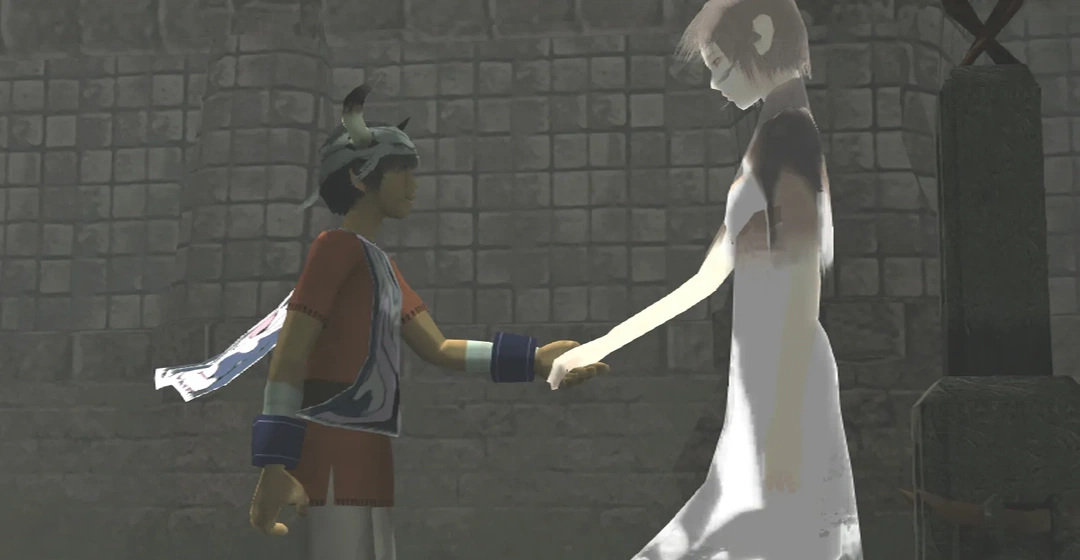
Considering the vast majority of the game is an escort mission, let’s talk about the escort mechanics. To escort Yorda, you’ll generally guide her around by holding her hand. You can also call to her to come to you, but there are certain obstacles she can’t navigate on her own; she can’t climb up chains, and she’ll need help climbing up ledges, or making jumps across platforms. The fact that you pretty much constantly need to be holding her hand helps build a sense of companionship and create a bond between Ico and Yorda.
In addition to this, at certain points in the game, shadow creatures will appear and try to take her back to the queen of the castle. The main goal of these sections is not to focus on defeating the creatures, but to protect Yorda. There are two ways you can game over: falling from a great height and failing to protect Yorda. These brief combat moments range from being mediocre at best to tedious at worst. The shadow creatures are very bulky; they could have 60% of their health and I think it'd be an improvement. However, to be fair, the combat sections do a great job at conveying a feeling of danger and worry to the player. Whenever I heard the music alerting me of the shadows, my thoughts weren’t “not this again” but rather “where’s Yorda? I have to get back to Yorda now!”
In regard to the world and map, I think it’s great. You can really feel the scale of the castle, especially in moments where you are outside walking on the walls or are navigating heights over large depths. Sometimes you’ll be jumping across platforms held up by chains, other times you’ll be sidestepping against the wall, with a vast chasm beneath you.

Visuals and Aesthetics
ICO is one of many examples of how good art direction can defy graphical age. The game uses a very minimalistic artstyle. I am in particular a big fan of Yorda’s character model and design. It always seems as if she is giving off a faint white glow, indicating her “otherworldliness” to Ico. Her design contrasts well with Ico’s more rough and “wild” character design, as he instead wears colorful clothing and has horns protruding out of his head, conveying that he is an outsider, and does not belong in the castle.

As I mentioned earlier, there is a great sense of scale when exploring the castle. The game has various shots that convey the magnitude of the place you’re trying to escape. There were many times where I would be in the middle of doing something, but then I would just stop and admire the scenery: the intimidating stone walls of the castle, and beyond the castle and the water that surrounds it, where there lies a view of a distant, but enchanting forest. Overall, I think the visuals have aged quite gracefully.

Music and Sound Design
The soundtrack for the game is short (like the game itself), but I’ll talk about some tracks that I liked. The track “Who are you?” encapsulates the mystique and otherworldliness that is felt when Ico meets Yorda for the first time. The track “darkness” conveys a feeling of imminent danger and urgency each time the shadow creatures try to steal Yorda back. The track “heal” to me represents the charming bond growing between Ico and Yorda, and the feeling of two people trying to push forward despite the harshness of the world. The tracks “The Gate” and “Queen” encapsulate the otherworldliness of the castle, but in a way that invokes a feeling of sinisterness rather than curiosity. The track “Shadow” has this almost somber howling, which helps convey the tragedy of failing to save Yorda, making you feel like you are responsible for the outcome because you weren’t enough. Lastly, the track “ICO-You were there-” is the final track of the game, and represents how the ending of the folktale-like story of the game will be passed down for generations (kind of like how the influence of ICO has continued to inspire games that came out after it).
I don’t have a lot to say about sound design, but I think it works well to create a sense of serenity in the environment and atmosphere. I enjoyed hearing the sounds of nearby birds chirping or the crashing of waves against the shore of the island.
Story, Themes, and Ending
The plot and characters of the game are pretty simple, so I won’t talk much about them. That being said, to me, a story is more than just a plot. Sometimes it’s less about what happens, and more about how the game made me feel. Yes, the game is about two people escaping from the labyrinthian castle. But it’s also about helping someone in need. It’s about how a bad situation can still result in people making genuine and meaningful connections. How the relationships we form with others can allow us to grow and mature. In the beginning of the game, Ico is the more dominant character, constantly guiding Yorda around. But throughout the game, it seems like Ico’s determination rubs off on Yorda. There would be times where I would expect to help Yorda up a ledge, but to my surprise, she does it herself. Sometimes after opening a gate, instead of waiting for Ico, Yorda would dash ahead by herself. You can even notice her becoming curious about birds for example. Towards the end of the game when I was busy climbing a ladder, I noticed Yorda walking away and curiously approaching a white bird before it flew away, perhaps symbolizing her growing desire to see and know more about the outside world beyond the castle. And by the end of the game, Yorda saves Ico during the collapse, a thanks for saving her, and allowing her to truly grow as an individual and discover herself. To me some of the moments that stuck out to me the most were the save benches. They are nice moments of respite from all of the puzzle solving and shadow fighting. Sometimes after saving it’s just nice to sit there and just take in the atmosphere. It’s okay to take a break. It’s okay to rest.

Regarding the ending, there are some differences in interpretation. As I mentioned, during the collapse scene, Yorda saves Ico by sending him away on a boat. Later, Ico wakes up on a bright, almost heaven-like beach, where he finds Yorda, and she wakes up. It seems many players interpreted this moment as a dream that Ico is having, and that Yorda truly did die in the castle collapse. Others say that it’s not Yorda, but actually the Queen. But I don’t agree. The queen, Yorda’s mother, claims to Ico near the end that even after Yorda wakes up, she will cease to be Yorda, and will instead be the reincarnation of the queen. But after the queen’s defeat and when the castle starts collapsing, she states how Yorda will still be unable to escape the castle. In my opinion, the Queen wouldn’t have mentioned the statement in this way if Yorda wasn’t really Yorda. But that’s just my interpretation. It’s what I believe, and nothing will take away from the moment where I discovered Yorda on the beach and yelled, “hell yeah!” Because that’s what ICO did to me. It made me care about Yorda. I didn’t view my experience with the game as an escort mission where I had to drag around a useless NPC, I felt like I was saving a real person born into terrible circumstances, and that’s the magic of ICO’s storytelling.
Would I Recommend?

Determining whether or not I would recommend ICO is a difficult choice. I didn’t think the combat or puzzles were fun, and I didn’t find the gameplay as whole to be very enjoyable. But I liked how the game made me feel, and what the game made me feel. Some people only play games to have a fun time, and there’s nothing wrong with that. I myself usually pick games to play based on how fun I think they would be. So if you are a “gameplay is what’s most important” person, then I wouldn’t recommend ICO. On the other hand, some people are more open to games regardless of how good the gameplay can be. If you are one of these people, then I would recommend giving ICO a try.


 ‘The Hand’ is what makes ICO stand out as a sophisticated and distinctive game. It introduces a remarkable mechanic, which I like to call it imaginatively: ‘the Yorda mechanic’. In the game the player takes control of a horned-boy (Ico) as they set out to escape from a castle where they have been sent as a sacrifice, they will cross paths with Yorda, a mysterious girl. The boy will need to guide and protect her as they make their escape; this is where the mechanic takes full effect. A single button/command is assigned for the player’s interaction with Yorda (NPC/AI), this command does several things: it makes Ico call their friend, pull her from heights or save her from being consumed by shadow vortexes, and most essentially hold her hand to guide her. Yorda can't fight back enemies, so the player has to balance solving the many environmental puzzles while always defending her, failure to do so ends up in GAME OVER. Unlike many AI companions who need an escort, Yorda never feels like a burden; for a game released in 2001, it's impressive how responsive she is to her environments and the player’s commands. For instance, I noticed how she will directly hide behind Ico’s back when accosted by ‘the shadow monsters’, she will sometimes (there are some occasionally small issues with path-mapping) seek to move out of the action to protect herself. When left on her own for a while, she will began to wander around the map (the player will learn not to leave her alone for a long period of time lest she is captured, and the moments they have to because the level demands it, will be filled with a sense of tension and even fear), this small details, give the impression that Yorda is far more than a McGuffin to the gameplay/story, but a sentient being as lost as the player, in this mysterious and sometimes dangerous environment.
 Score: 98/100


 Top PS2 game and game from this era. most of the games were weird and experimental, but less were functional and most dont …
 thanks to grouvsters in the threads on the newer games mentioning this one. I really liked it. it was easy and kind of short, and I more or less played it blind. Play it if you havent! I decided to play the PS2 version after looking at comparison between it and the PS3 bundle with colossus and opted for the orig as it really didnt look that much different from a comparison I saw on youtube, and I dont mind the grainier resolution.