Tokyo Mirage Sessions #FE (2015)

Atlus, Intelligent Systems

Wii U

3.61 from 298 ratings

1124 members have it in their collection · 95 playing now · 529 backlogged · 483 wish listed

How long? Main story 34h · with extras 47h · 100% 91h (from 25 logged playthroughs)

Tokyo Mirage Sessions #FE is a crossover role-playing video game developed by Atlus and Intelligent Systems for the Wii U, based on the two companies' Shin Megami Tensei and Fire Emblem series, respectively.
Remove Ads with Grouvee Gold

Release dates

  • Dec 26, 2015 (Japan) Wii U
  • Jun 23, 2016 (North_America) Wii U
  • Jun 24, 2016 (Europe) Wii U

Also available on

Related

Remove Ads with Grouvee Gold

Featured in lists

Rating distribution

5 stars
57
4 stars
121
3 stars
80
2 stars
23
1 star
16
Remove Ads with Grouvee Gold

Community All Reviews Statuses

SoulboundFlame

Review SoulboundFlame 5/5 · Sep 27, 2024

Seriously underrated

This game has a really nice loop iterating on the Persona formula.

It has FE characters, but not the gameplay system.

Great music, nice setting. This was a hidden gem on the wiiU glad it came to the switch.

Readers should note that the reviews for this game were tanked by >SMT and FE fans that expected TMS< #FE to …

Read more

This game has a really nice loop iterating on the Persona formula.

It has FE characters, but not the gameplay system.

Great music, nice setting. This was a hidden gem on the wiiU glad it came to the switch.

Readers should note that the reviews for this game were tanked by >SMT and FE fans that expected TMS< #FE to be a very different experience. This game has vibes inverted to those game, like playing a Mario game and experiencing Resident Evil.

Read less
Witt997

Review Witt997 3/5 · Sep 8, 2022

Shin Megami Tensei X Fire Emblem

Gioco molto atipico, che mescola elementi da Shin Megami Tensei, come il combattimento focalizzato sullo sfruttamento di punti deboli dei nemici e elementi da fire Emblem come i personaggi. Il tutto in una ambientazione moderna e molto J-Pop. Sinceramente ho opinioni miste sul prodotto: Trama e dungeon crawling li ho trovati noiosi e skippabili quando ne ho avuto occasione, mentre …

Read more

Gioco molto atipico, che mescola elementi da Shin Megami Tensei, come il combattimento focalizzato sullo sfruttamento di punti deboli dei nemici e elementi da fire Emblem come i personaggi. Il tutto in una ambientazione moderna e molto J-Pop. Sinceramente ho opinioni miste sul prodotto: Trama e dungeon crawling li ho trovati noiosi e skippabili quando ne ho avuto occasione, mentre il combattimento e la presentazione li ho trovati geniali. Alla fine devo dire che mi sono divertito e ho anche raggiunto il finale vero! Voto: 7.5/10

Read less
tylerisrandom

Review tylerisrandom 2/5 · Jul 23, 2021

Okay, I really need to stick to Persona…

The main characters enter the idolasphere.

I really wanted to like this game. I've been trying to scratch that Persona itch lately, and after the dismal setting of SMT: Nocturne, I thought the comparably colorful and lighthearted presentation of Tokyo Mirage Sessions might do the trick.

It more or less delivered on those two points: It is similar to Persona, and it is colorful and …

Read more

The main characters enter the idolasphere.

I really wanted to like this game. I've been trying to scratch that Persona itch lately, and after the dismal setting of SMT: Nocturne, I thought the comparably colorful and lighthearted presentation of Tokyo Mirage Sessions might do the trick.

It more or less delivered on those two points: It is similar to Persona, and it is colorful and lighthearted. I just wish the game itself wasn't so boring!

The dungeons feel incredibly basic, padded only by the sort of groan-inducing rotating gate puzzles that have been an RPG mainstay since the 8-bit era. The battles are similar to Persona on the surface, but each character is so dramatically customizable that they eventually become almost indistinguishable. The demons you encounter feel repetitive and unmemorable. The world is small and under-realized: This silhouette-laden Shibuya of identical crossroads is a far cry from that of Persona 5! And I can't tell who this story was written for: The characters have these unerring Pokémon-esque motivations that seem like they're for children, but their proportions (and the exaggerated animation thereof) and some of the game's situations suggest a teen or adult audience.

If Atlus had imparted the world with a bit more atmosphere and cut 10 or 15 hours of filler gameplay, I might have stuck with it. As is, this felt like a chore to play.

Read less
HitchensRIP

Review HitchensRIP 4/5 · Jun 5, 2021

Lovely Persona Clone

Excellent JRPG, Lovely J-Pop Setting. A bit of a Persona clone, but better IMHO Nice mechanics to circumnavigate tiring grinding Not too long. Had to play it on Hard as Normal was too easy, and I suck at games 7.5/10

yyninja

Review yyninja 3/5 · Dec 18, 2020

Light hearted, saccharine and colorful JRPG

Tokyo Mirage Sessions #FE Encore or TMS for short, is a goofy, fun and lighthearted JRPG. The game is a collaboration between ATLUS and Nintendo and was planned to be a merger of the Shin Megami Tensei and Fire Emblem franchises. Unfortunately fans of either series will be disappointed to learn that neither franchise is properly represented in TMS. The …

Read more

Tokyo Mirage Sessions #FE Encore or TMS for short, is a goofy, fun and lighthearted JRPG. The game is a collaboration between ATLUS and Nintendo and was planned to be a merger of the Shin Megami Tensei and Fire Emblem franchises. Unfortunately fans of either series will be disappointed to learn that neither franchise is properly represented in TMS. The game is best described as a Persona game with heavy J-Pop themes. The Fire Emblem elements that are there are barely noticeable such as: sound effects, names and the weapon-triangle. TMS, despite being barely recognizable from its original vision, is still worth a try if you can tolerate the paper-thin story, the inconsistent censorship and the outdated game design.

TMS is a JRPG set in modern Japan and revolves around the entertainment industry. A mysterious force is kidnapping and draining the life-force from people at concerts and event halls. You play as Itsuki Aoi, a typical high school student and a childhood friend of Tsubasa Oribe who dreams of becoming a pop idol. Itsuki by pure coincidence visits a talent show competition and learns that Tsubasa is one of the contestants. Problems immediately arise, once the MC of the show gets possessed and kidnaps all of the contestants including Tsubasa into an alternate world. After some story beats, Itsuki and Tsubasa join an entertainment label called Fortuna Entertainment, that moonlights as an organization that investigates these mysterious occurrences.

The game’s initial premise is interesting but fails to deliver at the end. The first two chapters of the game are very well paced and feature some candid commentary on the state of the Japanese entertainment industry. I was surprised that the game implied that some characters may have agreed to sexual advances by others in order to advance their careers. Outside of the first two chapters, the game’s writing nosedives into a standard JRPG comfort zone where the power of positivity and friendship is used to overcome all odds. In a positive light, the side stories in TMS are interesting and help flesh out the relationship between Itskui and the other party members. Highlights include Kiria struggling to maintain her status as a “cool” idol with her personal love of childish things and Yashiro who is so dedicated to his craft that he doesn’t know how to find food to eat.

What really works about TMS is the battle system. Fans of the Persona series, especially starting with Persona 3 and its sequels, will feel right at home with TMS. The battles are turned based and combo focused. In the Persona series, damaging an enemy with its weakness will grant an extra turn. In TMS, damaging an enemy with its weakness, creates a follow-up attack called a Session Attack. For example if an enemy is weak to fire, and a character has a sword session attack that follows up after fire attacks, that character will land a sword attack on the enemy. The session attacks get more complex as another character could follow up with the previous sword session attack if they have a Session Attack that activates with sword attacks. Rather than mindlessly targeting an enemy’s weaknesses, it is more important to see which weaknesses will land the most session attacks. In the late game, expect to see Session Attacks ranging in the double digits.

Session attacks aren’t only for dealing damage to enemies. Landing session attacks charge your special attack meter so that your characters can use their devastating special skills. These special skills are almost always guaranteed hits and will always start a session attack regardless of the enemies' resistances. Session attacks also grant bonuses in EXP, items and money. I found the battle system thrilling and it makes using weaker single target attacks sometimes better than using powerful group attacks.

The other exemplary feature is the weapon system. In TMS, skills are learned by equipping weapons and using them in battle. Once you think you have mastered all available weapons, the game throws an interesting curveball where you can upgrade your mastered weapons to unlock new skills. Some of the early upgraded weapons you obtain have surprisingly good skills that you cannot learn from late game weapons. In addition to learning new skills, you are also motivated to relearn existing skills. Most skills in the game can be upgraded multiple times to deal more damage, have a higher chance of activating or cost less mana to cast.

I’m six paragraphs in and unfortunately I have to talk about the white elephant in the room, the game’s censorship. The western release of the original TMS is censored and the Encore edition has made it worse. All releases of the Encore edition, even the Japanese release, are censored. It has created such an uproar that Nintendo had to publicly apologize to their Japanese fans and allowed pre-orders to be cancelled. The problem I have with the game’s censorship is that it is glaringly inconsistent. Tsubasa’s bikini outfit cannot be equipped or seen in cutscenes but is visible when she triggers her Ad-Lib performance attack. Cleavages are censored with conveniently placed shadows in the anime cutscenes, but are clearly visible in battle. The context for the scene in Chapter Two is completely changed but characters still reference it as a gravure scene (gravure is similar to swimsuit modelling). Kiria mentions that she does not have “the body to pull that off”. Tsubasa talks about being embarrassed that her dad will see her “model shoot”, yet is okay with her debut music video where she wears even less clothes than the censored outfit. The Encore edition also cuts the Japan exclusive hot springs DLC from the original game. I personally did not find any of the censorship insulting or ruined my enjoyment of the game. It is reasonable for Nintendo to request Atlus to censor the game especially since it is not a good look to have underage girls show cleavage and wear so little clothes in a Nintendo published game, but it’s weird how they gave the thumbs up to leaving the breast jiggle physics in the game.

The pace of the game is hampered by frequent trips to the Bloom Palace. The Bloom Palace is where you obtain new weapons and upgrade your characters. The main story and side stories routinely involve you leaving the dungeon to upgrade something at the Bloom Palace then backtrack to the dungeon in order to progress further in the quest line. Even in the Encore edition with the faster loading times, there are so many unnecessary loading screens, dialog and animation sequences that it becomes progressively more annoying to deal with as the game goes on. Instead of having an option to quickly jump back and forth to and from the Bloom Palace, you are forced to sit through multiple loading screens just to upgrade a single skill for one character.

There is also a dearth of content in TMS. The same enemy designs are recycled with different palette and texture swaps. Side quests involve revisiting the same dungeons in the main quest. Outside of character side quests, there are smaller requests you can take from NPCs but are often not involved and simply require you to talk to another NPC to fulfill the objective. The DLC content is lackluster. Outside of some interesting costumes and new moves, the DLC dungeon is a boring square map with 4 levels.

At the end of the day, Tokyo Mirage Sessions #FE Encore is a textbook definition of an okay JRPG. Even though I am not a fan of J-Pop, I still found myself entranced by the music and impressed with the choreography in the anime scenes. I was pleasantly surprised that the battle system is leagues better than even my favorite Persona game: Persona 4 Golden. And I also chuckled at some of the character side stories that I’m glad to have experienced. It’s a shame that the game had so much potential to be great but is wasted away on a boilerplate main plot, questionable game design and a lack of overall content.

Read less
LCSnoogs

Review LCSnoogs 4/5 · Apr 29, 2020

Tokyo Mirage Sessions #FE Encore Review

The Fire emblem Connection is pretty weak. The characters from Fire Emblem that appear in this game are pretty unrecognizable in their strange new costumes. The Fire Emblem influence comes through strongest in the battle system where they add the weapon triangle to the Shin Megami Tensei combat along with session attacks inspired by Fire Emblem: Awakenings pairing system. It's …

Read more

The Fire emblem Connection is pretty weak. The characters from Fire Emblem that appear in this game are pretty unrecognizable in their strange new costumes. The Fire Emblem influence comes through strongest in the battle system where they add the weapon triangle to the Shin Megami Tensei combat along with session attacks inspired by Fire Emblem: Awakenings pairing system. It's a fun mechanic that makes it possible to get the entire party involved in one attack. The game also allows for swapping out characters during battle without losing a turn which is a nice feature. Since I was coming to this as more of a Fire Emblem fan than a Shin Megami Tensei fan, this was a bit disappointing.

The game does manage to feel unique because of its focus on the entertainment industry in Japan. It stars a cast of charming characters helping each other become the best idols they can be. The bosses tend to be established names in the entertainment industry who have lost their way because demons have been twisting their minds. As the characters become better idols through completing side quests, special performances and duo arts are unlocked which are powerful attacks or support skills to use during battle. Each involve a fun performance involving the characters.

Read less
midnattsvarg

Review midnattsvarg 3/5 · Aug 18, 2016

Persona light with a slight touch of Fire Emblem.

TMS-FE is a dungeon-crawling JRPG reminiscent of games in the Persona series, telling the story of a group of teens trying to make it in the Japanese Idol business, being dragged into the mystery of artists either vanishing without a trace or inexplicably losing their artistic capacity - their so called "performa". While I thought the game was enjoyable and …

Read more

TMS-FE is a dungeon-crawling JRPG reminiscent of games in the Persona series, telling the story of a group of teens trying to make it in the Japanese Idol business, being dragged into the mystery of artists either vanishing without a trace or inexplicably losing their artistic capacity - their so called "performa". While I thought the game was enjoyable and certainly delivered in terms of presentation, I did think it struggled a bit both in terms of narrative and mechanics.

Presentation (visuals and audio)

This game is a spectacle to behold, especially when it comes to battle animations and the full-length anime cutscenes accompanying various musical performances. Character animations could be more expressive, but they are certainly not atrocious like the ones in Xenoblade Chronicles X. Dungeons are not that attractive, but if you tolerated the endless corridors of Persona 4 or the countless other JRPGs found on the PSVita, then you'll probably find them pretty good looking. The final dungeon in particular offered open views and looked quite nice. Interestingly, the recreation of the Shibuya district is actually somewhat faithful to the real deal - Shibuya 109 was rebranded 106 and served as one of the dungeons in the game, which I thought was interesting. This game features many musical performances mostly belonging to the cutesy style of Jpop, which I'm sure fans of the genre will enjoy. The Japanese voice-acting is mostly well done, but the character Barry - supposed to be an American immigrant - sounds terrible. Makes you wonder why they couldn't just find an native english-speaker to make the voiceover in broken Japanese.

Narrative (story-telling and character development)

The game proceeds from a rather interesting premise: the entire cast and audience of an opera performance vanished out of the blue, save for a young audience member who we now--five years later--get to follow on her path to become a Japanese popstar. Unfortunately most of the story-telling that follows feels rather shallow, introducing a range of characters who are basically just anime stereotypes with mostly minor character developments. Unless Persona 4, where many smaller day-to-day interactions made each character feel like a real person, character development takes place more or less exclusively during three short subquests for each character, often boiling down to the character gaining an important personal insight simply from killing a certain time of enemy a few times. Anime stereotypes don't have to be bad--they can be quite fun--but I don't think they did a very good job making you care about the characters you encounter. As for the overall mystery, for the first few dungeons you are served nothing but hints that a greater power might be behind these targeted attacks on artists (no shit Sherlock), but it wasn't until around 30 hours into this roughly 50 hour game that the bad guy even got a name. It takes even longer before you really understand what you are fighting against and what the stakes are, which means that the game really offers little to those who aren't that entertained by the whole idol drama playing out in between. Another thing I don't get is why they added "intermissions" in between each story chapter which all focus on new disappearances and new dungeons. It's obviously made so that you can get character subquests and similar done, but you can do those even during the main chapters - only then they really break the immersion, going on a pointless errand for a character worrying about the next performance while they really should be focusing on, say, the friend who was just kidnapped. It would make far more sense if they restricted the trivial quests to the intermissions and focused on the mission in the main chapters.


Mechanics (function and enjoyment of controller inputs)

Despite a number of flaws that get progressively worse over time, I enjoyed the overall mechanisms of this game more than I did, say, Persona 4. The battle system was quite interesting at first, giving you tons of upgrades to unlock, giving you the opportunity to build chains of attacks against enemies using all three members of the active party: A sword-based special attack builds into a wind-based follow-up, building into a spear-based final. Like in Persona each monster has its own elemental strengths and weaknesses, meaning some types of chains are more effective against some monsters than others. Building effective chains is important in this game, partly because they level up your weapon skills and partly because enemies don’t drop critical upgrade items just from dying – they drop them when they are hit with chain attacks. After a while you gain the ability to add members who aren’t in the active party to the chain attacks, which ultimately means each chain attack involves 7 people. This is great for damage output, skill upgrades, and item drops, but each chain animation takes a lot of time. It takes just one press of a button to start a chain attack, but then you need to sit back for 10-15 seconds while the chain plays out automatically. These chains also go into “overkill-mode” if the last monster is killed early in the chain, meaning the chain always finishes before the battle ends. It's a good thing the game has tons of upgrades for you to make, because it makes the long chains feel a bit more worthwhile to suffer through.

Bottom Line

Tokyo Mirage Sessions #FE was an enjoyable experience, but then I’m a patient player. I don’t deny wishing for this game to end several hours before it did, and I also have the feeling the game would have been over much quicker if you could speed up to skip all the chain animations. It’s not a marvel of story-telling, not even by average JRPG standards, but if you are a patient person into a bit of visual spectacle with Jpop and anime thrown into the mix, you might enjoy yourself too. I give it a 7 out of 10.

Read less
Capsulejay

Review Capsulejay 4/5 · Aug 1, 2016

A Cool RPG That Needs Some Streamlining

There's a lot to like about this game, but it's hampered by pacing issues. Here's an overview of the good stuff:

The graphics are beautiful and stylish, the puzzle-based dungeons are pretty unique, the boss battles require a lot of strategy, the dialog and characters are entertaining (though quite tropey), there's some catchy J-Pop tunes, and it has some of …

Read more

There's a lot to like about this game, but it's hampered by pacing issues. Here's an overview of the good stuff:

The graphics are beautiful and stylish, the puzzle-based dungeons are pretty unique, the boss battles require a lot of strategy, the dialog and characters are entertaining (though quite tropey), there's some catchy J-Pop tunes, and it has some of the best gamepad implementation I've ever seen

Unfortunately, while experiencing all this cool stuff, there's a pervasive feeling that the game doesn't respect your time. Some examples:

Extremely long animation sequences for "Session" combo attacks can't be skipped (and they're the main form of attack in the game), the flow of dungeon exploration is frequently broken up by having to warp back to the hub world to run errands, and there are fairly long loading screens every time you open a door

Keeping those somewhat glaring flaws in mind, the fact that I'm giving this game a 4/5 should be a testament to the exceptionally high quality of the game's content. With some patience, playing this game would be a rewarding experience for any Wii U owner that likes turn-based RPGs and anime.

Read less
deepdoop

Review deepdoop 3/5 · Jul 6, 2016

7/10

Edit: I originally gave this an 8, but upon more consideration, I've opted for a 7 based on the fact that the pacing issues really annoy me. I'm not going through the entire review to change things but as far as I know, everything I said from here on out remains the same. But this game has serious pacing …

Read more

7/10

Edit: I originally gave this an 8, but upon more consideration, I've opted for a 7 based on the fact that the pacing issues really annoy me. I'm not going through the entire review to change things but as far as I know, everything I said from here on out remains the same. But this game has serious pacing problems that make it more of a slog than it should be.

When the announcement of this crossover happened, I was excited because it seems like such a weird mixture. It was the crossover that people didn't know they wanted until it was revealed, and then when they showed off gameplay it wasn't the crossover we expected it to be. So it's an interesting case study in expectations.

I love what they did from a story perspective, even if it's a little shallow. The ridiculousness of it--complete with music videos, lots of singing and a whole lot of Japanese culture--because I gravitate towards unconventional and odd things. Explaining the game to people who are unfamiliar with it may prove difficult because it's not what most people want, unless they're engulfed in anime or J-Pop... or are just looking for a strange time. Despite that, I think that it really makes the game stand out amongst the RPGs we get these days.

The combat also stands out. It basically mixes Fire Emblem and SMT together, but adds a combo system called "sessions" where you can chain your attacks if you hit the weaknesses of the enemies. On top of that are Ad-Lib and Special Performances that make you more powerful and can give you some real advantages.

The skills you acquire are like in SMT, where you have to drop some to learn some. You gain these abilities by utilizing the Carnage Unity system, but there are also other, supporting abilities called Radiant Skills. So from a mechanics standpoint, it's solid though not entirely original. It's satisfying, which is what matters.

So the game plays well and I think the story is interesting enough... so where are the problems? Simply put: the pacing. My god, the pacing. When you're in a dungeon and you're exploring/solving the puzzles, the game is fine. I think the themes and different types of puzzles are refreshing, though not especially difficult (that's fine).

It all seems passable until you realize you spend a lot of time looking at loading screens, backtracking through dungeons, or visiting places you've already been a million times. For example, you may have to learn a Radiant Skill in order to progress to a boss; the problem is that you then have to go back to your office, learn the skill, then go back. Once in a while, this would be okay... but it's a frequent thing. Players spend too much of their time simply traveling from place to place, in order to accomplish tasks that should have been more streamlined.

The same goes for side-quests. The jobs involving your characters are good because I enjoy how it fleshes out relationships and characters, but too often the quests themselves are tedious for the reasons in the above paragraph. I found myself just going through the motions, wanting to get them done because I wanted the rewards it would give me.

TMS #FE deserves to be played by anybody who has a Wii U, because it's yet another entertaining exclusive on a console that gets no love or respect. It's big, loud, beautiful and thrilling when it's getting it right, so it's a shame that it lacks polish and becomes a bit of a slog at times.

Read less
OneWingedCaius

Review OneWingedCaius 4/5 · Jul 3, 2016

Tokyo Mirage Sessions ♯FE - Baby's First Persona

Scroll down to read the review, or watch it in video form here!

Tokyo Mirage Sessions # FE is the current 1st place contender for most utterly stupid game title of 2016. It’s also a turn-based JRPG developed jointly by Intelligent Systems, creators of the Fire Emblem series, & Atlus, the guys behind the extremely dark and mature Shin …

Read more

Scroll down to read the review, or watch it in video form here!

Tokyo Mirage Sessions # FE is the current 1st place contender for most utterly stupid game title of 2016. It’s also a turn-based JRPG developed jointly by Intelligent Systems, creators of the Fire Emblem series, & Atlus, the guys behind the extremely dark and mature Shin Megami Tensei series, and published by Nintendo on the Wii U.

The story takes place in modern-ish day Tokyo. A series of mysterious incidents have begun occurring result in numerous people vanishing seemingly into thin air. When our player character, witnesses his friend, and a room full of people disappear right before his eyes, he discovers a supernatural parallel world &, through the magic of “it’s video game logic so who cares” acquires a demon, I mean, persona, I mean a “mirage”, an amnesiac individual who can transform into a weapon which he will then use to battle the monsters within this world and hopefully find a way to save his friend and stop these incidents from….wait hang on a sec…
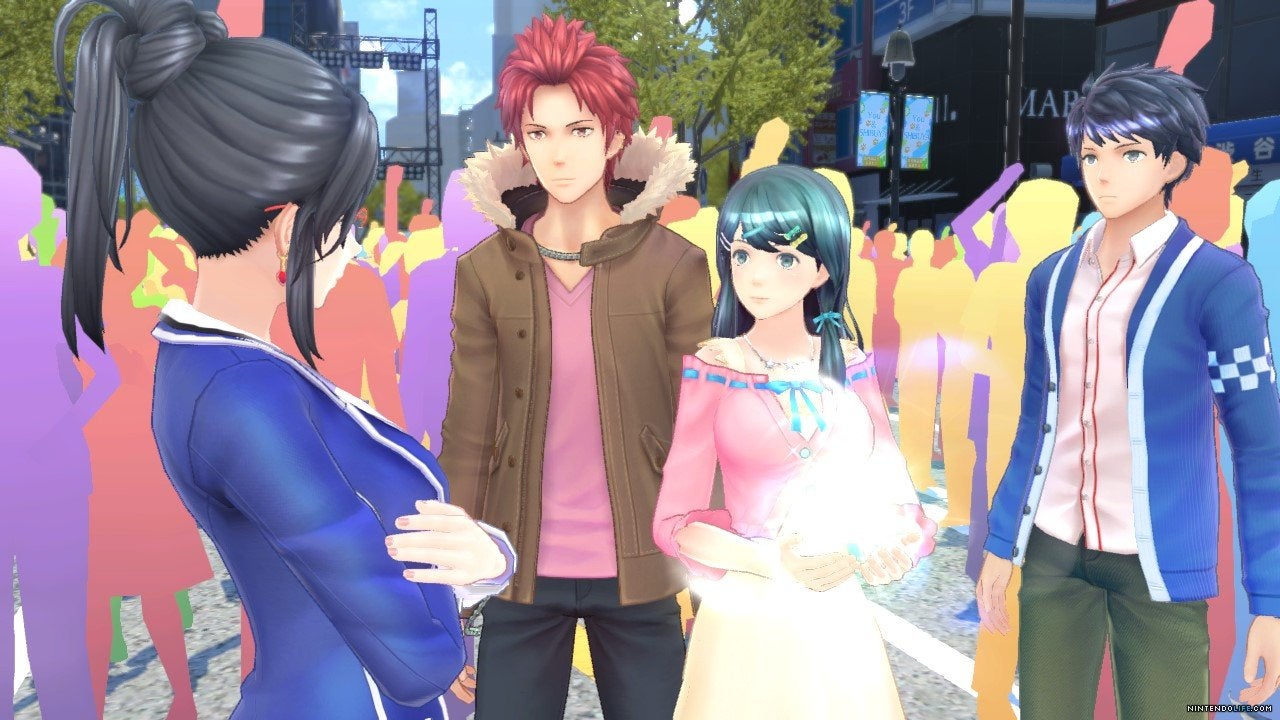
Yep, this is another RPG that blatantly copies the Persona formula almost exactly. And you know, it’s not like that’s such a bad thing, because it’s a formula that works really well, or at least it can in certain circumstances.

That said, if you’re hoping for some super-original, complex or interesting story, then I’d recommend you check elsewhere, because the plot & characters are about as cliche high-school anime as you can possibly get. Just looking at the line up, you got the benevolent airhead hero, the shy overly-friendly girl who may or may not have the hots for him, the flamboyant comedic-relief best friend, the stoic action girl, the popular girl whose full or herself, the creepily hyper-sexualized boss, the hardcore otaku, the loli-bait, & the one who’s ark and edgy so he must be the most interesting. As each character levels up, you’ll unlock side missions for each of them that give them each more individual development, but it’s never so much to the point that if you don’t already like these archetypes, which I admittedly do, then I wouldn’t count on getting that attached to anyone.

Though at least the character get by with just being “okay”. The story fares far worse. It tries to set itself up as a mystery plot, but this the bad kind of mystery, where instead of the characters actively working towards finding answers with key plot points being revealed at just the right time for dramatic effect, the whole thing is basically everyone just sitting around waiting for the next dungeon raid or plot twist to happen on cue so you can go “alright, let’s crawl through another pretty-looking, sluggishly paced dungeon for 2 hours, fight the boss at the end and save the damsel-in-distress for the day”. Occasionally the story will pull something really interesting adding another layer of intrigue but then refuses to give you even the slightest explanation for literally no reason. Withholding information for the audience just for the sake if it doesn’t immediately make your story interesting, if anything it makes it annoyingly frustrating.

For a Shin Megami Tensei game the plot is rather dull and uninspired, and it’s not like the Fire Emblem references help anything since it hardly borrows any mechanics from the series and the crossover characters are essentially limited glorified cameos. Even when the game tries to tie the two series together more, it’s still basically just fanservice without adding any really difference to the story.

Now I realize there’s a possibility that you’re probably getting the feeling that I hate Tokyo Mirage Sessions, or I’m one of those whose writes the game of as “Weeaboo Trash” and moves on. Well, the truth is I actually really like it a lot. In fact, barring Ara Fell (which you all still need to play right now), Tokyo Mirage Sessions is probably the most consistently fun I’ve had with a classical JRPG since probably Radiant Historia on the DS. From a purely mechanical and gameplay perspective the actually combat and character progression is some of the best designed and most refined in the entire SMT series.

Again this is turn-based combat so there’s not a lot to explain in terms of how you play, but there’s a number of additions that keep things interesting. For one thing, the Fire Emblem, rock-paper-scissors-esque weapon triangle means that you can’t just spam attack you way to victory, since even normal attacks won’t work equally on every enemy, but there’s also a mechanic that whenever you strike an enemy’s weakness, you can have your allies do a follow up attack for extra damage, and rewards you for finishing battles in as few rounds as possible. What this does is force you to carefully plan out every single attack you make even when fighting trash mobs, and gives you an intense sense of satisfaction every time you take a risk in strategic risk in combat that pays off. The whole thing is very risk v.s. Reward based, but it’s all balanced well enough to where as long as you know what you’re doing you’ll be able to clear your way through each dungeons with little frustration.

In terms of the design the game, the entire thing has a heavy Japanese Pop Culture vibe going on, which is definitely something that will turn a lot of people off, but I actually really appreciated it. I’ve seen plenty of elements of JPOP used in japanese games before, but they always feel like their being snuck in there, or that they are somehow ashamed of their existence. It’s so refreshing to see a game that so unapologetically goes “balls to it. We love JPOP and were not ashamed of it.” Every element from the catchy soundtrack to the art direction to the actual plot is basically one big celebration of JPOP culture and I admire that it fully embraces the crazy weird world without shame out of sheer love for it.

“Now hold on a minute. What was all that you were going on about before, then about the story being bland, or the characters personalities & development being so cliche, huh?” Well consider the fact that maybe I actually enjoy these cliches a bit. The characters may have cliche personalities & characters arcs but at least they HAVE them, which is more than I can say for the miserable attempts at characterization I see in most modern game narratives. This isn’t a Legend of Legacy situation where you have a paper-thin plot and characters who are basically walking mannequins. There is an actually story with dedicated characters here, and as corny as it all is, it’s at least committed and sincere in its execution. It never takes itself too seriously and there is an overall sense of self awareness to the whole thing, which is appreciated.

And that’s the thing with Tokyo Mirage Sessions. If you’re into the JPOP culture or the heavy modern anime style then this is going to be your jam. If not, then this isn’t going to do anything to sway your opinion. It’s a game designed for a very specific and niche audience, but instead of using that as an excuse for mediocrity, it does it’s best to make an experience that those within that niche can unashamedly enjoy to it’s fullest. While this is yet another JRPG of the year that I have to throw into “good not great” category, I’m at least glad we’re moving up the average from the sea of mediocrity is was most of the last generation.

And explanation of my rating system is available here.

Read less
Cheezpuff

Review Cheezpuff 4/5 · Jun 30, 2016

Refreshing take on the Persona format, but ends with a wimper

Even though the game is supposedly an Shin Megami Tensei x Fire Emblem crossover, it's essentially a Persona game with some characters named after ones in Fire Emblem Awakening. There are a few non-aesthetic references to Fire Emblem, which I'll discuss later, but the relation to FE is very limited. I don't mind, since I like the Persona games anyway. …

Read more

Even though the game is supposedly an Shin Megami Tensei x Fire Emblem crossover, it's essentially a Persona game with some characters named after ones in Fire Emblem Awakening. There are a few non-aesthetic references to Fire Emblem, which I'll discuss later, but the relation to FE is very limited. I don't mind, since I like the Persona games anyway.

The core mechanic is that attacking an enemy's weakness initiates a "session," which is a combo where your other party members can attack after you. Only certain links work (e.g. this character might only be able to link Sword attacks to Wind magic, e.g.) but the game automatically picks the best combo (and shows you what it is before you attack), so you don't have to think about it too much. It looks complex, but the game takes care of it for you. This concept expands as the game goes on. At first, only members of your party currently in battle can session, but later on you get the ability to form longer combos by incorporating your characters on the sidelines. In addition, some characters get "ad lib" performances which will randomly swap a attack with a more powerful one, and some get "duos" which are strong attacks often with healing that occur at the end of sessions, which restart your session allowing you to attack even more times.

As you get more characters, your survivability goes up, even when you can still only have three out at a time, as you can swap in characters with no penalty, so you can swap out a member who's hurting for a full-health one with no penalty. The caveat is that you can't (reliably: see below) heal a party member on the sideline, which could be bad since most status effects block their ability to participate in sessions, which means you've lost attack power.

I've been saved more than once by duos, since some will heal/cure/revive the party (even the members who aren't active in the battle, the only skill that can do this), but since they are activated randomly, it doesn't seem legit, just lucky. Theoretically the activation rate could be high enough that you could rely on them, but it isn't. Usually you'll only be attacking if you are doing well, and then any healing is just a bonus, not a godsend.

The Good

-The game mechanics evolve over time in a very satisfying way

-The session concept is really cool to watch (for the first 40 hours, that is)

-The story is comically succinct, essentially each chapter starts with "music thing is happening" and then immediately after "oh no it got attacked by bad guys"

The Bad

-The game runs out of steam, as the final dungeon is pretty boring

-There are a ton of randomly-activating attacks

-Game lets you save anywhere, but doesn't have an auto-save (so if you die, you have to load a save, which might be a ways back - to be safe you should save before every battle, but the game could take care of this if it just popped you back in the overworld, which is effectively what happens if you save and then load that save if you fail)

-Depending on what bonuses activate, a single attack might take like a whole minute to carry out (a way to speed this up would be greatly appreciated)

I'd say the first two-thirds of the game is fantastic, where you're continually unlocking more characters, skills, and mechanics, but by the final chapter, you've become jaded to the system and kinda just want to get to the end, which takes a while since combat becomes very long.

Read less