Before the Wii, Nintendo had already experimented with the idea of motion controllers. Just like the Wii Remote has an accelerometer inside that turns your movements into inputs, some Gameboy Color and Gameboy Advance cartridges used similar techniques to achieve the same result, one of them being Kirby Tilt 'n' Tumble (2000).

However, this game, among others that used similar technology, like WarioWare Twisted, which had a gyroscopy inside; or Yoshi's Topsy-Turvy, that included a tilt sensor; were never released outside of their original consoles, so the only way to experience them with the intended controls without spending more than a hundred dollars in original and second-hand hardware is using emulators with motion support, one of them being the VBA GX, for the Nintendo Wii.

And while emulators are a touchy subject among the gaming community, in cases like this they are the best way to experience games that were forgotten by their creators, especially nowadays, where the retrogaming market is full of scalpers trying to sell worn-out cartridges and consoles at premium rate. It also doesn't help that Nintendo never bothered to adapt these games in modern hardware, which is totally possible, as fans have proven time and time again.
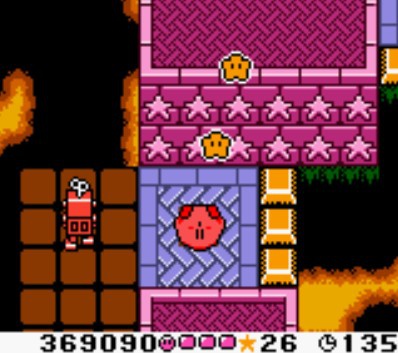
And it's a shame, because Kirby's Tilt 'n' Tumble is a really fun game that uses the motion controllers better than most Wii games I've ever played. King Dedede stole the Sparkling Stars yet again, so Kirby have to stop them, but instead of walking or floating, Kirby can only move by rolling around the world, which is where the accelerometer is used: Instead of using the D-Pad, you have to tilt the control in the direction you want to take, and shake it whenever you want to jump. However, you have to be careful, as you can't float, so this time bottomless pits are a real danger!

The physics are really precise and you can calibrate them whenever you want just by pressing the Select button, so most of the time you die it feels like it was your own fault. The game is also really generous with lives, and you can easily get 50 lives by the time you are at Stage 4, which is appreciated, because it can get really challenging, but not frustrating, as the level design is really good and understands the advantages and limitations of the unique controls. There are also some bonus games that you can play if you get a blue star in some levels, which are a nice change of pace and let you get even more lives. The best part? The are totally optional, so you don't have to touch them if you don't want to!

Another optional thing are the red stars, which are similar to the Crystal Shards from Kirby 64 and other collectibles that you can get on most Kirby games. The main difference is that you don't need them to unlock the final boss, only for unlocking an extra mode which is basically a harder version of the normal one. I really liked them, as I didn't feel forced to collect them and yet decided to do it just because I was having a great time and didn't have any problem replaying most of the levels again. It really shows how making a collectible an optional sidequest can transform it from an annoying thing to do to just a nice little bonus for completionists.

In conclusion, this was not only an interesting experiment from Nintendo, but a really good game that you need to try with motion controls to understand how well-implemented the gimmick was. It's really surprising they never did anything similar for the Nintendo Wii or the Nintendo 3Ds, which had the technology necessary to even improve on the formula, a fact that is even worse when you realize that you can't experience games like this by conventional means.


