Am I the only one who noticed how similar the title screen theme is to the Terminator 2 theme? Not a bad thing at all.
This is my first true Armored Core experience. I didn't own a PS1 until well past it's heyday and while I had a friend who loved Armored Core, I was never able to play enough to get into it. It had an overwhelming learning curve and awkward controls. Playing Armored Core 6 required a lot of patience and effort from my end. It's not a poorly designed game, but it is both dense and overwhelming. I think the tutorial for the most part is thoughtful and well designed. You are barred from the AC shop and forced to play with a specific AC for the first bit of short and simple missions. The tutorial boss is certainly a steep increase in difficulty and because you need to fight it to progress the game properly, it's certainly one of the most challenging fights. Mechanically it isn't complex, but because you are still learning the controls it will challenge you. The boss forces you to learn the core mechanics of the game which will likely be a turn off for a chunk of players who don't like to be challenged by games. I'm not criticizing players who don't like being challenged, merely warning that the tutorial boss will feel too punishing if you aren't used to challenging games.
Then gradually, the game gives you training missions (which I recommend, not only for learning purposes but also for the free parts each tutorial rewards you), unlocks the shops, arena battles (a low risk way to get stronger and test out your build. Both from the money you earn and the OST chips which allow you to strengthen your Mech meaningfully) and parts. Eventually, I reached a point where I was excited for the next wave of new parts and arena battles to unlock so I could experiment more.
With all of that said, It wasn't until about 3 hours in that the game finally gripped me. I am glad I stuck it out in the early parts of the game. Once it clicked for me I was zipping around and causing total destruction. It's a fun power fantasy that is further elevated by the sheer amount of customization and ease of switching play styles (once you get over the learning curve). Compared to any previous Souls game, the customization is far more robust. While every weapon and part are certainly not balanced, there is a clear sense of progression and satisfaction from mastering the complex systems. While I was able to figure out most of it on my own, some of the menu description were disappointingly vague and I did have to look up some info. One example would be in EN shortfall (meaning not having enough energy to power your mech).
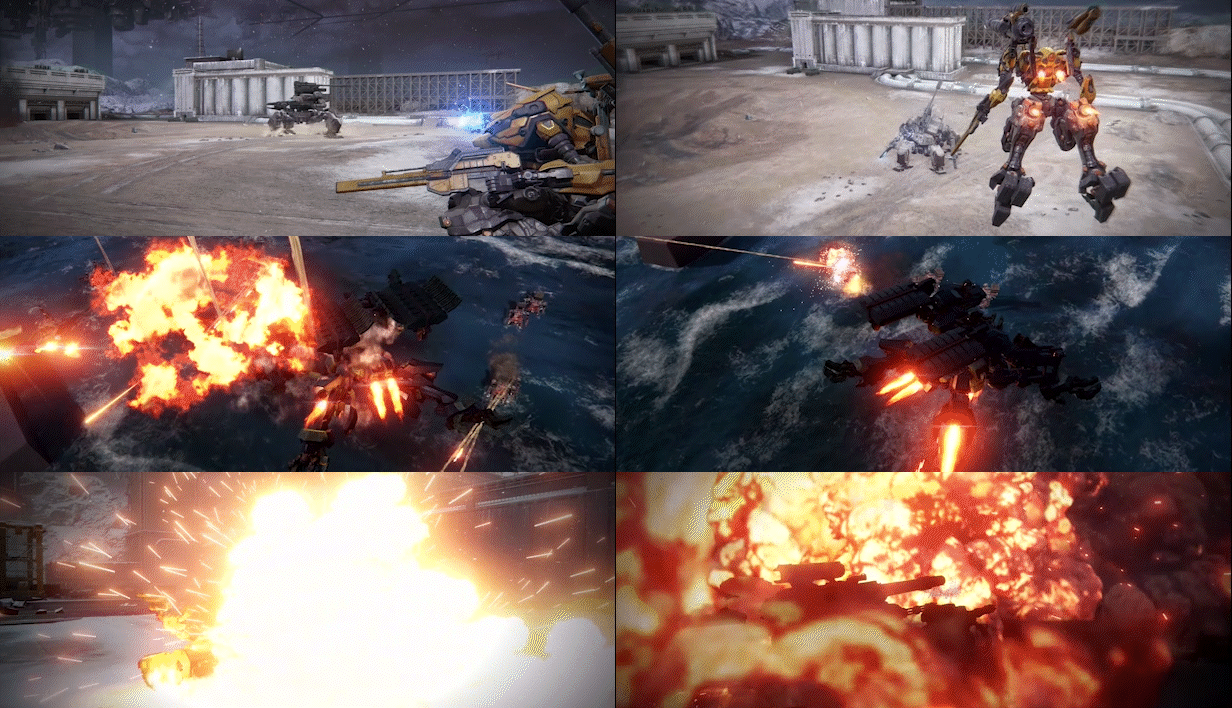
I really don't view this as a souls game. Yes there is a lock-on mechanic, yes there are limited healing options and there are "checkpoints." But most games feature these same mechanics and outside of those factors the gameplay of Armored Core is so different that they feel like completely different games. This isn't a bad thing. For starters, this game is exponentially faster than any soulsbourne game. Bar none. Your speed can vary, but even in the slowest option you are still vastly faster than any previous Souls game. While AC 6 does have a stamina meter (energy in this case), it does function differently then the Souls game. Here only mobility, whether offensive or defensive, are restricted by energy whereas in Souls game it typically is tied to both attacking and movement. This is a good change. AC 6 is extremely input heavy in comparison to the Souls game. This is the aspect that I believe new players to the series (myself included) will struggle with the most. Having to be mindful of multiple cooldowns and energy management is a lot to wrestle with. For that reason, I found automatic primary weapons or slower firing primary weapons and shoulder weapons to be more appealing. I tried using the the handguns and while they were definitely powerful, it was giving me carpal tunnel and straining my multitasking making evasive maneuvers significantly more challenging. I ended up using the Cheng machine guns or the Needle guns. Both are strong options for a medium sized speedy build. The Cheng's were very appealing being automatic and having a relatively large ammo capacity. Either way, there's a ton to manage and the speed of the game is manic. Having to press four buttons for weapons while managing your energy and dodging to avoid attacks takes a LONG time to adjust to. It did eventually all click together for me and while I heard the later chapters had very challenging bosses, I ended up having no issues with the final few bosses (IB-01 CEL 240 was nerfed before I fought it though I beat the earlier bosses pre-nerf). Beating them in only a few attempts. It did help that I discovered how stupidly strong the Stun Needle Launchers are. Great tracking, fast speed and HEAVY damage. For me I had the hardest time with Balteus and the Sea Spider both pre-nerf. The first Enforcer fight I also had a hard time. This was due to the restrictions of the arena and how aggressive and tanky the mech was. I think mechanically later bosses are more challenging, but at that point I had built a very powerful mech and had gotten acclimated with the controls and combat. Once you reach that point of enlightenment the game is a blast.
I did go on a bit of a tangent above, to circle back another major differences between this game and Soulsbourne (and why I would argue it isn't a souls game) is the mission structure and lack of exploration. This game is far more linear than any other recent FromSoft game and rarely rewards you for exploring. Not a bad thing. I feel they likely avoided an open world not only for performance reasons but also to have a greater connection to the old games. The missions all have level designs specifically tailored for the mission and mechs you fight. This results in varied and engaging gameplay. You need to consider more than the enemies while building your mech. Some of these missions, which I thought were among the better, feature a gimmick. These gimmicks will typically instantly kill you and forces you to approach the mission and objective in a completely different way. Breach The Wall is the first mission that comes to mind and will likely be the first mission players struggle with. Another great mission, which is never repeated, is investigating a base to discover it is flooded with invisible snipers. In previous missions you typically could blitz ahead with reckless abandonment but here you forced to take things slow and use your scan constantly.
I personally think AC 6 is a difficult game. The average gameplay is pretty easy in comparison to the average gameplay of a Souls game. Where AC 6 elevates it's difficulty is in the diverse mission structures (including gimmick scenarios) and in the boss encounters. Unlike in Souls games, the devs never shy away from a novel boss encounter that forces you to completely change your play style and build. This wouldn't be possible in Souls games due to the commitment you make via stat allocation and upgrading your weapons. In contrast, if you die in AC 6 and you have spare parts in your inventory, on the fly you can completely swap out your weapons and Mech parts mid mission or you can quit the mission and buy new parts to completely change your style. This gives you unparalleled adaptability and the devs push this by not restricting boss design to accommodate a broad spectrum of approaches like you see in souls games. Souls game bosses are typically restrained because the Devs want all builds in the game to be viable. That restriction isn't present in AC 6 and the end result are some of the best boss encounters in any FromSoft game I've played.
I've heard people criticize this game over the graphics. This is a common critique for any FromSoft game and I think it's an extremely flawed approach to take. Game development isn't contained in an infinite vacuum of possibilities. There are restrictions imposed by hardware and design decisions. Performance in FromSoft games are usually top notch (some exclusions would be the dreaded Blight Town in DS 1 and Bloodbourne had some performance hiccups here and there) but in general their games perform well and gameplay is always king for them. In addition, while their games don't push graphical boundaries, they never market their games as that... so why judge them for something that is clearly not a priority? They always have a distinctive style and that ALWAYS ages better than any technical achievement graphically because hardware is always improving. In 10 years, even the best looking games being released now won't look good anymore... and there is a cost for pushing graphics to the limits... it isn't a free decision to make. It results in the game being more demanding to play... which is another reason why so many AAA games perform like complete garbage... because they are pushing graphical limits and the end result is garbage performance because of hardware limitations and design decisions... it's extremely taxing to render a giant open world with intricate game mechanics with the best possible graphics... then people complain those games don't run at 144 FPS... like dude use your brain cells and refer to how game development isn't an infinite vacuum. I'll take a highly stylized game with mediocre graphics that performs well any day over a one hundred million dollar shiny toy that breaks the moment you open it... rant over.
If you are on the fence about this game but like action games or have an itch to be in a giant robot I'd say buy it. There is a learning curve but the game feels satisfying to master and the boss fights are awesome and some of the best designed from FromSoft.