Antichamber is one of the classic indie puzzle games, and it's easy to see why. This is easily one of the most unique puzzle games I've ever played.
The puzzles here, by and large, are more like riddles rather than the logic or spatial puzzles that are so common in first person puzzle games. Each room has something it wants you to do. A room can have its own rules, its own physics even. One early room asks you to do something as simple as walk instead of jump, a later room may require you to do the opposite. This obviously does get more complex and connected as you go on.
The puzzles constantly ask you to break walls and boundaries, to think outside of the box. It will ask you to rethink conventions, both of the first-person puzzle genre and of Antichamber itself. The game teaches you a rule, then it teaches you to violate it. You must constantly be aware and observe, be ready to adapt, to try some new approach, to look at each problem from a new angle, if you are to complete all of the challenges.
The game's structure is nonlinear and complex, with many rooms containing one-way warps to completely different parts of the map. Fortunately, you can return to the main hub at any time by hitting Esc, and it contains a really well-implemented map system:
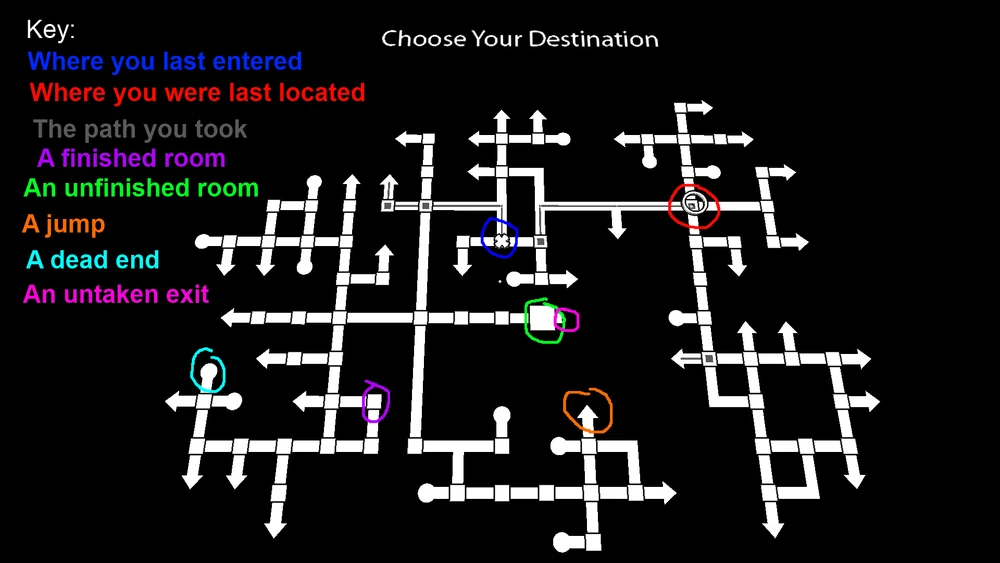
Mousing over any node on the map shows exactly what the room is, and you can click on it to instantly be sent there. The map also shows what all the warps are, where you've explored, where you haven't explored, where you entered and exited the map the last time you left the main hub. This makes it sensible and effortless to keep track of a game structure that would otherwise be quite confusing.
Perhaps one of the best points of the game is that in addition to the challenges of the puzzle rooms themselves, there are a few "hidden" game mechanics that you must learn. You will need to know them in order to progress. They're always present, always accessible. However, like the "pogo" mechanic in hollow knight, these mechanics are never directly taught to you. Instead, the game guides you, pointing you in the right direction, presenting you with situations where you can see them in action, but leaves it up to you to observe and draw the right conclusions. You must figure out how they work.
Catching on to these "hidden" mechanics gave me one of the most satisfying "aha!" moments I've ever had in a puzzle game, and my mind immediately started searching back through all the places I knew I could apply them. Rather than unlocking some ability or upgrade in game, it is you, the player, who have progressed. You've learned. You've gained knowledge you didn't have before, and with this knowledge, you can now move forward to places that were previously impossible.
Everything about this game is a masterpiece of design. Absolutely brilliant.


