Some fresh news from PlayStation Magazine on West Of Dead
--
A roguelike that glares down at you and asks ”Do you feel lucky, punk?"

A massive no-no in games usually is having creatures that you just can’t see,” co—founder and coder at Upstream Arcade Adam Langridge tells us, “[...] [but our art style] looks its best when you have things emerging out of just darkness.”
Borrowing from the shadowy works of Mike ‘Hellboy’ Mignola and the high-contrast panels of Frank ‘Sin City’ Miller, this western-infused cover shooter quickly instils a justifiable fear of the dark. It’s impressive work from a two-person art department, composed of studio co-founder Imkan Hayati and Patrick Martin. Gwilym Rees rounds out the four- man-band as a second coder, and makes the studio 3 Lionhead reunion. Langridge tells us how supportive publisher Raw Fury has been throughout West Of Dead’s development, expanding the scope of what was originally intended to be “a little indie thing” and making one particular developer dream come true. “

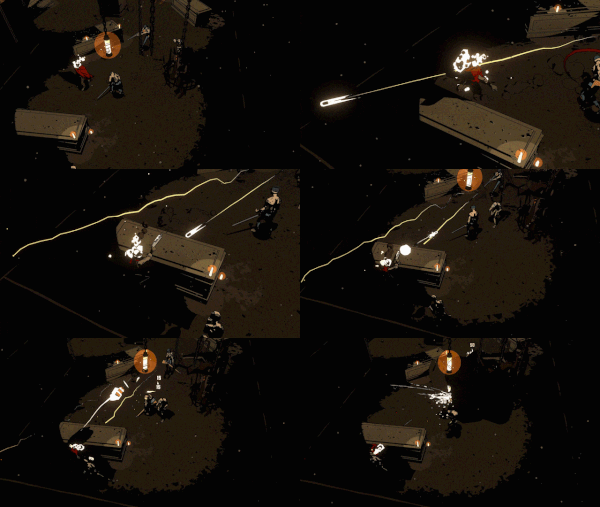
[Our publisher] started suggesting, ‘If you could choose anyone [to voice the protagonist], who would you choose?” Langridge tells us, elaborating, “We were a little bit insulated from the process [...] So, we had a short list and at the very top was ‘Ron Perlman.’ But it was one of those things that was like ‘Well, put it in. It’s not gonna happen but put him in anyway? [...] Every now and then I’d get an email and go ‘It sounds like Raw Fury is talking to Ron Perlman! No, that must be a mistake!’ And then I’d forget about it a bit longer until they said ‘Yeah, we’ve got him. He’s in.’ So that was fantastic!” As you explore each randomised room in Purgatory (Wyoming), unknown horrors lurk in every poorly lit corner. If you can get to a lantern, you can light things up with square, temporarily stunning nearby monsters. Pelting towards a dim lantern, glirnpsing a ripple of sinew in the dark, we experience the magical moment the art style is aimed at evoking. During our hands-on, lighting lanterns becomes a reflex, as getting caught by the ghoulies is a hard lesson that only bears repeating a handful of times. Langridge says, “Something that we want to do is pull people into the centre of a room even if it looks scary, so that they can get surrounded a little bit more, rather than [...] take pot shots from the corner [...] and the lanterns turned out to be quite a nice way of doing that. So you’ll see this scary dark room and there’s a bit of bait in the middle [...] [The light stunning] the creatures gives you a bit of a chance to think and then you can start shooting.”
Going in with a vague plan is helpful, but the ability to improvise is key to survival. Enemies can destroy cover, which regenerates after a while. You'll need to htmker down to speed up your automatic reload but you can’t just sit and wait either. Facing off against the first boss, seeing him diving in and out of cover, lobbing explosives, not to mention all the other ways he draws from the same intelligent bag of tricks as us, drives home the point that it doesn’t hurt to be adaptable.
RUN AND GUN
Your two guns are assigned to and I, aiding the fantasy of dual-wielding. Abilities, of which you can also equip two at a time, can be popped off via Ill! and I. Swarmed by enemies en route to the next lantern, we hurl a grenade at the approaching horde before diving over cover and making a break for the next passageway.
Now, this is a roguelike so you can’t carry over pickups like guns and abilities — of which there are a lot — between runs. Throughout Purgatory, there are places where you can channel the life force of enemies you’ve blasted into next week into stat upgrades. Reaching the end of a level finalises these changes so you can carry forward, say, your obscene amount of health into future runs. Let’s just say as we go from slow-moving zombies to dogs, we’re glad to have that cushion of hit points. (What is it about videogame dogs that makes them either the best or the absolute worst?)
Anyway, after peeking into a room only to see three dogs sniffing around, we decide to explore a different, procedurally generated path — and try to ignore the developers standing behind us, chortling. Our reason for turning back isn’t just cowardice (though that’s definitely part of it). We’re also regretting our specialised shotgun loadout. While every bit as powerful as you’d expect, shotguns are slow and necessitate close-quarters combat that we’d rather avoid for the time being. It’s worth exploring, but we’d rather make our escape before becoming demonic Fido’s new chew toy.