Main game
4.03 average rating based on 819 ratings
I invested most of my February and March playing two games that spent a lot of time telling me exactly where to go next. One made use of extensive quest markers, map location icons and signposts, and the other employed a main character that talked you through every problem and solution in the game. Both left me feeling largely overwhelmed by a system of guidance that never appeared to trust me, the player, to discover things for myself.

Tunic by Andrew Shouldice and published by Finji, attempts to do away with excessive guidance to afford the player opportunities for in-game discovery and satisfying ah-ha moments. That’s not to say that Tunic doesn’t provide plenty of clues or hints, but I’ll get into that in a bit because the way it does is very satisfying, clever and reminiscent of 8-bit era games. But first I want to touch on something that intersects that last fact. Tunic is very assuredly influenced by the Zelda franchise, and it borrows mechanics that can be found in most Zelda games, from the original on NES to A Link to the Past on SNES, and so on. However, where other Zelda-likes tend to be modeled after …
I invested most of my February and March playing two games that spent a lot of time telling me exactly where to go next. One made use of extensive quest markers, map location icons and signposts, and the other employed a main character that talked you through every problem and solution in the game. Both left me feeling largely overwhelmed by a system of guidance that never appeared to trust me, the player, to discover things for myself.

Tunic by Andrew Shouldice and published by Finji, attempts to do away with excessive guidance to afford the player opportunities for in-game discovery and satisfying ah-ha moments. That’s not to say that Tunic doesn’t provide plenty of clues or hints, but I’ll get into that in a bit because the way it does is very satisfying, clever and reminiscent of 8-bit era games. But first I want to touch on something that intersects that last fact. Tunic is very assuredly influenced by the Zelda franchise, and it borrows mechanics that can be found in most Zelda games, from the original on NES to A Link to the Past on SNES, and so on. However, where other Zelda-likes tend to be modeled after A Link to the Past or Ocarina of Time, Tunic borrows a core philosophy from the original, and that is an open landscape filled with secrets, secret passages and alternatives to the obvious core game path. Every nook and cranny of Tunic’s world is filled with secret shortcuts, or items that can help you solve your next obstacle, be that obstacle object or enemy. During an initial playthrough you might find yourself sticking to the most obvious path, completing tasks in an order that Shouldice has encouraged through excellent level design that renders certain paths obvious while hiding others behind canted angles or obfuscating objects.

In this way Tunic is perhaps the most like Breath of the Wild because that game too contains a somewhat defined path to follow, but lets you discover alternative routes if you are so inclined to search for them. However, Tunic brings something unique to the table in that it takes the somewhat loose ambiguity of BotW and amplifies it by turning every bit of actual information provided in game into a puzzle to be solved. You are left to your own devices, to ponder where you can find a weapon, where you can locate a key that you need for a locked door not far from where you wake up, and what to do with that odd tooth that you found in a chest. Tunic’s solution to these quandaries is a mix of undecipherable (or is it?) words on signposts and found on scraps of paper littered throughout the world. Those scraps of paper assemble into a manual, from cover to back, with more unfamiliar language and the occasional recognizable bit of text. This text is paired with various images. Early in the game it’s the images that tell you more about your world around you than any of the text manages to convey.

To what end, you ask? Tunic is an attempt to reinvigorate our love of game manuals, handwritten notes and puzzles that require a pen and a piece of paper. Thus, it incorporates its game manual into its world as a set of both instructions and puzzles to solve. Sometimes you discover something only to confirm it from a manual page you find later in the game. Sometimes you find yourself up against a dead end and discover a solution on one of the pages. Or maybe you just find out what to do with that tooth you found. One time I discovered a certain action which could only be performed at a specific object because a little drawing of that first object was juxtaposed with another object that I already knew how to use. Another time I discovered a brand-new attack simply because someone had scribbled a note at the back of the manual.
Ultimately Tunic is an attempt to strip away a lot of the prescriptive elements of game design to leave a mix of intuitive level design and written puzzles, ciphers and clues that encourages experimentation, discovery, and even the externalization of puzzle elements to pen and paper solutions. The question is, how well has that worked out. I think I found my answer via Xbox achievements.

I don’t usually pay much attention to achievements. However, because I was having a good time playing Tunic and was close to completing 100% of the achievements, I decided to poke around in the list and read some of them. This led to an interesting discovery. Of the people who started Tunic 83.52% found the stick, the game’s starting weapon. 55.88% died at least once, which means there was a good percentage of people who picked up the stick and then quickly decided “this game isn’t for me”. 42.38% discover the sword. 33.27% completed the first major task of the game, a task that requires killing the first official boss of the game, albeit one that is just a larger version of enemies encountered so far.
Here’s where it starts to get really telling.
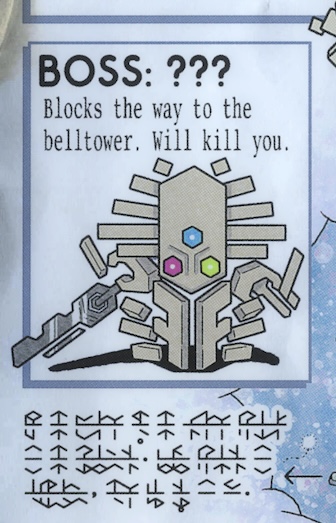
Only 14.52% discovered how to upgrade the hero’s basic stats. 10.43% completed the game’s second major task of the game. There is a 22.84% drop off in players between the first and second task. There’s a pretty clear reason and it's this guy:
](https://img-grouvee-com.b-cdn.net/upload/cache/06/fb/06fb64dd42aca54f12f86932a971614d.jpg)
This is the game’s first unique boss and the sudden jump in difficulty is significant. I’ll point out the note in the game’s manual, which you can see in the image above: "Blocks the way to the belltower, Will kill you." They are not kidding. During your first fight this thing stomps you good. And there’s no going forward without defeating it. You can go back and hunt for any missed upgrade items (there is a good chance most people miss some initially), but if you can’t perfect the timing needed to beat this boss, you’re probably going to initially feel discouraged, and are one of the 22.84% that drop off at this point. And if you are one of the 27.86% that found the sword but never learned how to upgrade your equipment, you’re in even worse trouble.

What does this say about Tunic, a game that I thoroughly adore after completing it twice over the course of a single week? I think anyone’s first impulse is likely to say Tunic is too hard. It’s a fair conclusion to make because the game does see a significant initial drop off. However, let’s establish a few reasons other than difficulty for that drop off. If 83.52% of people stuck with the game long enough to find the stick, 16.48% didn’t. So just a little above 15% of people booted Tunic up and possibly didn’t enjoy the art direction, the controls, or some other non-combat element and quit within the first 3-6 minutes of the game. Given only 42.54% stick around to find the sword, another chunk of people probably come to some conclusion about the art style, movement or general feel of the game and quit before ever finding that sword. And let’s not forget Tunic is part of Game Pass, so there will be a lot of people who drop off between starting the game and finding the sword simply because they only logged in to engage their curiosity about a free game.

However, it’s probably fair to say some people get lost or find combat with the stick too difficult. By the time we get to that good old boss pictured above, it’s probably guaranteed that a bunch of people fall off because of difficulty. As the game goes on, steadily more players drop off and I can only conclude that people are either felled by the increasing difficulty of the bosses, or because they didn’t pick up on the fact that the manual was itself a problem to be solved, leaving them clueless about the game’s many mysteries. The fact that only 15.02% of players discover how to upgrade their stats means that many people don’t figure out the manual, so to speak.

Ay this point, do we conclude that Tunic is too hard? Perhaps. But it’s considerably less difficult than many Soulsborne games, and I’d argue it’s no more mechanically difficult than something like Death’s Door. I think the problem that Tunic presents is one of unfamiliar ambiguity. Many games preen us to expect a guided experience with a certain amount of power fantasy attached. Think Assassin’s Creed games, or any of Sony’s narrative driven games like Horizon Zero Dawn, Marvel’s Spider-Man or God of War. They can be hard if set to a difficulty high enough, but they are largely games with plenty of guidance that turn your starter character into an absolute powerhouse by end game. And then you have Soulsborne games wherein getting better usually means facing a challenge multiple times and improving your approach. Perhaps it means finding items, or devising a build that gives you an edge, but largely it’s about perfecting your personal skills fighting difficult bosses. Maybe it means learning how to dodge, or to parry at the right moment. Maybe it means applying fire to your blade to add DoTs to your attack.

For the most part Tunic adheres to the latter. it’s a game in which a lone enemy can skewer you at the wrong time, or a boss can one shot you if you dodge at the wrong time. But Tunic has simplified upgrade items that can increase your attack, HP, stamina and so on so that you have more of a chance against difficult enemies. If you find those items, it’s a bit like you find yourself halfway between a Soulsborne with multiple important stats to upgrade, and a God of War or HZD wherein you mostly just dump points into all your stats until you are tougher. Thus Tunic offers a slightly less micromanaged upgrade path that almost anyone can wrap their heads around without worrying about things like min-maxing. Lastly, tunic borrows a number of weapon items from a Link to the Past, granting you a decent toolset.
Therefore, you can get increase your chances of winning various fights like you can in a Soulsborne through improving your skills, and you can up your stats like you can in your average action-adventure game, and you get decked out like you can in your average Zelda game, why then do achievement percentages for main game events drop off so drastically with ever new boss you have to fight?

The answer to that is probably Tunic’s best feature: the manual and all it’s secrets. Which may also be its most frustrating feature if you do not enjoy solving cryptic puzzles. Going back to what I said at the beginning of this review, Tunic is a love letter to old NES games and thick manuals. However, that manual is not just an homage to 8-bit nostalgia, it’s a part of Tunic’s world, story and puzzles. To solve some of Tunic’s more difficult problems, you need to be willing to dig into that manual and solve its little riddles. Doing so becomes one of the game’s most satisfying aspects. Failing to can be one of its biggest obstacles.
SPOILER WARNING: from this point on I am going to delve into some spoiler territory. I’ll try to keep it light, and I’ll use tags while trying to keep the content logical for those who don’t want to click into the spoilers

The manual is designed as the first step in mitigating Tunic’s difficulty spikes. One of the things you might notice is that the manual provides a recommended level for attempting the
A second set of tools Tunic provides is something I posted a status update about:
Tunic has accessibility settings like Celeste. Not quite as many but there are two things you can adjust that can help you survive a tough fight:
- Unlimited stamina: toggling this will prevent you hero from running out of stamina, increasing the number of times you can dodge-roll, and thus increasing your supply of I-frames to avoid damage. Turning this on can give you a bit of an additional edge in a fight.
- No fail mode: toggling this turns off damage. It’s full god-mode, and Celeste had a similar toggle. If you simply can’t beat an exceptionally tough boss, or just can’t past a particularly annoying area stacked with enemies,
like the Quarry if you visit it before you’ve upgraded your attack and defence high enough and don’t yet have the gas mask, you can turn this mode on to help you survive so you can continue to enjoy the game. Turn it on temporarily for an assist, or permanently if you just want to enjoy Tunic purely for its exploration and discovery.If you’re having a tough time but enjoy the world of Tunic don’t give up yet, there are options to help see you through.

While Tunic can be tough, it includes measures to ensure that everyone, whether they enjoy tough battles, or just want to play Tunic for its exploration and discovery, can enjoy themselves. Those who are interested in the latter are in for a treat because there are no menu options to simplify Tunic’s various puzzles. You are going to need to sit down and read that manual, pull out a pen and piece of paper, or your phone note app, and start jotting things down. You’re going to need to decipher some of the text and determine what various images in the manual truly mean. If you like that sort of thing, Tunic is going to be glorious, especially if you’d prefer that over the alternative, fighting.
Why?
SPOILER WARNING: Ok, we are stopping here again because I’m about to reveal another spoiler and this is a big one. It might be something that you want to experience for yourself. You might not want this spoiled for you. If you are already intrigued by anything I wrote above, you might want to turn back now and just find out what happens in the last third of the game.
But if you’re still unsure, and you want to know why I think Tunic is 2022’s first brilliant game (Elden Ring folks, don’t @ me), keep reading.

Despite the various boss fights,
But it’s not the only way to go.

However, there is no toggle to help overcome the challenge presented by the manual, the collection of its pages, and its many puzzles. Tunic may give us all a means to withstand its difficult combat, but we are left to solve the problem of the manual on our own. And what if we can’t? What if I can’t reach the glorious moment I reference above when everything in the manual falls into place? Well, that’s when the manual becomes the obstacle that I mentioned a few paragraphs ago. For those who struggle with the puzzle aspect of the manual, it might be the final roadblock that forces them to drop the game. But there is an alternative, if we accept the manual’s final lesson: one person alone may not be able to answer every riddle, and we may have to turn to others for help. That collected minds can solve the riddles presented, through the sharing of assembled knowledge. Tunic almost necessitates a turn to others for the help we need. But what makes this different from any other game with online communities sharing walk-throughs? The answer to that is that the act of building upon existing knowledge through the discovery of new knowledge is a central theme of the game.

Tunic’s brilliance is in its thematic treatment of the manual as a repository of knowledge, something that is both of and external to the world of our Fox hero. The manual is our guide to success, but also the hero’s final weapon, one much stronger than the sword. The act of collecting information and then sharing it becomes the single most important act of the game, and articulates Tunic’s fundamental central tenant, that the sharing of knowledge, knowledge built over time and through concerted effort, is the key to salvation. But more importantly it is through community between players, as mirrored
The manual and its scattered existence signify both existing and yet to be discovered knowledge. Its pages are partially translated but other information still needs to be discovered. The act of discovery in the game mirrors the process of finding and assembling the pages. The act of searching for knowledge among the community mirrors the process of accessing existing translated information in the manual. A parallel exists where what we do in the game mirrors what we do outside of it, all revolving around the discovery and sharing of information. Tunic is itself about how information is most powerful when made whole and shared with each other, and thus why a complete manual is the Fox’s greatest asset.
Tunic is a beautiful game about adventure, adversity, discovery and the power of shared and combined knowledge. It’s about the practices we keep when playing games, the ways we deal with various challenges, and the importance that community has to gamers who rely on each other for the knowledge that is required to overcome gaming challenges. It’s also a meditation on the idea of hero, the endless cycle of the hero’s quest, and what it means to succeed. Do we win because we beat the difficult boss, or do we win because we experience something to it’s fullest? Tunic offers paths to both answers, and clearly has a few things to say about those paths along the way, but ultimately leaves us to decide if winning is the challenges we overcome, or the community we develop.

This game is getting invited to your friend's house for a nice dinner and they don't give you a fork or knife so you eat with your hands. They're like "why aren't you using a fork?" You're like "Oh, because I didn't see any in the drawer" and they say "You didn't see my note in the bathroom cupboard that explains the utensils are in the mouth of the mounted and stuffed bear's mouth on the exterior of the eastern wall? It's the one that was in illegible glyphs!"
Then after dinner, you're playing a card game. You're doing well and having fun despite the obtuse way your friend communicates. Then your friend takes all the cards you were using away. Are you starting a new game? No, your friend gets to keep all their cards. They inform you that actually, you aren't going to get any more cards.
You say goodbye to your friend. As you give your valediction, your friend says "I just want to let you know, I had a bad time. However, I will have a good time if you stick around and solve 40 puzzles from old issues of Highlights Magazine and complete a scavenger …
This game is getting invited to your friend's house for a nice dinner and they don't give you a fork or knife so you eat with your hands. They're like "why aren't you using a fork?" You're like "Oh, because I didn't see any in the drawer" and they say "You didn't see my note in the bathroom cupboard that explains the utensils are in the mouth of the mounted and stuffed bear's mouth on the exterior of the eastern wall? It's the one that was in illegible glyphs!"
Then after dinner, you're playing a card game. You're doing well and having fun despite the obtuse way your friend communicates. Then your friend takes all the cards you were using away. Are you starting a new game? No, your friend gets to keep all their cards. They inform you that actually, you aren't going to get any more cards.
You say goodbye to your friend. As you give your valediction, your friend says "I just want to let you know, I had a bad time. However, I will have a good time if you stick around and solve 40 puzzles from old issues of Highlights Magazine and complete a scavenger hunt around my house. Don't worry, I have more chowderheaded memos!"
This was not for me. So many of the puzzles are what I would consider busywork. Being forced to either decode a language or disregard much of what is being communicated is not more desirable for me than having environmental and interpersonal storytelling. That being said, I do like the story.* However, I didn't even bother playing through the end of this game and after getting to the
*I also liked the music. I liked the art style, but sometimes it could be oversaturated. The themes are interesting, and it would make for a compelling critique of Zelda if the mechanics didn't make me think "I wish this was Zelda instead".
**The Youtube video I watched started by saying "Tunic is a game with deep lore like Dark Souls or Five Nights at Freddy's", and I haven't stopped laughing since then.
Aww how adorable~ I sure do wish this isn't a dark souls type game disguised in a cute visage that willingly saps my sanity each and every time I go against the bosses. That'd be crazy~
I played through Tunic a while back and I was absolutely amazed by all the things the game did. There's so much care put into every puzzle, that this is without a doubt the smartest game i've played. It masterfully changed how the game worked not once, but twice, and it somehow managed to make the game feel cohesive after that. It was definitely not what I expected, but I loved it nonetheless.
Before I start this review, I wanna say that this game is probably not for everyone. It's not a cute adventure game about a funny fox, but rather one gigantic, genius puzzle that you're trying to solve while playing. I've seen a lot of people not like Tunic because it turned out to be something completely different to what it presents itself as. Personally I absolutely loved it, but if you're not into it I fully understand.

If you've ever played a game that wasn't available in a language you speak, then you'll be familiar with the feeling Tunic tries to create. There are close to zero words you can actually understand in the game. And yet, even when you don't know what anybody is saying, …
I played through Tunic a while back and I was absolutely amazed by all the things the game did. There's so much care put into every puzzle, that this is without a doubt the smartest game i've played. It masterfully changed how the game worked not once, but twice, and it somehow managed to make the game feel cohesive after that. It was definitely not what I expected, but I loved it nonetheless.
Before I start this review, I wanna say that this game is probably not for everyone. It's not a cute adventure game about a funny fox, but rather one gigantic, genius puzzle that you're trying to solve while playing. I've seen a lot of people not like Tunic because it turned out to be something completely different to what it presents itself as. Personally I absolutely loved it, but if you're not into it I fully understand.

If you've ever played a game that wasn't available in a language you speak, then you'll be familiar with the feeling Tunic tries to create. There are close to zero words you can actually understand in the game. And yet, even when you don't know what anybody is saying, the game manages to form a cool story that you can get even if you don't want to spend hours translating every single line of text, just by looking at the visuals of the game and the few words that are actually in english. Sure, you may not understand everything that's happening, but you still kinda know what the story is about.
The best part about this, though, is how the game integrates this whole feeling of not knowing what's happening into the story itself. The Ruin Seeker, your character, is an outsider. They are just as clueless as to how this new world functions as you are. They don't know why they're going forward, they just are. It's only through exploration and analysis of the manual that the Ruin Seeker is able to fully understand what the real problem is, sharing their knowledge and saving the day. It's absolutely genius.

At first glance Tunic may look like a Zelda game, but it's actually more of a souls-like with an overhead camera, and then you get to the end and it turns out that it's actually a puzzle game, like FEZ. The game keeps surprising the player at every turn and yet none of these changes feel bad or forced.
The main gimmick of Tunic is that the game, unlike most modern releases, has an instruction manual (which also functions as a kind of walkthrough). It's not a physical book you can read, or a pdf included in the files, but rather a part of the game that you can find in the menu. This manual is incomplete at first, with the pages scattered around the world serving as the main collectibles for the game. But it doesn't matter if you get all the pages because, just as I mentioned before, everything in this game is made in a language you can't understand. It's up to a few numbers, some english words, and a whole lot of diagrams and drawings to convey all the information in the game. Yet somehow the developer managed to do this seemingly impossible task. Of course you can't read the page with an in-depth explanation on where to go and how to start, but you can read the word West and that might just be enough to get you through the game.
As for the gameplay, it's like if Dark Souls played more like one of the 2D Zelda games. Battles are intense, fast-paced, and require you to think a lot about how you should approach these enemies, especially the bosses. It's not perfect by any means, the range of your sword makes your character feel super clunky against a lot of enemies, some bosses have really janky hitboxes, and there are a few button combinations that might activate some moves you didn't want to use at that moment. It might not be the most precise, but when it works it works (Spoiler: it totally works during the final boss)

Presentation-wise the game is beautiful. The cute 3D artstyle is amazing, and the soundtrack complements the game really well too. However I think the best part about this all is how detailed the world is. There are so many breathtaking views in the game. It goes from gigantic structures showing in the background, to closed spaces filled with books and drawings. A huge range of unique and different places in the world, and all of these have so much love and care put into them, it's unreal.
Once you reach the end, and if you want to get the true ending, you're faced with solving the ultimate puzzle: The golden path. I think this is an amazing part of the game, it literally makes you go through every single part of the game, thinking outside the box all in an attempt to solve it. It's an incredible ending to the story, and while I didn't have the patience to fully solve it, every other puzzle in this game still amazing so I don't think I missed much. I personally don't like that the only way to solve it is by painfully translating the entire manual though, but there are translations available online so it's ok I guess.
In conclusion: I absolutely loved this game, both in concept and in execution. It's probably one of the hardest games i've played, not because it requires too much skill, but because every puzzle is masterfully crafted and requires you to think a lot. This is the smartest game i've ever played, and I really wish i could talk about the puzzles in this game but I don't want to spoil them. If you're interested, please do yourself a favor and buy the game. 10/10

Nah fuck it I have to gush about this game.
There's nothing I can add to what great writers (including our own @BMO) have written about this game and how it takes us back to other times of gaming, when reading the manuals, taking notes and even looking at the save file of a previous owner of a cartridge was part of the experience, so I won't even try.
After A LOT (and I mean A LOT) of attempts, I was finally able to defeat the final boss and "finished" the game. But I knew there's more to it. I was still missing two pages of the manual. So I put myself to the task. I'd already found a few fairies and a couple of secret treasures, I was in the right path...

But I quickly felt overwhelmed. There were fairy puzzles that I simply cannot begin to understand and I hit a wall just starting with the translation of the language. I also didn't wanted to go looking for answers on the internet because... welll. They're already there. I missed the community experience of solving it together.
I like this kind of experiences, but... I kinda wanna go for something different right now.
Keep your secrets, …
There's nothing I can add to what great writers (including our own @BMO) have written about this game and how it takes us back to other times of gaming, when reading the manuals, taking notes and even looking at the save file of a previous owner of a cartridge was part of the experience, so I won't even try.
After A LOT (and I mean A LOT) of attempts, I was finally able to defeat the final boss and "finished" the game. But I knew there's more to it. I was still missing two pages of the manual. So I put myself to the task. I'd already found a few fairies and a couple of secret treasures, I was in the right path...

But I quickly felt overwhelmed. There were fairy puzzles that I simply cannot begin to understand and I hit a wall just starting with the translation of the language. I also didn't wanted to go looking for answers on the internet because... welll. They're already there. I missed the community experience of solving it together.
I like this kind of experiences, but... I kinda wanna go for something different right now.
Keep your secrets, golden path. Maybe the next playthrough.
For the majority of this game, Tunic seemed to me like a much better version of Link to the Past. The secrets were tough, but interesting and completely solvable with the help of the in-game manual pages. The boss battles were difficult, but fair.
But in the final 5% of the game, it all fell apart.
Much of the game is filled with fun moments where you realize that there are things you could've done & places you could've gone from the beginning; but they were cleverly hidden. Eventually, it becomes a requirement to find these secrets to progress in the main story -- and many of the hidden passageways seem created simply to troll the player.
The
For the majority of this game, Tunic seemed to me like a much better version of Link to the Past. The secrets were tough, but interesting and completely solvable with the help of the in-game manual pages. The boss battles were difficult, but fair.
But in the final 5% of the game, it all fell apart.
Much of the game is filled with fun moments where you realize that there are things you could've done & places you could've gone from the beginning; but they were cleverly hidden. Eventually, it becomes a requirement to find these secrets to progress in the main story -- and many of the hidden passageways seem created simply to troll the player.
The
And then there's the the Mountain Door.....

Eventually I just gave up on the late-game puzzles and looked up enough solutions in walkthroughs to the meet the minimum requirements I needed for the "good" ending.
The final boss was obnoxiously difficult, to the point where winning felt like it would simply be based on pure luck after dozens of attempts -- especially
Overall, a great game, spoiled by an obnoxious conclusion.
Tunic is a gem of a game that draws inspiration from a number of classic adventure games-- most notably the 2D entries in the Legend of Zelda series. Something about the game's presentation and soundtrack gives me strong Fez vibes as well. You can expect a lack of direction similar to the games which inspired it too, which is what I think makes the first half of this game so stellar.
This game is filled to the brim with secrets, neat powerups, and puzzles. I was constantly delighted to find myself rewarded for totally scouring each area. Had I been told where to go and how to get there outright I'm sure I would have missed out on a lot of the secrets this game has to offer in my hurry to get to the next major zone. But that's not to say the game gives you no direction at all.
One of Tunic's highlights is the implementation of a digital in-game manual which you discover new pages for throughout the game. The manual is mostly written in an unfamiliar language created for the game (save for some small bits of English text) but if you keep a sharp …
Tunic is a gem of a game that draws inspiration from a number of classic adventure games-- most notably the 2D entries in the Legend of Zelda series. Something about the game's presentation and soundtrack gives me strong Fez vibes as well. You can expect a lack of direction similar to the games which inspired it too, which is what I think makes the first half of this game so stellar.
This game is filled to the brim with secrets, neat powerups, and puzzles. I was constantly delighted to find myself rewarded for totally scouring each area. Had I been told where to go and how to get there outright I'm sure I would have missed out on a lot of the secrets this game has to offer in my hurry to get to the next major zone. But that's not to say the game gives you no direction at all.
One of Tunic's highlights is the implementation of a digital in-game manual which you discover new pages for throughout the game. The manual is mostly written in an unfamiliar language created for the game (save for some small bits of English text) but if you keep a sharp eye out while poring over it you'll be able to use what's there to more thoroughly explore areas and discover mechanics you never knew you had all along. It's a very clever way to drip feed the player information that also functions as a cute callback to the days when games came with their own manuals-- something which unfortunately has been mostly phased out with the more digital-centric era of gaming. Tunic does a stellar job of capturing these manuals of old at their peak, with the little booklet adding important context to the game world's lore and brimming with little hints and secrets you'd miss out on if you never opened it. The manual is also really neat because after your initial playthrough you can jump back into New Game and approach the game in a totally different way with the information you now have.
Also, much like the games which inspired Tunic, this game has no qualms about kicking your ass. The opening segment in particular can be particularly brutal if, like me, you manage to miss grabbing one of the most important items in the game until you're further in. While I appreciate the flexibility of the game-- that you can make your way through while also missing out on some major items-- I was less appreciative of some other aspects of the difficulty.
The combat is basically a more mechanically demanding version of the combat in the 2D Zelda games. For me, this was kind of a negative. While it's nice because it makes the combat system relatively simple, when you reach the back half of the game, Tunic becomes less exploration heavy for a bit and instead asks that you fight your way through a number of particularly difficult boss battles and enemy encounters. I just found myself frustrated with many of these. I found the combat to be "good enough" during my playthrough so when the game started demanding more and more from me late in the game (as it should, to be fair) I just felt annoyed. Many of the later boss encounters feel like they want to be Souls game bosses, relying on tight dodge timing and utilizing small windows of downtime to heal/attack, but the combat mechanics just didn't seem to mesh well with that desired level of precision. There were two particular encounters in the game where I eventually threw my hands up and turned on "No Fail Mode" in the accessibility settings so I could get back to the exploration I enjoyed quickly.
Big shoutout to the devs for including a bunch of nice accessibility settings for those who need them and not gating achievements behind avoiding them though! The inclusion of these settings goes a long way to making sure anyone can enjoy this game even if they aren't so good at the combat, which is fantastic.
Thankfully once you make it through this combat-heavy portion of the game it falls back to being more puzzle-focused for its remaining playtime. I didn't expect to 100% this game, but I was having too much fun to stop after hitting the credits for the first time. There are few moments I've found quite as satisfying as finally piecing together how to read the manual and tackling the game's final major puzzle.
Despite some missteps in the combat, Tunic is a fantastic adventure exploration game that has a deep respect for its own roots. It's probably not a good starting point for someone new to gaming but it is an easy recommendation for any experienced fan of the genre.
Tunic is a wonderful game. I was drawn to it because it apparently looked like a Zelda game. I just finished a Zelda marathon and was craving for more Zelda.
I was blown away. This isn't so much a Zelda game as much as it is a Soulslike with a ton of puzzle solving. It is a fantastic game with much rewarding for explorations and figuring out the puzzles. The story is excellent. The pacing wasn't even off by the slightest. Clever use of every detail in the game.
The only criticism I can give is the fact that I Feel some puzzles were extremely cryptic and I unfortunately couldn't solve them on my own.
I managed to get both endings in the game, and it left me extremely satisfied and happy. I can't recommend it enough. An easy 5-star rating for this one.
What a great game, some of the best game design I’ve ever seen, with an absolutely phenomenal central conceit that I won’t spoil here. The less you know the better your experience.
If you enjoy Zelda and puzzle solving, do yourself a favor and play this game.
Amazing game, really!
Felt like a mix of an old Zelda game and Dark Souls. Love how the manual works, the combat, the puzzles, the soundtrack, like really, this game is severely underrated and more people should play it.
That being said, it's an one time experience only, new game + is cool but does not add anything other than difficulty when you reach the 2 part of the game.
Still, great game, I felt like a child again playing this, a feeling that most games won't give you nowadays.
Tunic is a game I was really excited for when it first got announced. When I played Death's Door last year, that excitement tempered a bit as I assumed they were similar games, and while Death's Door had it's enjoyable moments it just largely wasn't for me. So I was holding off on Tunic for a big price cut, but after recently acquiring an Xbox Series S with Game Pass I decided to give it a shot. Folks, I was a FOOL to wait as long as I did.
While Tunic does share DNA with Death's Door (which I'll stop talking about in a second), with it's cute animal protagonist and isometric top down view, the two games stop sharing similarities around there. Tunic is a game that just feels COOL to play. When a lot of big games today spoon-feed you everything you need to know (and don't get me wrong those are some of my favorite games), Tunic is a really nice change of pace where not only do you know nothing, but knowing nothing IS the game. The way it lays out secrets, exploration, and discovery is so clever that even when it takes you longer than …
Tunic is a game I was really excited for when it first got announced. When I played Death's Door last year, that excitement tempered a bit as I assumed they were similar games, and while Death's Door had it's enjoyable moments it just largely wasn't for me. So I was holding off on Tunic for a big price cut, but after recently acquiring an Xbox Series S with Game Pass I decided to give it a shot. Folks, I was a FOOL to wait as long as I did.
While Tunic does share DNA with Death's Door (which I'll stop talking about in a second), with it's cute animal protagonist and isometric top down view, the two games stop sharing similarities around there. Tunic is a game that just feels COOL to play. When a lot of big games today spoon-feed you everything you need to know (and don't get me wrong those are some of my favorite games), Tunic is a really nice change of pace where not only do you know nothing, but knowing nothing IS the game. The way it lays out secrets, exploration, and discovery is so clever that even when it takes you longer than you'd like to figure out your next move, you find it hard to be frustrated because you're simply too delighted with the solution.
Quick word on the art style, it is GORGEOUS. Trailer footage doesn't do it justice, interacting with the toy-box-y world illuminates so many incredible details. The way actual mechanical gear mechanisms are used to activate shortcuts makes me way happier than it should. And it's an environment that seems impossible to find secrets in at first, but the world teaches you how to read it (kind of like Celeste does) and you can FEEL progress in understanding. Also the soundtrack is lovely. The whole game is lovely. I'm guessing I have more to uncover in this world, and I'm excited to jump back in.
I'd recommend this to anyone. To everyone. Incredible game.
This game is gorgeous. Visually (and to a lesser degree aurally), it is a work of art. And I appreciate, too, the attention to detail, especially with the manual pages, as well as how much of this treads a line between adventure game and a world that needs puzzling out.
Too bad navigating said world is laborious and rather dull.
I made it... maybe four or five hours into Tunic before putting down the controller. Not for frustration or difficulty or anything like that. It just... never managed to grab me. At all. I managed to translate a fair bit, but unlike Fez, say, or the Witness, where there was excitement in figuring out the world, here it just felt like homework. No doubt this is accentuated by combat/exploration issues. In short, the combat is boring as hell, and I do not really care for how it controls.
I wanted to love this, I really did. I crave a good Zelda-like, and the praise this has received is thunderous. But in the end, it gets marks for design and effort, and that's it for me. The charm wasn't enough to carry me through, and the puzzle/translation work wasn't enough for …
This game is gorgeous. Visually (and to a lesser degree aurally), it is a work of art. And I appreciate, too, the attention to detail, especially with the manual pages, as well as how much of this treads a line between adventure game and a world that needs puzzling out.
Too bad navigating said world is laborious and rather dull.
I made it... maybe four or five hours into Tunic before putting down the controller. Not for frustration or difficulty or anything like that. It just... never managed to grab me. At all. I managed to translate a fair bit, but unlike Fez, say, or the Witness, where there was excitement in figuring out the world, here it just felt like homework. No doubt this is accentuated by combat/exploration issues. In short, the combat is boring as hell, and I do not really care for how it controls.
I wanted to love this, I really did. I crave a good Zelda-like, and the praise this has received is thunderous. But in the end, it gets marks for design and effort, and that's it for me. The charm wasn't enough to carry me through, and the puzzle/translation work wasn't enough for me to get past the subpar movement and combat. A beautiful and ambitious disappointment.
If you're looking for a game to painfully master and turn over every stone chasing obscure hints for unsatisfying secrets, this is the game for you. If you're not that very specific kind of person, I suggest passing on this frustrating experience.
The combat difficulty is extremely high, even when you turn on reduced damage mode, in large part because the controls just aren't very good compared to games that make similar skill demands of you like Hollow Knight. Dying in Tunic seldom feels fair, and if you dare use your consumables in an effort to survive but still die, guess what, those consumables are still gone, rendering your next attempt even harder. Don't worry though, you can grind out killing another 30 enemies to accrue enough gold to buy three bombs.
The main puzzles for the game are solvable, but anything beyond that is so obscurely hinted at that you need to be completely immersed in this experience and devote tons of time in it to get anywhere.
Don't get me wrong, it's a beautiful game visually, and has a ton of really clever mechanics packed into it. It just presents itself aesthetically as an intermediate challenge, and then …
If you're looking for a game to painfully master and turn over every stone chasing obscure hints for unsatisfying secrets, this is the game for you. If you're not that very specific kind of person, I suggest passing on this frustrating experience.
The combat difficulty is extremely high, even when you turn on reduced damage mode, in large part because the controls just aren't very good compared to games that make similar skill demands of you like Hollow Knight. Dying in Tunic seldom feels fair, and if you dare use your consumables in an effort to survive but still die, guess what, those consumables are still gone, rendering your next attempt even harder. Don't worry though, you can grind out killing another 30 enemies to accrue enough gold to buy three bombs.
The main puzzles for the game are solvable, but anything beyond that is so obscurely hinted at that you need to be completely immersed in this experience and devote tons of time in it to get anywhere.
Don't get me wrong, it's a beautiful game visually, and has a ton of really clever mechanics packed into it. It just presents itself aesthetically as an intermediate challenge, and then blindsides you as the most unforgiving game I've played in the last decade.
Death's Door is a similar game but without any of these painful excesses. Go play that instead.
I've read that this game is similar to old-school Zelda and I can't say that I agree since I never played Zelda despite my relatively old age. Nevertheless, I think the comparison is justified given how freakin' awesome this game is. I never had that passion for 100%-ing a game as much as this one.
World-building is great. Combat is supreme but what I like most about this is that the difficulty's just right. It's dark-souls-y but it's not dark. And the progression and is what kept me going. The puzzles were just divine.
GIVE THIS GAME A TRY.
I think many would argue this is a perfect game. It is so original in its sense of discovery and exploration, leaving a ton of room for the player to truly craft their own adventure. It is very unique in its presentation, structure, and atmosphere. It has some excellent a-ha moments of victory.
But personally, I have a limit with cryptic puzzles. I won’t touch La-Mulana with a stick, and Fez really burnt me out. This one is full of extremely cryptic puzzles (albeit optional) that really discouraged me from getting the 100%.
I got it anyways, using mapgenie, and I still think it’s nearly impossible to solve without community support. The mainline puzzles are totally doable though, but they will challenge you.
But besides that criticism (and I’m sure others would love that aspect), I really enjoyed it. Loved the variety of locations and overall level design. Many of the secrets are a blast to discover. The combat was a little basic and I could’ve gone for some more unique abilities, but the game as a whole is pretty remarkable.
Definitely recommend for Zelda fans and Metroidvania fans alike (and yes I would consider this an isometric Metroidvania - …
I think many would argue this is a perfect game. It is so original in its sense of discovery and exploration, leaving a ton of room for the player to truly craft their own adventure. It is very unique in its presentation, structure, and atmosphere. It has some excellent a-ha moments of victory.
But personally, I have a limit with cryptic puzzles. I won’t touch La-Mulana with a stick, and Fez really burnt me out. This one is full of extremely cryptic puzzles (albeit optional) that really discouraged me from getting the 100%.
I got it anyways, using mapgenie, and I still think it’s nearly impossible to solve without community support. The mainline puzzles are totally doable though, but they will challenge you.
But besides that criticism (and I’m sure others would love that aspect), I really enjoyed it. Loved the variety of locations and overall level design. Many of the secrets are a blast to discover. The combat was a little basic and I could’ve gone for some more unique abilities, but the game as a whole is pretty remarkable.
Definitely recommend for Zelda fans and Metroidvania fans alike (and yes I would consider this an isometric Metroidvania - sub genres exist for a reason!)
I meant to post this when the campaign launched, but if anyone want some great games, including Tunic, and wants to financially assist with wildfire support, check out the California Fire Relief Bundle on itch.io.
I woulda liked this game more if Cranky Kong harassed me through the instruction manual
This game is so good. The mechanic of the game manual pages you pick up is so cool and the art on them is phenomenal. The moments of discovery keep coming at a steady rate and all the items and tools are all so useful. This makes thoroughly searching the world for chests very worth it as nothing feels like a waste of time to have found.
OK. Now I'm absolutely positive I'm against the final boss of the game. The ending is just about the corner!
(dies a thousand times and quits in frustration).
The
Nope.
(My hands really hurt now).
I considered dropping this several times during my playthrough, but I'm glad I didn't. That last boss fight was satisfying to beat, even tho it might be a bit too hard IMO and a sure skill wall for most players, I wonder how many actually finished the game. And, while the book mechanic never successfully hooked me the same way other people were, that last investigation to unlock the alternate path was pretty rewarding. I didn't like it the same way many others do, but I still think it's pretty good.
Follow-up to my previous status update complaining about The Quarry:
So I guess I'm just dumb and didn't realize I already had the solution to the eye-destroying purple haze. I feel a little stupid cause it was technically there in the manual the whole time but they really could have made it more clear that the little token things in the inventory
Still having a blast with this game after getting back to it but holy fuck my eyes are suffering after going through The Quarry. That visual effect the purple corruption stuff causes is absurdly painful to look at.
After searching for around 3 hours I FINALLY found the key to the Old House. I must have walked past it like ten times and cleared multiple areas meant for after you get it before I finally spotted it. So now I feel stupid but at least I have a
I picked this up during the steam sale and fired it up today on my steam deck since it seemed like a good fit for handheld play. I probably had a stupid grin on my face the entire time I was playing, because this game is hitting my love of exploration just right. It gives off Fez vibes while playing like a Souls like which is a mix I never knew I wanted.
I'm so excited to get back to this later but for now, it's dinnertime.
Ok, I no longer hate this game.
I like challenging games but I hate being punished with backtracking\having to repeat some routine after I die.
I found the path from the save point to the spear wielding enemy that stands on top of a key to be a frustrating chore and disrespectful of my time, since that enemy 2-shots you unless you've got
So I decided to refund.
Unfortunately, I bought this game more than 2 weeks ago and steam refused the refund.
Fortunately, I gave it another go and accidentally
I didn't even understand how it happened at first, I thought that all of the enemies that I leashed into the area overwhelmed the shield with shots or attacks, but that didn't reproduce when I tried. But after a while I understood what's up. Fancy gimmick but boy was I lucky to find it. Killing that enemy without this trick would've been a repetitive chore or "attack-roll-attack-roll".
In any case, now I found the best item ever:
Beat the Siege Engine in the Eastern Vault. Starting to really understand this game.
So far this game reminds me a lot of Hyper Light Drifter, for better or for worse.