

Review ailoutwar 5/5 · Mar 25, 2016
Entry Point into Strategy Games
I was 12 years old, had tired of the Super Mario fare, and was ready to sink my teeth into a little something better. On a lark I rented this strategy game, seeing the pictures and thinking like Top Gun on NES I would be flying and bombing stuff, only better.
You can't imagine my initial disappointment with the slow-moving …
I was 12 years old, had tired of the Super Mario fare, and was ready to sink my teeth into a little something better. On a lark I rented this strategy game, seeing the pictures and thinking like Top Gun on NES I would be flying and bombing stuff, only better.
You can't imagine my initial disappointment with the slow-moving war strategy simulation. But over time, after I bought the game and really got immersed, it was the first game to really demand and eat up hours of my time. I would have 12 fleets - battleships, carriers, subs - all fighting the Japanese all over the Pacific. My mother would come in, see me watching an AI battle between my fleet and the Japanese, and complain to my dad that I was in there watching the game play itself. 
Koei really broke through the windows for me, making games not just about run/jump/race, single-night events, but about long-term planning and building and strategy. PTO is the game that changed my life. 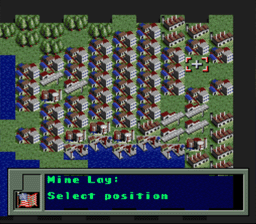
In PTO, you take the role of either the US or Japan. No other countries to play - they can ally with you, even send in some ships to help your fleets - but they stay out of the way. Much of the WWII genre is plugged up with landing at Normandy, and infantry/tank battles across the dry land of Europe. Not so with PTO - it's naval warfare, all the time, and tanks can suck it.
You are put in command of all naval fleets - from the carrier Enterprise and dreadnought battleship Yamato, all the way to the lowliest destroyer. You must create fleets, up to 16 ships in each, and strategically use them - defend bases, attack and occupy enemy bases, meet the enemy at sea, or sink them from underneath using submarines.
But it doesn't end there. You have to occupy bases with troops, and also supply fuel, planes, and building materials so they can repel enemy attacks. Ships get damaged and need repairs - some are minor and can be fixed at a few ports, but severe ones will have to be sent home to drydock. Ships that get sunk can be rebuilt in the shipyards, under a new name or class, in 6 to 24 months - the faster you build them, the more resources it takes.
Industry is a big piece of this game - Japans starts out weak industrially, but they have TONS of ships and bases. The US has relatively small forces - some scenarios have them starting with very few remaining ships - but are an industrial behemoth. The US can snap its fingers and produce hundreds of bombers - but without good supply lanes, they can't go anywhere. 
Allies are important - as the US, some of your ships come from Australia, Great Britain, etc. You can request adi from allies, or give gifts, or even get neutral countries to join like Sweden, to increase your Intel levels. One of the most memorable games ever is getting everyone to ally with Japan.
PTO takes this warfare and occupation piece, and puts it together with an industrial engine, espionage, base management, political alliances, scientific research, and even a human commander element. Then there's individual crew experience, fatigue, a ship's raw Luck score - even the chance of plague or disease from shore leave in the pacific south. The result is a hugely engrossing game that can span years. 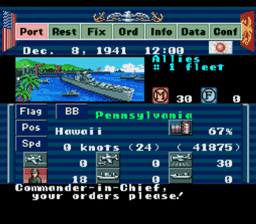
There are significant flaws to this game, as to be expected from a huge strategy sim from the early 90s. Here is a brief run down:
- Long, long battles. With 16 ships on both sides, and any number of air units or base units, battles that are 12 turns by default can last FOREVER. There's an option to have the AI take over, but it makes poor decisions, and you can't exit or auto-complete. You're stuck watching the action, even if its just moves.
- Three-target system for goals every time you arrive at home port can get old
- Commanders aren't real names (MacArthur, Yamamoto, etc) - just created ones
- Game can be taken advantage of by imposing military rule at bases, then gifting back some of the seized goods to increase loyalty (can be done infinitely)
- No specific aircraft types or ratings - just general classes (fighter, bomber, long-range bomber)
A few years later, PTO II came out, but the system had changed from a single turn system, to a dual turn system - one for PLANNING and one for ACTION. There was a ton more detail in ships, real-life commanders and plane models, and even land battles and routes - but it made it impossible to play, for me anyway.
The Final Score:
As close to timeless as a strategy game can get. Sure, the graphics are poor in today's world, but ~24 years after it's release, I could still spend hours upon hours plotting and planning. So much depth - from politics and alliances, to research, to occupation, to sea battles, air battles, land battles...ship details, commanders, strategic goals, industry, and on and on. The AI limitations/exploits and simple pick-three-targets system can get old, and battles can take three FOREVERS due to all the units and CPU limitations - but for some reason this one will be timeless in my eyes.