Kingdom Hearts Re:Chain of Memories, the 3D remake for PS2 of the GBA title Chain of Memories, is a strange, disjointed, complex beast. It continues the story of Sora directly from where the first game left off, but with even more bizarre characters and plotlines, while introducing a new combat system that is cumbersome and unbalanced.
The story starts with Sora, Donald and Goofy chasing Pluto for some news on the whereabouts of Mickey and Riku. Eventually, they end up finding a strange castle called Oblivion, where they start to gradually lose their memories as they climb the place in search of their friends.
Chain of Memories’ narrative continues to explore the themes of the first game, but looking at them from a new angle. Kingdom Hearts’ universe, for example, seems to be built on the ambivalence of its most important elements, and here it is no different. When he first enters Castle Oblivion, Sora is told that “To find is to lose, and to lose is to find”, a warning that comes full circle during the climax, when the boy must make a difficult decision. Sora’s journey has him clinging to his most beloved memories in hope that they do not fade away with the rest. Being Sora, though, he never backs away and stops his search for Riku, even knowing that he is risking not only his life, but also his memories – and with them, his personality – in the process.
In a climactic scene in the first Kingdom Hearts, Sora claims that his friends are his power, but here he begins to understand that this power exists only because of his memories. Without remembering his friends, he has nothing. That is why they boldly claim that “No matter what happens, you won’t forget your friends.” Sora, Donald and Goofy have to believe that everything is going to be okay. They are helplessly optimistic.
However, as they rapidly discover, things are not that simple. Friendships, even the ones that seemed that they would last forever, can one day fade away, forgotten. Sora learns that the hard way, forgetting not only the places he has visited, but even his most beloved friend, Kairi. In return, he begins to remember a girl he met in his childhood and who suddenly vanished one day. A girl he made a promise to, but one who he couldn’t remember before coming to Castle Oblivion. The mystery surround her quickly grows and becomes the protagonist’s obsession.
Sora believes he must find this girl no matter what, knowing deep down that his purpose in life is related to her. That makes him so certain of his righteousness that he inevitably becomes unbearable. His struggles in Castle Oblivion show that a little bit of doubt can go a long way in protecting your inner self. After all, it is precisely because Sora is so certain that he must chase that mysterious girl, shackled by his memories of her, that is easy for malicious forces to manipulate and use him.
The game’s antagonists, certain members of a sinister organization, intend to make Sora their personal pawn to overthrow their leader. Unfortunately, this is the part where the narrative falters, since the Organization XIII, as it is called, is not fleshed out in any way, being surrounded, instead, by questions and mysteries. That is a big problem because it makes their plan – the coup – devoid of any sense of urgency. The player doesn’t know what exactly they’re fighting for, what it’s at stake, why they are planning to take control of the organization, and even if that is a good thing or not.
And if the narrative of the previous game also faltered when it came to the Disney worlds, Chain of Memories makes no efforts to correct that mistake. As in the first Kingdom Hearts, the plot that takes place in each world that Sora visits has no impact whatsoever in his journey. To make matter worse, here he revisits almost all of the worlds of the first game – almost all, because Tarzan’s is absent – meeting their inhabitants as if it was the first time, since they don’t remember ever meeting Sora. These worlds are illusions created inside the castle with Sora’s memories, so their events are slightly different retellings of what happened in the first game. The main difference being the word heart being replaced by the word memory. In Halloween Town, for example, instead of Oogie stealing a fake heart, he steals a memory potion. It’s all useless and repetitive.
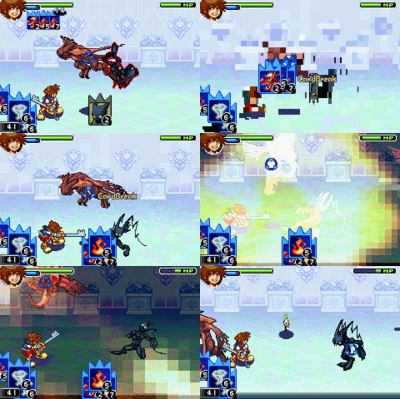
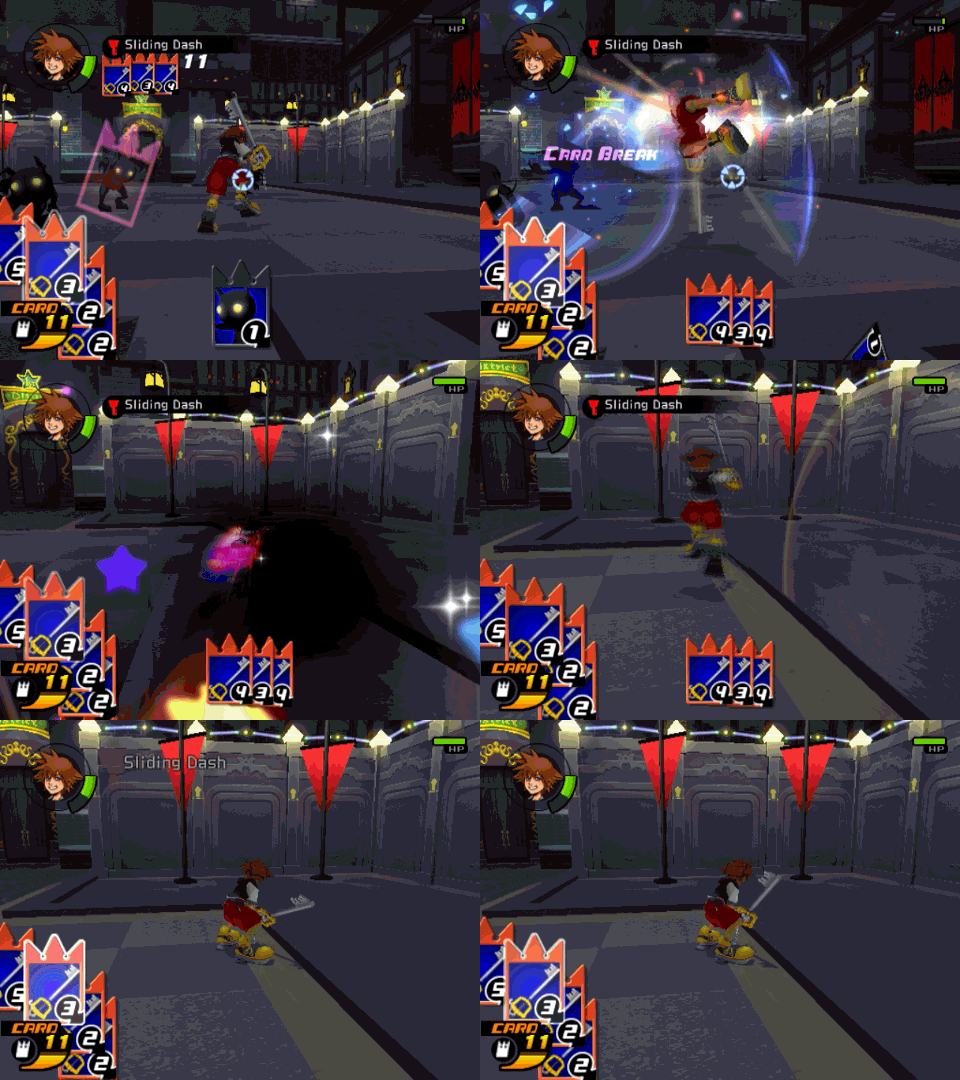
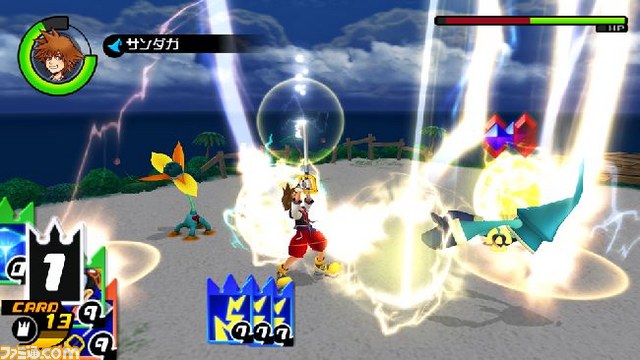

Chain of Memories’s gameplay, on the opposite end, is completely different. The game is all structured around cards: they are used in battle and in exploration. Now you don’t fight monsters directly on the map anymore, but is transported to a battle arena. There, the combat happens in real time, and to attack or use magic or even an item you have to select and use the appropriate card. Each one of these cards has a number, which is compared to the card that one of the monsters is using. The biggest card wins and breaks the other attack. To complicate things, the Zero card can break any other if used after them or be broke by any other if used first, and you can stack three cards in a combo to add their numbers and maybe trigger special attacks, called sleights, if the right combination is selected. The excellent endgame theme has a name that symbolizes everything that this system is not: “Simple and Clean”.
---> Join the discussion and read the full review at: http://litonthespot.com/kingdom-hearts-rechain-of-memories/games/review