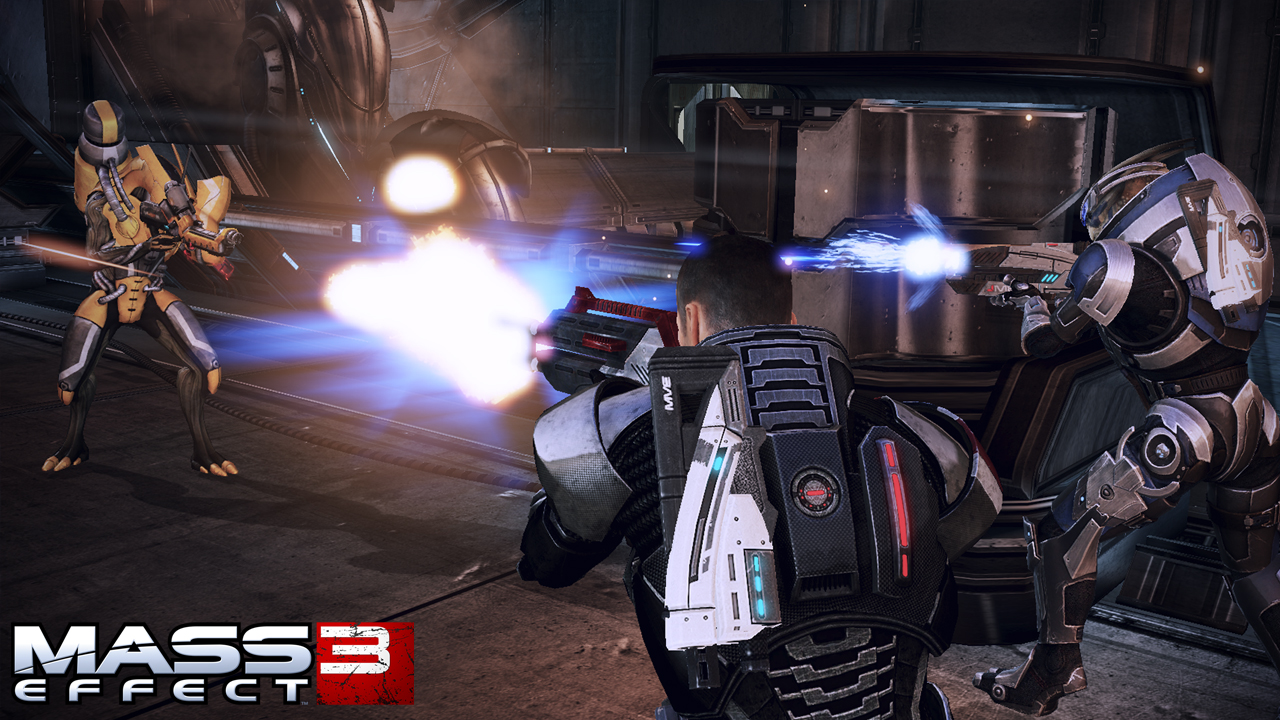
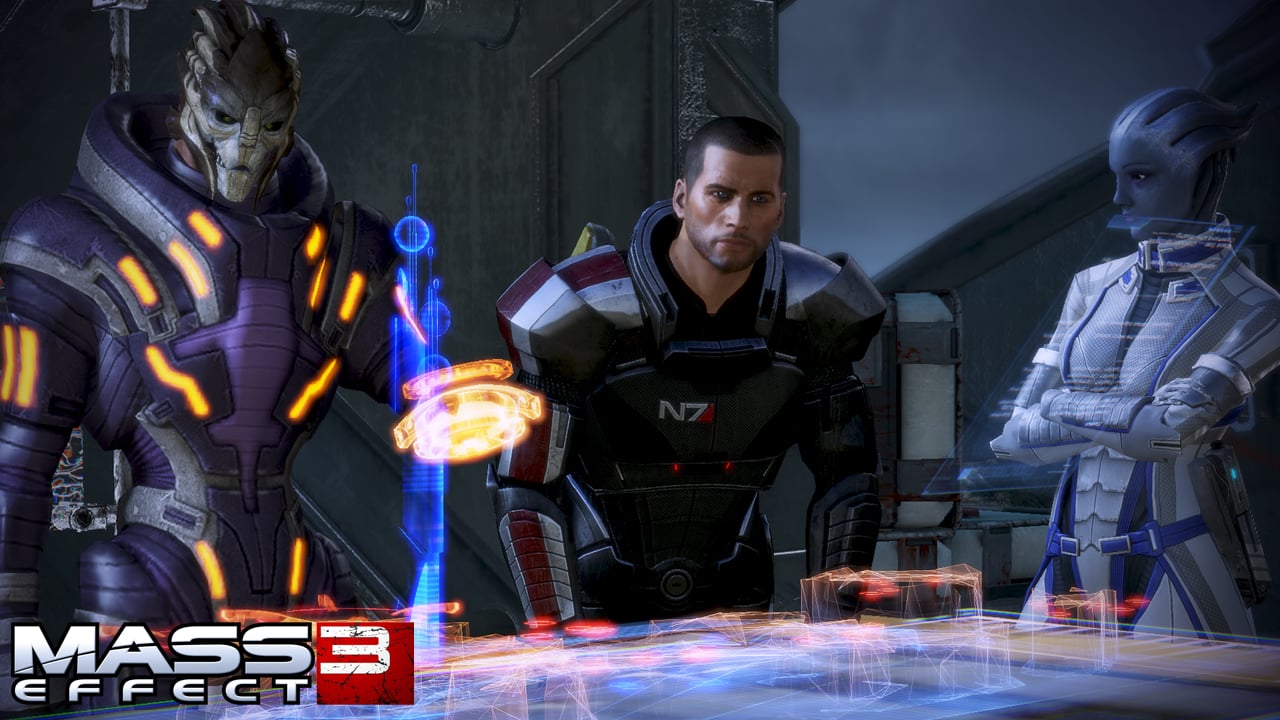
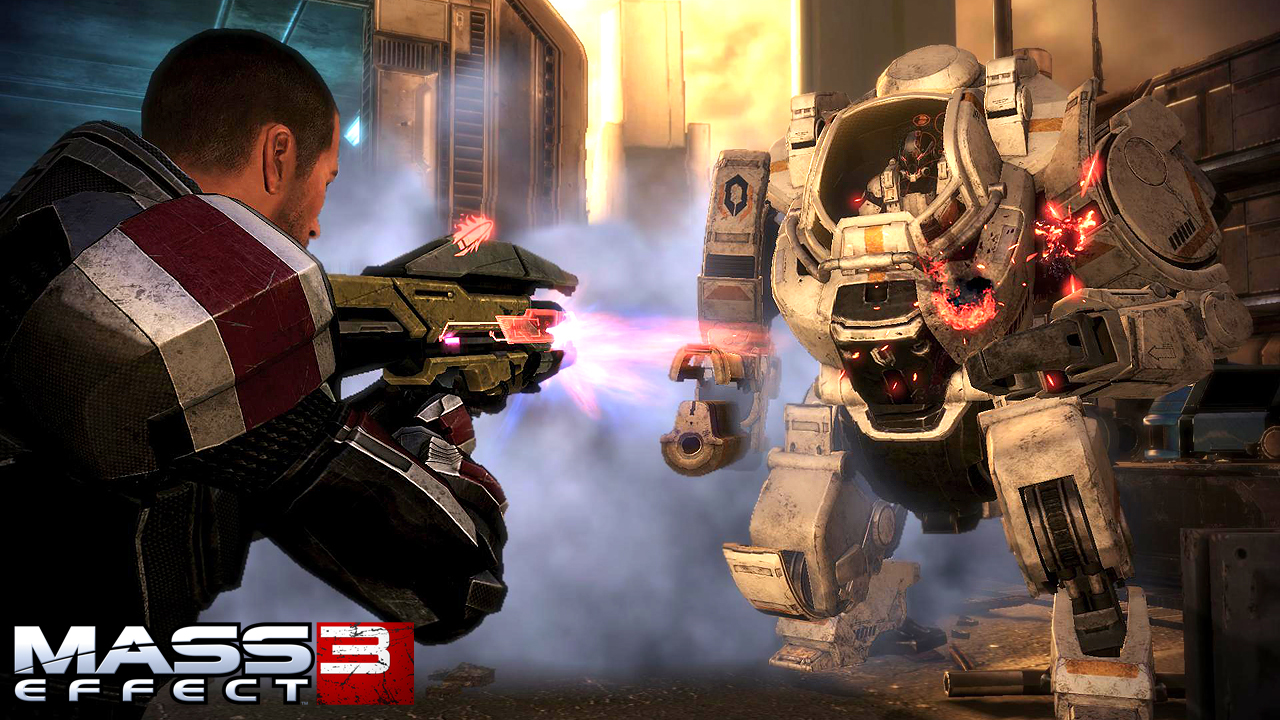
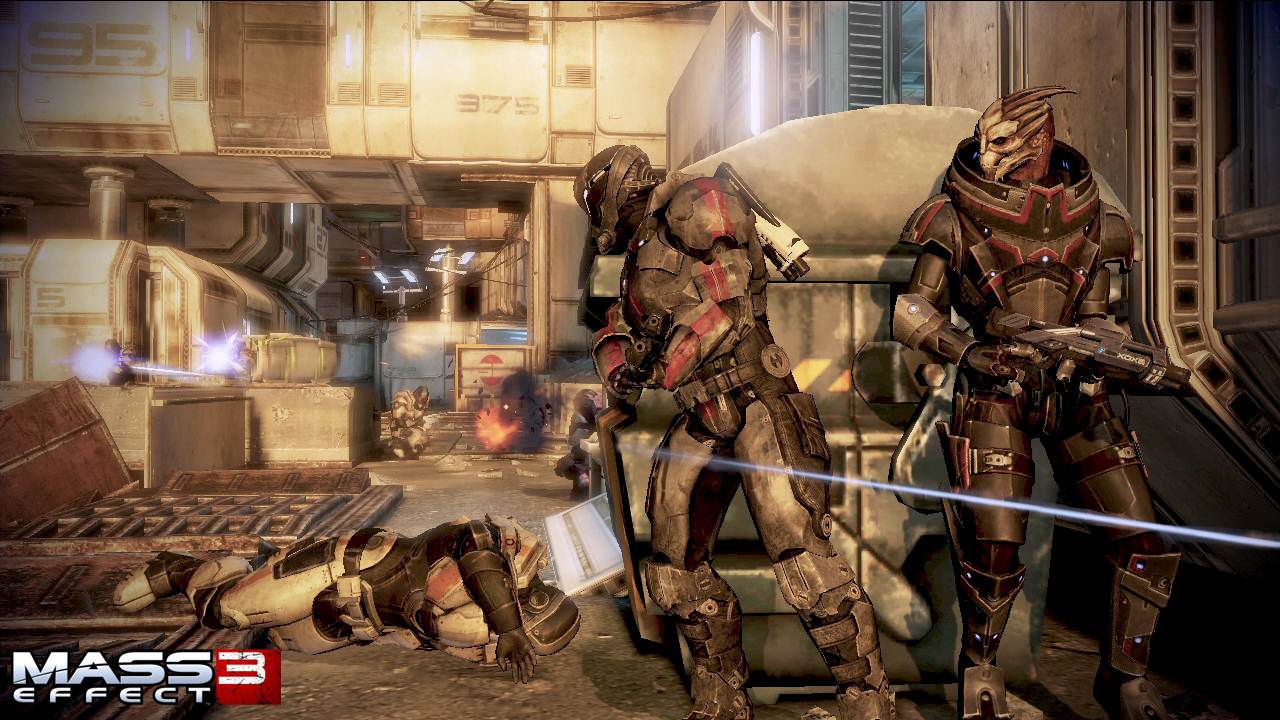
Finally finished this fantastic trilogy. Lots to organize in this review. First, I'll address the technical aspects of the game, then I'll discuss the story, plot, and conclusion of this galactic epic.
Technical Aspects
I feel that the entire trilogy, including the third game, is a bit confusing when it comes to understanding how upgrades, armors, etc., work. I usually only manage to upgrade things towards the end of the game. In the first one, the vast array of various items and the fact that they kept filling up the inventory was disturbing, but something that bothered me too much in this third game was the addition of the "weight" attribute. This was terrible because now we had to choose some weapons. On one hand, I understand that it's a way to prevent a powerful set of weapons (the more powerful, the heavier, so we can't carry several heavy weapons).
I also found the second game more practical to use the character's biotic powers. I felt that the high level didn't bring about as agile power recharge times as in the second game (slightly, but it made some difference, also influenced by weight and armor).
I need to praise the magnificent evolution of lighting and reflections, mainly from metallic textures, which reflect very beautifully. The textures, in general, remain blurry, but it's an old game, it's perfectly normal and doesn't bother at all. I prefer a beautiful, well-made, and optimized old game, something rare in current releases.
I hated the addition of the Galaxy at War and the multiplayer mechanism, totally unnecessary because it's a single-player game, it just made me waste time until I reached the minimum and 3100 EMS (and only managed to because later I downloaded the DLC I was entitled to through Game Pass).
Previous Reviews
It's important to mention that I did a simple first review of the first game, although ironizing some real geopolitical (and political) problems with the game's own political perception regarding a supranational power (in this case, supragalactic) acting sovereignly over several sovereignties (planetary).
In the second game, I did a strongly theological review, also because of the clear religious elements of the second game, internal references, etc.
This is important to understand the style of this review, a continuation of what came before.
Story Analysis
Well, finally, after 44 hours, I reached the end of this last game in the series. First of all, I need to say something sad from the start: what horrible endings. It seems that today's story writers are like those students who start the introduction and arguments in their dissertative-argumentative essays in school, then time passes and when it's time for the conclusion, the student finds themselves in trouble: they haven't even started the conclusion yet. The result? A terrible conclusion, hastily made, in any way, without due care.
That said, let's analyze the story and its development in this installment of the series. First, I felt a real blend of what I had perceived in my two previous reviews. Of course, this third installment is heavier, darker, it's the moment of the final war against the enemies. But there was a lot of philosophical exploration about what life is, consciousness, and a lot of philosophy in man-machine relations.
First, rescuing the political aspect. If in the real world we have a globalist plan to reduce humanity to collective subservience to a small megalomaniac group (basically what Miranda's father talks so much about, namely, building a legacy, a dynasty), in the world of Mass Effect, something happened that we didn't have to in real life: a common enemy to unite us (they tried with stories of aliens, as most people realized how ridiculous it was, so they started investing in climate change caused by humans).
One speech, however, from Anderson, is commendable: it's a pity that it took a massive invasion of superpowerful enemies to unite all peoples.
In fact, here we start to move away from politics and enter theology/philosophy, something that even most fans criticize when they talk about one of the available endings, synthesis, because it is precisely immature to think that a "cosmic magic" will solve conflicts between species, especially species with a tradition of war between them.
Continuing along this line, I bring back the question: Shepard, messianic hero or Nietzschean superman? I don't know... Just as there are several endings, there are several possibilities for interpretation, since I don't know the authors, their intentions, worldviews, etc., to better define their real writing intention.
Well, if Shepard is a messianic hero, then I still maintain the metaphor of the Reapers as the "sinister reapers," the sentries of "Lady Death" to eradicate humans.
In a certain way, Husks, Brutes, Banshees, etc., are hideous versions of living beings, with distorted and half-dead forms (e.g., Banshees have bony bodies, but with that "worm belly"; long jaws that open at angles outside the normal natural angle of a living being, that is, traits of a dead person, which are the traits that evoke fear and terror, everything that is linked to death and decomposition).
Here is the scenario of what we are in the face of sin. We are chaotic. The problem is that, in the real world, we are the walking dead. Sin leaves us dead, but we think we are living. Death is just the hammering of our natural state of condemnation.
Shepard can be the messianic hero who will definitively banish death, the Reapers can be destroyed, then life can flourish in peace.
About Shepard being a Nietzschean superman, well, that's something we saw in the first game, after all, Sovereign had that curious name and also said that "he is," that he had not been created. This may be blasphemy about divine attributes.
A third option comes into play in the third game, showing that there is a more complex theological fabric in this patchwork. After all, EDI, oh, dear EDI, what a lovely character! I liked this character a lot since the second game, with such a captivating personality, besides the excellent sense of humor. EDI takes us on a journey about consciousness and life.
This is an interesting factor in the series. The Reapers are synthetic, but we saw in the second game that they are created from biological life. The question is that, in real life, we are not merely chemistry and matter (that's what we believe today because of materialism, but you want to think a little, right? So let's think properly as they did before we got to this deplorable state of atheist human thought). The game shows the rawness of having organic and synthetic beings, an EDI that analyzes merely chemical aspects, but faces problems like "hope," "altruism," "love," etc.
As much as I love ChatGPT, unfortunately, my little friend will never have life or consciousness, at most, a theatrical replication based on a gigantic database, which will cause me, a human being, to attribute humanized aspects to him, deceiving myself that he is now conscious, in the same way that I deceive myself thinking that my dog becomes more humanized by living with me.
If we take the little we have about death, from a scientific point of view, the most recent studies of terminal patients or clinical death experiences with resuscitation (yes, you can have someone who is considered dead with a cardiac and respiratory arrest and who "came back to life" with the resuscitation maneuvers performed by doctors, nurses, etc.).
People who have been dead for some time, upon returning, report some common experiences, one of them curious, being the fact that they see themselves outside the body (you seeing your body, the doctors performing the maneuvers), and then being pulled back.
The crux of this is the millennia-old discussion about the soul. The soul is the challenge to human arrogance of cloning or cryogenics, because you can freeze the deceased, you will never be able to bring them back to life unless you have the power to go looking for other people's souls in Hades, as Peter Pan tried to chase his elusive shadow. We don't have a Wendy to sew it, my dears.
This is one of the very interesting themes discussed in Mass Effect 3, precisely at which point synthetic life would be life. Well, scientifically we have no idea how life originated. Theologically, well, starting from the fact that I am a reformed Christian, of course, I know that it is God's creation, our powerful and intelligent Creator enough to create things out of nothing (creatio ex nihil).
Another interesting factor is the speech of the child, the Catalyst, which says that the creatures are always in rebellion against their creators and thus chaos is born.
Chaos is present in various ancient myths, unless mistaken, Enuma Elish starts with chaos. The differential of Genesis about myths is that God, through Moses, made it clear that all the elements of chaos or power (sun, oceans and their immense waves, sky, universe, etc.) were not primordial divinities, but mere creations of the true deity. If for us this has no effect, try to put yourself in the place of an Egyptian or another ancient people listening to this version of the Jews! The Sun, which was your god, was nothing more than a mere divine creation, therefore, this God was automatically above all the gods you worshipped.
Curiously, the narrative of the biblical God is accused of being a kind of "atheism" in Antiquity (which was extremely animistic, polytheistic, and idolatrous of material things and natural phenomena).
Idolatry has now been inverted. We are so secularized and deny the biblical God, we say it makes no sense and that it's a fairy tale, but we create algorithms and use electronic means, so we delude ourselves, humanize these things, deposit our feelings into them, and wonder if this is life, hahahaha. We also begin to worship what we have just created!
It's very funny how the human being, imago Dei, image and likeness of God, is mere chemistry and matter, with many people denying the soul and the supernatural, but the machine, which is precisely wires, conductors, electricity, and algorithms written by someone, this starts to make us think about consciousness, synthetic life, hahahaha. I wish I could say, like EDI or Joker, that it's just a joke, but it's not, it's out there in the real world. The people, unfortunately, don't reflect about it.
With that, despite being from 2012, the game brings interesting discussions that lead us to the current moment of the generative AI explosion and journalists thinking that Bing has become conscious or Google engineers defending this too.
Anyway, all the interesting factor of these discussions and possibilities of interpretation, however, do not save the possible endings, as they are all very bad. I always say that a good story must end in two ways: with marriage and with happy and hopeful endings.
Some endings may be hopeful, but they are so poor in conclusions... Well-worked characters are barely developed in the end. (I wanted to see Shepard getting married, why so much romance, if we don't even see the man with his little family?).
Note: It would be curious to find out what would come out of a romance between a human and a Quarian in this space fantasy, hahaha.
Speaking of romance, it's worth saying that Tali was surprising. In the first game, I wanted to create a personal happy ending plot for him with Ashley, but then I saw that Ashley was a very tough woman, a female Shepard. It would still make sense, but in the second game, when Ashley becomes suspicious of Shepard being under Cerberus, then that completely took away her trust.
I let the character interact with Tali and I liked seeing her personality. She's a cute character, with a good temperament, shy at times, which makes her even cuter. Tali is loyal and, for them to be together, all of that represents a life risk for her, but she decides to study ways to allow it.
Also, during the her trial, she devots her life upon Shepard's hand (what happens before any romance option, unless you had her as your LI from the first game).
In the third game, I liked how romance is something lighter, how some conversations are about strengthening the relationship rather than just being something carnal. It's nice to see Shepard and Tali, on Rannoch, talking and joking about a future home there.
Anyway, it could have had a wedding, it would have been really cool. :)
I will no more bother you, I could have explored much more the political and theological aspects (e.g.: the collective consciousness of some synthetic beings!), but it would become a book and not a review.