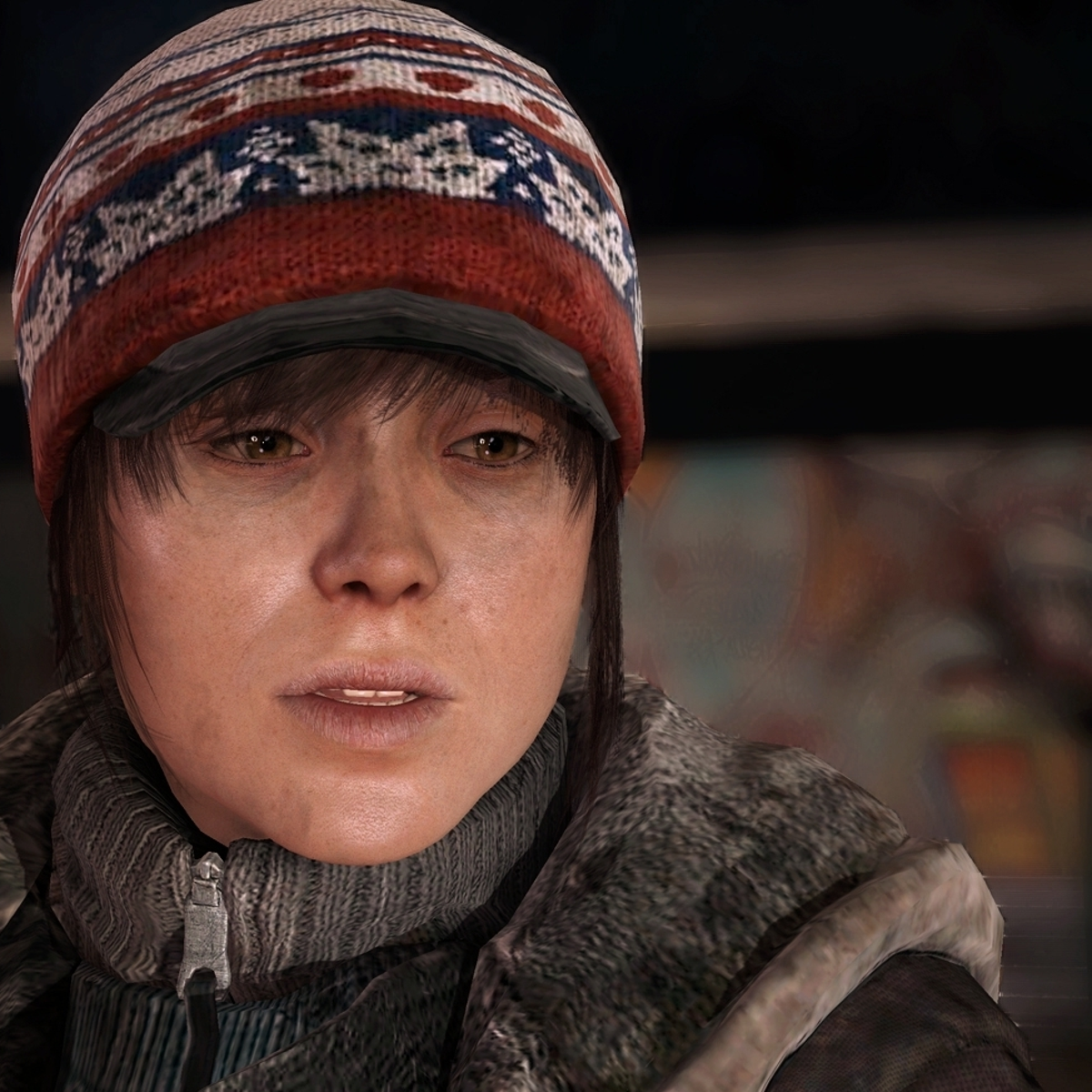
A major flaw with video games - and other entertainment mediums as well - is their attempt to be a medium that they are not. It's inherently a bad idea to try to make a TV show like a movie, or a book like a film, or in the case of Beyond: Two Souls, making a game like a movie. Beyond: Two Souls came out four months after The Last of Us, a game that excels because it knows how to tell a story in the medium that has been chosen, and use the pros and cons of that type of storytelling. With Beyond: Two Souls, the game's director and writer David Cage does everything he can to make the game as close to an interactive movie as he can make. The result is mixed at best.
The strange problem with Beyond: Two Souls is that I generally liked it. I appreciated the story of Jodie and was curious to see how it would play out. However, this is hardly a game. Controlling the character is mostly an opportunity to give the viewer something to do, and even making mistakes hardly ever serve a purpose. This is also probably a good thing, since the controls and the inputs it wants you to make at the drop of a hat are often confusing to figure out. Whenever the game goes into slow motion, you're supposed to move the character in some direction. It leaves this up to the player, yet it's often insanely hard to figure out what you're actually supposed to be doing. But again, making or missing these moments don't really matter. For example, at one point, Jodie is sent to a war-torn country to assassinate a person in power. During a part where I had to actively avoid gunfire, I failed. But instead of the game ending and making me try the area again, I healed myself quickly and that was it. My involvement did not matter in the slightest.
In comparison to other Quantic Dream games, this might be the weakest because of that. While Cage likes to pretend that his games are about your choice and the world evolving around that, the truth is that 90% of the game's choices couldn't matter less, and your only real choice that matters comes when the game makes it explicitly obvious that your choice finally matters. Cage is leading the game, it's you who ends the story however you see fit, which also feels like a gigantic cop out. Because this is Cage's game, there are so many barriers that are set up so you can't fail. Like I said earlier, you're almost guaranteed success, and even when you're hurt, there is something to fix you up.
The illusion that you're making your own choices is also thrown away pretty quickly, as the game is told in a non-linear way. Chapters are told in a random order, which means no matter what you do, these chapters are still going to occur largely unchanged. If this were at least in narrative order, it would be easy to pretend that you were actually making a difference in this world.
I did quite appreciate the relationship between Jodie and Nathan, that is until it goes full David Cage near the end and shifts the characters in a disappointing and weird way. And again, I appreciate Cage's story, despite how ridiculous it can get (that emo Jodie chapter? WOOF), but it doesn't seem like a video game is the right place to tell this story, especially when there's hardly any choice, despite how much Cage wants to pretend there is. I hope in the future, Cage and Quantic Dream embrace the positives of interactive storytelling, instead of trying to make a game into a movie.