
Triangle Strategy
Main game
4.00 average rating based on 236 ratings
- Developers
- Artdink, Square Enix Creative Business Unit II, Team Asano
- Publishers
- Square Enix
- Event
- Xbox @ Gamescom 2025
- Platforms
- Nintendo Switch, PC (Microsoft Windows), PlayStation 5, Xbox Series X|S
- Genres
- Role-playing (RPG), Strategy, Tactical, Turn-based strategy (TBS)
- Themes
- Fantasy
- Steam
- View on Steam
Release Dates
User Stats
How Long Is Triangle Strategy?
Related Content


Final Fantasy Tactics: The movie.
This review is for the Nintendo Switch version
Do you like cutscenes?
Cause Triangle Strategy has several games worth.
Thank Jebus they're beautifully written and acted. And there's multiple arcs so if you really enjoy the lore and the world, you can get in deep.
Lovely pixel art in this too. And the gameplay is solid, with a good difficulty curve that only takes minimal grinding to get over.
It's another strong 4 star from me!

Triangle Strategem
This review is for the Nintendo Switch version
5/5
Played on Switch, about 85 hours in total.
Loved this game. The gameplay is extremely tight and rewards tactical thinking and planning. In particular things that elevate it for me includeshaving bespoke character mechanics and abilities meaning you have to plan around the skills available to you, and can't swap everyone to a certain class for example. Another is the fact that dead characters don't stay dead. I played on Hard difficulty, which to my surprise, was bloody hard. Being able to allow some characters to get killed made for more tactical options. I think just in general as well the map design, abilities and depth of mechanics (environmental adjuncts, follow-up attacks, alternate map objectives) made for engaging gameplay.
Also got really into the character upgrading systems. Upgrading classes was awesome with visual changes to sprites and the same goes for weapons and weapon abilities. When a game creeps into your mind and you find yourself thinking about upgrade paths or battle strategies while driving, you know its good. In one map I figured that a character of mine could catapult an archer way up high to a vantage point, and he picked off everyone from up there. When …
5/5
Played on Switch, about 85 hours in total.
Loved this game. The gameplay is extremely tight and rewards tactical thinking and planning. In particular things that elevate it for me includeshaving bespoke character mechanics and abilities meaning you have to plan around the skills available to you, and can't swap everyone to a certain class for example. Another is the fact that dead characters don't stay dead. I played on Hard difficulty, which to my surprise, was bloody hard. Being able to allow some characters to get killed made for more tactical options. I think just in general as well the map design, abilities and depth of mechanics (environmental adjuncts, follow-up attacks, alternate map objectives) made for engaging gameplay.
Also got really into the character upgrading systems. Upgrading classes was awesome with visual changes to sprites and the same goes for weapons and weapon abilities. When a game creeps into your mind and you find yourself thinking about upgrade paths or battle strategies while driving, you know its good. In one map I figured that a character of mine could catapult an archer way up high to a vantage point, and he picked off everyone from up there. When the spear guys tried to rush my archer I teleported him with another character to the other side of the cliff. So satisfying.
I found the games story to be extremely compelling as well. I loved that it didn't have any hugely fantastical element to the ending and antagonist, it was mostly rooted in politicking and scheming (with some fantasy elements but they didn't take the form of a big bad evil spirit or something equally trite). Especially loved the idea of salt as a resource being so valuable, just a cool, unique idea in a JRPG. The story beats were definitely predictable at times but rarely crossed into cheesy territory for me, and the same for character writing. The voice acting ranged from grating to acceptable with only a few great performances in my opinion. There is certainly a lot of cutscenes between each battle, which can get tiresome. The endings, however, were great as well. It's rare that I'll finish a game and immediately go back for another playthrough to get another (Golden) ending. My original ending had this bittersweetness that I loved, and the Golden was just perfect.
This game is a certified banger. The defined characters, improvements to mechanics and great story send it right to the top of the tactics RPG genre for me in terms of gameplay. It's writing isn't able to touch something like The War of the Lions (few games can) but it's so strong in every other aspect.

A brilliant game with a stupid name.
This review is for the Nintendo Switch version
Triangle Strategy is the best traditional strategy JRPG I’ve ever played, with the only real competition being the Brigandine games. It was released about a week after Elden Ring, a major game developed by my favorite studio with assistance from my favorite writer of all time, and the highest praise I can give it is that I played it and finished it with full enjoyment during my playthrough of Elden Ring.
First Impressions: Created by the same studio as Octopath Traveler, with an almost identical visual style, Triangle Strategy (I’ll call it TS from now on) was clearly a spiritual sequel of sorts, just set in a slightly different sub-genre. After finishing most of that game but getting bored with the endgame, I expected TS to follow in Octopath’s footsteps: a deep and fulfilling character customization/combat system paired with a dull, barely-there story with simplistic characters and no real plot to speak of. After playing the first 3 hour demo, I realized I couldn’t have been more wrong. The deep and fulfilling combat system was there for sure, more enjoyable than Octopath’s in fact since it actually had enough challenge to it to make player mastery meaningful. But it was …
Triangle Strategy is the best traditional strategy JRPG I’ve ever played, with the only real competition being the Brigandine games. It was released about a week after Elden Ring, a major game developed by my favorite studio with assistance from my favorite writer of all time, and the highest praise I can give it is that I played it and finished it with full enjoyment during my playthrough of Elden Ring.
First Impressions: Created by the same studio as Octopath Traveler, with an almost identical visual style, Triangle Strategy (I’ll call it TS from now on) was clearly a spiritual sequel of sorts, just set in a slightly different sub-genre. After finishing most of that game but getting bored with the endgame, I expected TS to follow in Octopath’s footsteps: a deep and fulfilling character customization/combat system paired with a dull, barely-there story with simplistic characters and no real plot to speak of. After playing the first 3 hour demo, I realized I couldn’t have been more wrong. The deep and fulfilling combat system was there for sure, more enjoyable than Octopath’s in fact since it actually had enough challenge to it to make player mastery meaningful. But it was the story that was the true surprise. Story-to-gameplay ratio in Octopath is miniscule. The first 3 hours of TS I played involved 2 battles, each about 15 to 30 minutes long, with the entire rest of it cutscenes, exploration, and story decision making. And despite being very dry, it wasn’t boring. The writing is presented with enough expertise to clearly and concisely introduce a huge number of characters immediately without being overwhelming. The second chapter of the game, taking place after a fairly short and simple tutorial battle, takes place at a royal party in which literally about 20 named characters are introduced, and yet I was able to get an impression and remember each and every one of them (their roles and attitudes, if not all of their names). Getting this huge cast down and memorable is extremely important to TS’s story, because it is a story of widespread political conflict dictated by a small cadre of aristocrats belonging to 3 separate nations, who start the story in an uneasy alliance but are all prepared for war. I have never played a Japanese fantasy game with a tone like this, characters like this, or a plot like this. The game wears its Game of Thrones inspiration proudly on display. It’s characters are mostly older and measured, rather than the brash optimistic teens common in the genre. They are, nearly the entire cast, serious people with serious goals and fairly reserved personalities. The plot revolves around a complex economic web of trading resources that has each nation coveting and resenting each other for their goods and fleecing each other for what they can get in response. It is because of these very believable economic principles that war seems inevitable, but the people in charge are smart enough to realize that and try to head it off with a series of treaties and alliances beforehand. This all might sound very dry, and, well, it is. But it is very unique for the genre, and for video games in general, and I found it well written enough to really pique my interest even early in the game. The characters are a bit dry and simple, as well, but are immediately recognizable for their archetypes and given enough personality that they are charming enough to keep you interested until they begin to develop more deeply later in the game. The main party is comprised of 8 characters, with your protagonist being the young newly appointed head of his noble house, one of the main players in the politics of the river trade kingdom. The others are all members of his household: his primary strategist/advisor, a master-of-arms, a spy/assassin, his mage fiance and her magic tutor. They are also joined by the royal prince, who is your protagonist’s best friend, and his bodyguard. There are well over a dozen other characters you can recruit over the course of the game, depending on different routes you take through the game or decisions you make, but most of them have no effect on the plot, though they do each have their own personal character arcs. They are simply considered a part of your army, and do not appear in story cutscenes.
Gameplay: Combat and Decisions The main focal point of gameplay is the grid-based tactical turn based combat, along with the character management and customization between battles that comes with it. The combat is quite good, complex and challenging enough that you really have to strategize and use your abilities to their fullest to win. As someone who constantly whines that turn based rpgs aren’t challenging enough, I frequently had to try missions multiple times and almost always ended each battle with only a few surviving members of my team left. The characters abilities and styles are handled in a pretty fun way. TS doesn’t use the typical fantasy classes (thief, mage, tank, etc.), each and every character in the game has their own unique set of abilities that gradually build on each other over the course of the game to give them their own play style and tactical niche. Some of them are pretty straightforward: the fiance is a fire mage who blasts foes in large area effect spells from a distance, the man-at-arms uses a shield and taunting abilities to block damage and protect his allies. Others are quite a bit more unusual: the prince’s bodyguard is an archer who rides a giant flying hawk, allowing her to climb to the highest points of the map to fire arrows, the assassin can use stealth abilities in a tactical rpg. My favorites are the truly weird ones: the craftsman who can build ladders and spring traps to utilize maps verticality and open up completely new strategies, the juggler clown girl who is just really good at throwing items and tricking people into attacking her duplicate, and the weather witch who uses spells that simply affect the in-game weather. They’re a lot of fun to each figure out, and there are more characters than you can reasonably recruit in a single playthrough, which adds to the games replay value. You also can’t get enough money and upgrade materials to upgrade everyone on your team, so you really have to pick and choose who to focus on in the endgame. The other major gameplay system is for making story choices. Frequently (very frequently, as in almost every other chapter), your character is faced with a significant story decision. At first they have two options, but later almost every choice is between three different options. However, you are not given the option to simply choose what decision you want. The young lord values his retainers’ opinions, and so utilizes a voting system for each of these major decisions. Each of your 7 party members will have an inclination towards one option, or be completely undecided. If you want to pick an option, you’ll need to sway enough of them to your side to win the vote. This can be done through convincing them in dialogue, or sometimes by learning new information from npcs, books, or items around and using that info to change their mind. The characters are all well written and consistent enough that I was able to talk them around once I learned what made them each tic. For instance, the healer of the group is a kind and principled woman… but I soon realized that she had an understated by consistent cowardly streak, and I could almost always sway her by appealing to her sense of self-presentation. Unless, of course, her magic student had a strong desire, in which case she would defer to her judgment. This system is great. It really feels like an engaging gameplay system for steering the story, and it’s well written and full of good drama. More so, the decisions actually matter. The effects are usually short-term (aside from sometimes determining which characters you can recruit), with the story looping back to the same general flow after the chapters are resolved. But basically every single decision you make will lead to a different unique battle, with its own map (except when re-use makes sense), enemies, and objectives. There are many unique enemy characters you can only encounter through one fight in this way. You can replay the entire game and get an almost completely different set of battles each times. And this leads into the games endgame, in which it splits into one of three separate routes. I kept a save and played through all three endings, and all of them are satisfying and dramatic, with all of them having very serious fallout from the decision your character makes.
Criticisms: I love this game, and I still intend to play through a Newgame + on a separate route at some point (and maybe get the True Ending, which I still haven’t seen). There are many other things I could praise, from the characters to the overall story, but this review is… way too long. So I will mention a few criticisms and warnings. On the warning side, this game is unapologetically, blatantly novelistic. Cutscenes are wordy, thorough, and LONG. It depends on the player whether this is a pro or a con, but for those who feel the latter, it might ruin the pacing to the point of damaging the fun of the combat. And because of the story choice system, you can’t simply skip through it if you’re not interested. But personally I’m very happy with this, as the developers did not settle or compromise their vision to try to appeal to less patient gamers. As for actual criticisms: just like Octopath Traveler, the game severely underutilizes its fantasy setting. Almost every enemy in the game is an ordinary human soldier of some kind, with no monsters to be seen, and the only fantastical foes being spellcasters and hawk-riders. Magic is mostly just used as a combat technology, rather than being something that truly shapes the world and culture. The game is trying so hard to be grounded and mundane that the fantasy elements occasionally feel jarring. The voice acting is… middling. The characters all speak in a kind of very formal, stage-like manner, obviously also leaning in to that mundane fantasy styling. What makes good voice acting is a matter of taste but I felt that none of the voice acting in the game was above average, and some of them were rather stilted. However I still prefer the english dub for reasons I can’t quite explain. And at least one character who always spoke in the most dull monotone ended up winning me over and becoming my favorite character, lol, so it’s not all bad. Combat scales its foes for challenge in a way that sometimes kind of breaks immersion in the story. Most battles have a super deadly boss character or two on the opposing side, with even normal soldiers being as tough or tougher than your own main characters. Sometimes these boss characters make sense: a legendary battlefield commander, or a grizzled bandit captain. But sometimes the cowardly, gluttonous dandy lord who is portrayed as a total loser turns into an unbelievable badass the moment he gets into combat with you. But ultimately I appreciated the challenge and uniqueness of these enemies, though I wish they made a little more sense.
In conclusion, this review is way too long, but I highly recommend Triangle Strategy. Especially if you were a fan of Final Fantasy Tactics or Tactics Ogre back in the day. Know what you’re getting into with long, drawn out story sections and long, difficult battles. If you’re having trouble, prioritize upgrading Anna so she can use her double-actions to annihilate your foes. And seriously Square-Enix, Artdink, could you not have workshopped that title a bit? At least go with Trinity Strategy…

A Different Way to Play a Triangle
This review is for the Nintendo Switch version
Triangle Strategy is an interesting beast. It can easily be compared to Final fantasy Tactics but it has much less depth in its systems. It doesn't suffer for that, in fact that is maybe one of its greatest strengths. You spend a lot less time min/maxing and a lot more time fighting battles and trying to change the fate of a continent.
The battle system, being a grid based strategy game, will be very familiar to FFT fans and features the old mechanic of choosing a direction to face your units after movement and combat. There is no real class or job system, your units are on a path and you can upgrade them but you can't shift them around or reclass them. My Serenoa and your Serenoa are likely to be very similar by the end of the game.
The characters are interesting, the main cast struggles to keep themselves alive in the middle of a war and you guide the head of a major political house through the conflict by negotiating and prodding your allies to take the path you believe to be the best.
Unit recruitment is underwhelming, the game keeps track of three metrics (Freedom, Utility, …
Triangle Strategy is an interesting beast. It can easily be compared to Final fantasy Tactics but it has much less depth in its systems. It doesn't suffer for that, in fact that is maybe one of its greatest strengths. You spend a lot less time min/maxing and a lot more time fighting battles and trying to change the fate of a continent.
The battle system, being a grid based strategy game, will be very familiar to FFT fans and features the old mechanic of choosing a direction to face your units after movement and combat. There is no real class or job system, your units are on a path and you can upgrade them but you can't shift them around or reclass them. My Serenoa and your Serenoa are likely to be very similar by the end of the game.
The characters are interesting, the main cast struggles to keep themselves alive in the middle of a war and you guide the head of a major political house through the conflict by negotiating and prodding your allies to take the path you believe to be the best.
Unit recruitment is underwhelming, the game keeps track of three metrics (Freedom, Utility, and Morality) which are shifted based on choices you make in conversations, while exploring, and through combat. Depending on where you get these values to end up a unit will pop up asking to join you at certain points through the campaign. Nothing too exciting there.
The three metrics, called Convictions, also guide how your allies respond to your persuasions when it comes time to make significant story choices during the voting scenes. For example, you will reach a point in the story where an enemy faction demands you turn over one of your allies. You can defend them, or give them up. Your allies will fall into the two camps and you bargain with them for the outcome you want.
This usually results in your allies being evenly split with one undecided voter that's usually pretty easy to sway. There are a few choices where you can make all the right persuasion points and fail to sway your allies because your Convictions aren't high enough in the specific stat you need to make the sell and you can become stuck on a path whether you like it or not.
This made me wonder why even bother with the voting scenes? A vast majority of them you seem to be able to freely choose, the one undecided person being easy to sway and every other option always being tied means you can do as you please which only makes the rare times that the options are trickier frustrating more than anything else.
Another minor issue is that there are moments where enemy reinforcements spawn and there is no real indicator on where this spawn will happen. There is one mission in particular, where you defend a village, where you can use stage hazards to destroy the enemy or duke it out without them. I had holed up and set up a choke point, milling through the greater enemy numbers effectively, when suddenly three dudes appeared behind my line with no warning and threw everything into disarray. It's one thing to present a challenge, but one can't help but feel cheated when they are succeeding against the odds only to be undone by a set spawn point set behind the player and never communicated to them.
All that aside, Triangle Strategy is well worth a trip or two through. NG+ makes speed running for alternate endings real easy and the story is interesting enough to see where the different paths read. It's lighter, systems-wise, than FFT which makes it great for picking up on a whim without getting bogged down in numbers and optimizations. It's a cool little tactical RPG!

Tried the demo
I tried the demo of this game back in 2022 and I did like it but found it extremely similar to Fire Emblem. The fact that it’s similar to FE should ultimately mean I really liked it but I found that I didn’t enjoy the characters much. It also has Octopath Traveller vibes and that might not be the style I like.

Triangle Strategy (Switch)
Buah táctico, y encima en triángulo. Un muy buen "tactics" que bebe de los clásicos (FE, FFT) y aporta ideas frescas. Historia, intensa e interesante y arte y OST espectaculares. En ocasiones el farmeo es repetitivo pero aún así me ha gustado mucho.

A Great Tactical RPG With Just A Few Downsides
This review is for the Nintendo Switch version
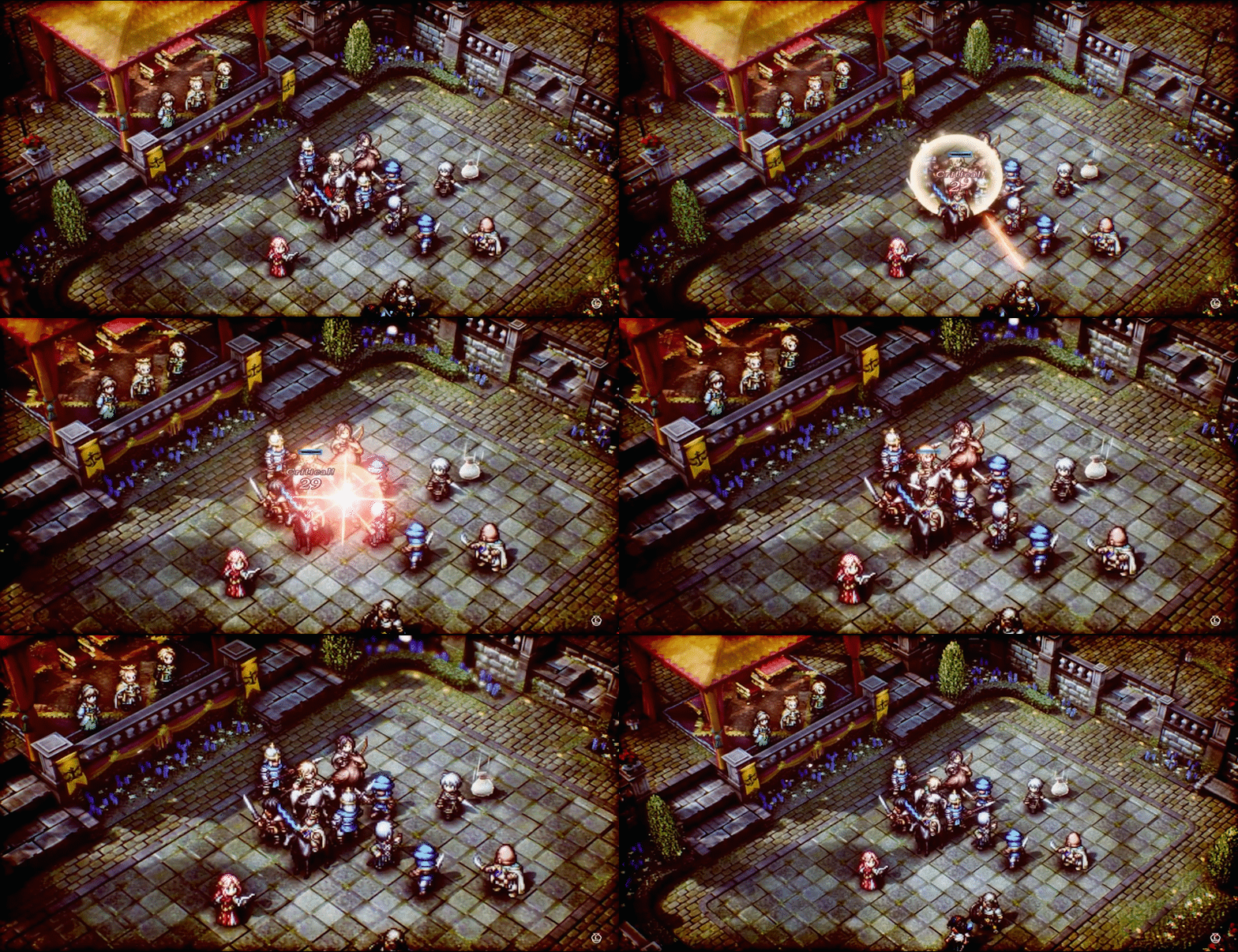
Triangle Strategy is a new tactical RPG in Nintendo's hot new 2DHD graphical style. The characters are pixel based sprites set in diorama looking set pieces. This works really well and the game looks beautiful because of it. My only complaint around the graphics are a few times it can be difficult to determine which direction an enemy is looking at right away. The characters themselves are not all that exciting and follow pretty cliche roles, though the story they are set in and world they live in is fully realized and very well told. It's a medieval like time frame with fantastical beings but still presents a pretty grounded story. Your story starts off with only a handful of characters, but you quickly gain many more that you can use in battle that have wildly different attacks or abilities. It became a struggle to determine which characters to use as typically you can only use about 10 in most battles, yet have a total of 30 to choose from. This adds some extra level of customization and replayability to the game. Do you want to just rush in and lead a full on assault? Or use a bunch of …
Read MoreTriangle Strategy is a new tactical RPG in Nintendo's hot new 2DHD graphical style. The characters are pixel based sprites set in diorama looking set pieces. This works really well and the game looks beautiful because of it. My only complaint around the graphics are a few times it can be difficult to determine which direction an enemy is looking at right away. The characters themselves are not all that exciting and follow pretty cliche roles, though the story they are set in and world they live in is fully realized and very well told. It's a medieval like time frame with fantastical beings but still presents a pretty grounded story. Your story starts off with only a handful of characters, but you quickly gain many more that you can use in battle that have wildly different attacks or abilities. It became a struggle to determine which characters to use as typically you can only use about 10 in most battles, yet have a total of 30 to choose from. This adds some extra level of customization and replayability to the game. Do you want to just rush in and lead a full on assault? Or use a bunch of traps and magical barriers to funnel enemies in to you one at a time? The characters all feel very different, and it was hard to decide which to use for certain battles. In between these main story battles, there is a base camp where you can deal with merchants, upgrade your characters, or take part in "mock battles" which essentially are practice fights to level up your characters. These greatly help keeping everyone around the recommended levels, but I wish there were either more of them or another option on top of these to level up. That is about where customization ends though, as the characters in battle can only be leveled up, but not change jobs as in most tactical rpg games. Your healer for example, will only ever be your healer. Your tank cannot learn any abilities to use magic or attack from afar. This may turn many off from the game, but with the variety of characters present I felt this wasn't too big an issue. Overall there are 4 different endings to the game. Three are standard whose side do you choose when you get to a certain story point, then a "golden route" which occurs if you make the proper decisions in the game and a certain battle plays out a specific way. This adds a significant amount of game time for completionists, as my first route took just shy of 50 hours (was watching Netflix while playing though, so that's a bit padded) and there is a new game plus mode so you can probably skip through most of the dialog and get to the fights. If I didn't have a massive backlog of games, I probably would go for the additional routes. Overall I really enjoyed this game, more than I thought I would as I didn't hear too much about this one upon release. My biggest complaint would be the long stretches of dialog, inter spaced with loading the next scene, for more dialog. These stretches though helped build out a great story that I feel anyone should look in to and hopefully enjoy.
Read Less
I finished my playthrough on normal mode, it took me about 26hrs to finish the game. First time in a long time have a binged a game this good. I finished it in 3 days. Really really had me going with the story and the gamplay, its perfect, I played it in my nintendo switch
There's great story telling and world building going on in Triangle Strategy but man does it go on a bit. Cut scenes weren't too bad in the demo but they are lengthy as you get further into the game. I'm watching stuff as much as I'm playing. At least it's well done.
I'm away for a week visiting family. I've brought Triangle Strategy with me. I bought it way back in May after playing the demo. It's really good. It will give me something to do when I start getting cabin fever after a couple of days!
loved everything about the game except how hard it could be at times to pick the path you would prefer. A bit too many lengthy cutscenes that could have been trimmed/cut out as well.
The art was beautiful , combat was fun ,fully on point voice acting, engaging story and characters, leveling and resource management was very engaging, decisions actually mattered which is rare in games now a days.

Ok, I give up on this game.
Not only it's a visual novel with barely any gameplay (and a repetitive grindfest if you actually dig for crumbs), but it's also plagued by this invisible "utility system" that makes your choices useless. They don't even explain half of this to you! I found out about it on Reddit or something. Such a major waste of time.

Finished the game with the Golden Ending while going blind. I thought it was locked on NG+ but here we are.
A great ending for a solid game with great worldbuilding, great story, great characters... Yeah, everything in this game is great! The game wants you to think about the consequences of your choices and in a way it reminds me of DAO Coercion system.
The "True" Ending is satisfying because everything make sense. Normally I'm not a fan of this kind of ending, but this time they did well!
I really enjoy the combat, but the exposition is long and time consuming.

A brilliant take on the Tactical RPG where your decisions really matter to the story and where customization options for your party members, and party, are numerous. Fans of final Fantasy Tactics and Tactics Ogre will love this. Great story, characters you’ll care about, and eye candy graphics make this an unforgettable gaming experience. Definitely my Nintendo Switch “Game of the Year”

Got a not very nice ending. Looked up the other endings
To quote one of the characters from here, this game "is cruel in [its] kindness." Yes, I do choose how the story proceeds but at what cost with these options they give me
It's getting less simple to choose which path to take. It's also getting harder to convince people to change their minds about where to cast their vote. I really do feel that my decisions heavily impact how the story goes and that worries me a bit.
I've noticed that I have several units that I haven't used even in a single battle. That's a shame, because some of them look interesting but I don't know when to deploy them. There're a limited number of battles, and I'm not really into redoing them. I guess that also leads to me missing the progression of their stories. As for the characters I follow, a twist came that I didn't see coming although, in hindsight, it is an established trope.
The end seems to be near, and I'm excited and in fear of what's to come next - story-wise and also, what to play next. Anyway, I'm really enjoying this game.
I had a feeling that I'm on the worst storyline because I am bad at the exploration phase and I keep on missing stuff that would have led to other options. This proved to be true when I missed a vital option this afternoon and suddenly it was game over. They didn't even let me fight the battle, my units just went poof on the map, and then I was directed to continue from autosave. I find it funny though that what I have apparently missed - which led to my downfall - is
It was so satisfying to
Getting close to the end, I think, and finally running into what I'm feeling will be my biggest gripe with this game...
I'm at a voting scene and I cannot sway anyone to switch to the option I want. I understand this as a mechanic but I despise it at this point. I've been save scumming, I've tried looking for any info I may have missed, but it seems I'm locked on a path I don't want to take and I can't help but wonder why I can't just choose for myself and be done with this nonsense.
The whole game to this point gives you a neutral who sways easily, essentially making the system pointless, and now all of a sudden I can't make a change?
Feels bad, man. Not a fan.