I'm begging any game developer to recognize that you can make a sequel to a game that isn't just the same game but with more collectibles. Please. I'm f***ing dying here.
Ok. Deep breaths. In. Out.
To make this easier, let's use the format from my HZD review. You know, the game I loved.
Visuals: Yeah, it looks great, woo hoo, whatever. What felt revelatory in the first game just feels kind of standard 5 years later. Like, yeah, it looks great, but there's nothing new to look at. It's just more pretty trees and mountains.
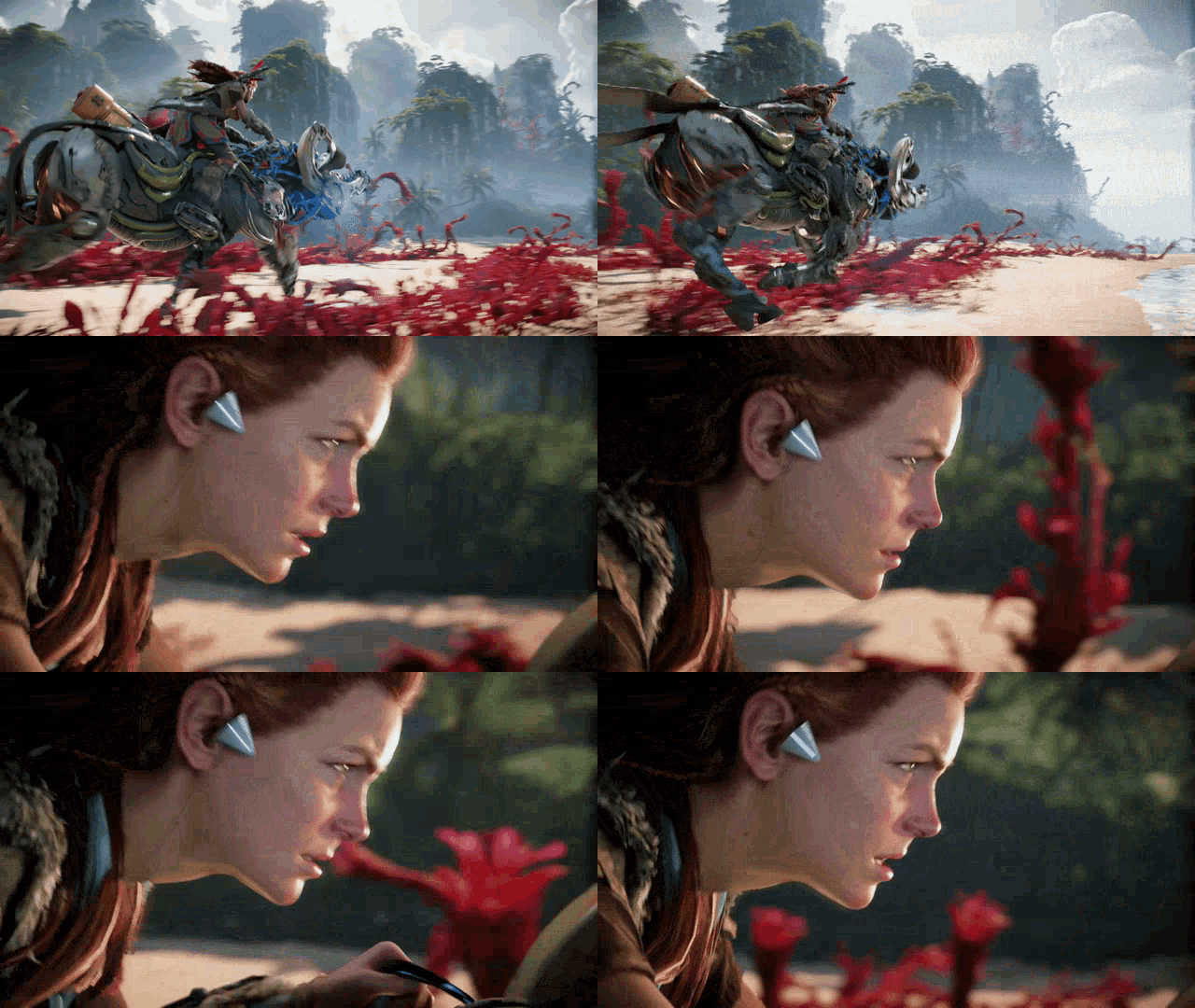
Ok, that's not entirely fair, the acting/character animation is also pretty good. There was actually a moment early in the game when I legitimately forgot I was watching a cutscene in a video game and just thought I was watching a movie or tv show. There's more nuance to the performances here than in the previous game, which is appreciated.
I also like that the snow sticks to your outfit. I can't remember if the first game did that or not.
Travel: So the thing about the first game giving you a world that's worth travelling through so you don't fast travel is that in the first game there was an actual time cost to fast travelling. But on a PS5, it takes about 2 seconds. Of course the other thing that encouraged actual travel in the first game was wanting to find out about the world and how things got the way they are. But, you know, we did that. HFW is just an inherently less interesting world than HZD because nothing it has to tell us really matters—all the stuff that mattered we discovered in the first game. But we'll come back to that.
Task Diversity/Just All The Things: Where they perhaps tried to make up for this was in giving you just a crap-ton of stuff to do and find in the world: more equipment to purchase and upgrade, an incredibly time-consuming task—I'm pretty sure I spent half my total playtime just hunting down random birds and arbitrarily chosen machine parts (oh and if you're not satisfied doing your own tedious busy work there are also salvage contracts so you can do other people's tedious busy work, and then be rewarded with an armor that you then have to do more tedious busy work to upgrade); more camps to raid (though, this time for story reasons); more combat challenges (in addition to the hunting grounds, which this time around are laughably easy to complete, there are melee pits [because what everyone wanted from Horizon was more melee, yup that's the thing we Horizon fans talk about, how we really want them to double down on the melee], the Arena [though lacking the specificity of the Hunting Grounds it does ramp up the difficulty...to maybe an absurd degree], and the races which aren't technically combat challenges but whatever; more cauldrons (now with additional overrides for more crafting jobs! Yay! 'Cause I really want to spend my time collecting 30 f*****g Frostclaw Sac Webbings which are needed for like 10 different upgrades!); more Tallnecks; more consumables that I will never use; materials for dyeing, in case the sets of 3 different outfits that are identical styles but different colors aren't enough; more side quests (some of which are sort of in the vain of AC: Valhalla's world events, in that you just kind of stumble upon them, which does incentivise exploration but then those ones are usually boring so...); more skills, including active skills called Valor Skills or something that I pretty much never used because the only times you actually need them are in the combat challenges when you can't use them, and even in regular combat you can't switch them out so you're just stuck with whatever one you happened to have equipped when combat started and it's just not fun; more pointless collectibles, including lenses, orbs (when I found out what the orbs do I nearly quit the game permanently, those effects are the tackiest bull**** I've ever seen how dare they make me work that hard for that fart of a reward), black boxes, probably something I'm forgetting; more minigames (Strike is more fun than Gwent but still more time-consuming than Orlog); more coils and weaves that mostly offer tiny inconsequential bonuses for 90% of the game (the instant acid coil does combo well with the bow that does more damage against corroding enemies though); more question marks that you go out of your way to get to only to find it's another Blocked Path that you don't have the equipment for yet (and then when you finally do the reward is just more random crap to sell and some greenshine); more tediously-difficult-to-line-up vantage points (they put one underwater and I will never forgive them for that); etc. etc. etc.
And if you thought that was exhausting to read, imagine playing it. I happily spent 80 hours in HZD, and I was ready to be done with this game after 30.
Story: But the thing that kept me going was the story. Until it became the thing that made me hate this game.
As previously mentioned, one of the driving factors of HZD is the mystery, both of how things got to be the way they are (what with all of the machines and ruins and whatnot) and the more immediate mystery of what Hades is and what it's trying to do.
HFW doesn't really have any mystery. There are the Zeniths, sure, but that's explained pretty quickly. Other than that there isn't really anything we need to know, because we found out all the important stuff in the first game. So instead we keep exploring ruins and finding out about projects that were happening at the same time as Zero Dawn, but are fundamentally less interesting because they didn't work and have little to no impact on the world as it currently is.
But that's not to say HFW's plot is boring. Also, just spoiler warning for the entire rest of the review.
Ok? Ok.
Where the first game had you discovering the mistakes of the past, it didn't really have you working to fix those mistakes, so much as just trying to prevent an encore. Though you are ultimately victorious against the immediate threat, there's an air of melancholy that hangs over the whole game, especially after Gaia is destroyed. But in this game you're actually working not just to stop destruction (though also that) but to actually build and grow and fix things. So you find Gaia. And you install Gaia. And you have a base. And you have companions. And you find Gaia's subordinate functions and reinstall those. And it feels, really, really good. It feels hopeful. Where the first game is built on mysteries and reveals, this game is built on action and resolution.
Or at least that's what I thought for 99% of the game, until it ended with a reveal instead of resolution and I felt like someone had had me trust fall into a pit of poisonous ants.
I don't know if I can really communicate how absolutely betrayed I felt by the reveal of Nemesis. No foreshadowing. Yet another world ending event before we've even stopped the one we're working on. Seemingly insurmountable. And perhaps most importantly, seemingly unresolvable.
What I mean is, I don't see how they could possibly make a third game that's about stopping Nemesis. And if they don't make a third game that's about stopping Nemesis, then that means we're just leaving our heroes facing impossible odds...and that's just it. That's how it ends. Like, the game says there's hope, but..............WHAT FUCKING HOPE? BECAUSE SHE HAS FRIENDS NOW? THE POWER OF FRIENDSHIP? GIVE ME A FUCKING BREAK!
It is possibly the cruelest ending to a video game I have ever experienced and I hate them for it.
Conclusion: Horizon Forbidden West is a lot more of what was tedious and boring about the first game and not enough of what made it fun and interesting. It's the Ubisoftification of Horizon. And it has a mind-bogglingly shitty ending that ruins the game if not the franchise. I'm honestly tempted to give it 1 star and bump Far Cry 3 up to 2...but I hate Far Cry 3 too much to do that.
Looking forward to all the people who will definitely agree with me 100% for exactly the same reasons.
p.s. Possibly my favorite thing about the game is that when I got to the point where I was having to track down Greenshine Slabs for upgrades I was like, "Oh, this is interesting, there's no standard way to get there you just kind have to cheese your way up a mountain," and I then proceeded to cheese my way up several mountains and into other seemingly inaccessible places (only occasionally causing game-breaking glitches). It wasn't until I did "Wings of the Ten" that I realized that there was probably a different way I was supposed to get to those. It's just that the game is so broken it didn't matter.
p.p.s. Why in god's name couldn't the salvage contracts just have the details in the quest tab or at least give you a button that takes you right to the matching contract in the data tab. Having to scroll through all of my data to get down to the salvage contracts section and then find the one I'm doing is just needlessly clunky.
p.p.p.s. Why is there no Carja representation among your companions when Telanah is right there? Everyone else is represented (well, except the Banuk, but they're in the DLC that this game doesn't give a s*** about so f*** 'em).
p.p.p.p.s. I think calling Aloy a Mary Sue and leaving it at that is actually ignoring a larger issue with hero stories in general, one that was brought home to me after Varl's pointless death. His death does not "raise the stakes" or "give the hero motivation"; the stakes are the end of the world and the hero's sole overriding motivation is already to stop the end of the world. While not as bad as the death of Phoibe in AC: Odyssey because Varl is not a literal child, it's still a hero's friend dying solely because the player was arbitrarily deprived of agency at a pivotal moment.
This kind of pointless NPC death happens A LOT in video games, and that's bad enough. But the hero's friends taking the brunt of the punishment isn't just a problem in video games. There are any number of stories in film, tv, and literature, where the protagonist gets through their adventures largely unscathed while their friends, family, and romantic partners get tragically injured and/or killed. It raises the question: why are so many of our heroes standing on a pile of their loved ones’ bodies?
When I was a kid I read The Hero and the Crown by Robin McKinley. There’s apparently a whole third act that I don’t remember at all about like a prophecy and a demon war and whatnot, but what’s always stuck with me is the first part of the story.
(What follows is mostly from memory with some help from Wikipedia to make it coherent.)
A young woman recovering from an illness discovers a recipe for a salve or ointment that protects the wearer from flame. She sets about figuring out how to make this stuff, does a lot of experimenting and whatnot, and ends up defeating a small dragon. Yay!
A little while later a big dragon shows up. So she gets set for battle, gets all slathered up, and rides out to fight the dragon. And then shit gets real. The battle is hard, and brutal, and she does win in the end, but she’s horrifically burnt, and barely makes it home alive.
And that, as far as my memory goes, is where the story ends. And I’ve always really liked that story. And I wish there were more stories like it. I guess I wish that story was actually like that. She ends up becoming an immortal queen apparently? Which is so much less interesting.
The point being I want more stories where the hero's suffering isn't just watching their loved ones get brutally murdered. I want heroes that suffer more than cuts and bruises, that don't just have a few tactfully placed scars for extra sex appeal. I want heroes that get 3rd degree burns, that lose limbs (shoutout to Kotallo), that lose mobility or even cognitive functions. I want heroes that get chewed up and spit out but fight on anyway. I want some heroes that just straight up die at the end (Harry Potter "I died but I'm back" bullshit doesn't count and you know it). And if their loved ones do get hurt or die, it better fucking matter, and they better have tried everything to keep it from happening, and if it's in a video game it better not be because I got laid out in a cutscene by an attack that I would've shaken off with a quick heal in gameplay.
p.p.p.p.p.s. Apologies for giving up on the censoring towards the end (of the main review and of these postscripts, which I was writing in parallel), I'm tired and angry and that's just how I feel. Also it's kind of annoying to get the censoring to work with Markup. It was worth it for the Shadow of the Colossus review because there it was more of an aesthetic choice, here I'm just legitimately mad.
p.p.p.p.p.p.s. I'm sure this thing needs a ton of editing but it's dinner time, so I'll probably come back and edit it later.
p.p.p.p.p.p.p.s. So I realize I never expanded on my opening statement. In my HZD review, I alluded to the idea of a sequel that did not follow immediately from the events of HZD but instead took place much later and had completely different gameplay.
There are a few reasons for that. One is that I didn't see the story of Aloy finding Gaia and putting her back together actually being interesting—with no immediate threat, it seemed like just a matter of time. Obviously, they found a way to give that story tension, but where we left off in HZD that was not a narrative inevitability. So instead, I was imagining a game that assumed that happened and that Gaia was able to finally fulfill the dream of Zero Dawn, and now we get to see what the new world looks like.
That brings me to my 2nd reason, which is that I'm generally interested in the concept of series that don't just iterate on the same format but are willing to change up their format to explore the world or the characters in new ways. I'm interested in this concept in all media, not just games, but Horizon felt like it would be a great opportunity to something like that, because the story felt resolved but the world felt so full of potential. Instead we got the kind of "what if same but more" sequel that Ubisoft has taken to its logical extreme with the Assassin's Creed franchise, lots of stuff but very little of it fun or interesting.
Obviously there are franchises that take these risks, but often they are able to do so because they center around an iconic but adaptable character (Mario being the obvious example), which wouldn't work here, as Aloy is very much grounded in a single specific context—Paper Aloy just wouldn't feel right.
I haven't actually played the first Nier game yet (I've got Replicant I swear I'll get around to it), but from what I understand that series basically did what I'm asking for. The first game is like a swords and sorcery thing, and then Automata is sci-fi, but somehow takes place in the same world? I don't actually know exactly how the two games are connected, though I know Emil is in both. But yeah, that's the general idea.
Other examples of series that do this to one degree or another: Alan Wake and Control; the Darksiders series; also pre-existing IP franchises like Star Wars and Lord of the Rings (e.g. Battlefront and KOTOR are very different games, as are The Hobbit and LOTR: The Third Age). Heck, FFVII and FFVII Remake are two pretty different games.
The point being while it doesn't happen as often as I'd like, it definitely can happen, and not just in artsy indy projects. So as much as I didn't expect Horizon to do it, it wasn't entirely outside the realm of possibility, and I'm disappointed that they veered so hard in the other direction.