Time played: 64 hours
Completion: Finished the main story, reached end credits
A world comprised of the decaying body parts of fallen titans. A war without cause, with no beginning and no end. Soldiers bred for battle, their short 10-year lives lived for the purpose of feeding the ominous Flame Clocks of their nations. The Xenoblade series has always excelled at creating imaginative and creative RPG worlds to explore, containing philosophical headiness and anime camp in equal proportions, and Xenoblade Chronicles 3 is no exception. This new entry quickly distinguishes itself as one of the most compelling games in the series, not only for its relatable characters, but because of how it distills the best gameplay elements of the previous games into a witch's brew of addictive RPG goodness.

STORY
Xenoblade 3's world of Aionios is the stage of an eternal war between the nations of Keves and Agnus. Our six protagonists consist of two trios from both nations, who end up in a tenuous truce after a certain event in the beginning of the game turns them into enemies of both nations. The protagonists were one of the best aspects of the story, and the game is at is strongest when we watch them deal with some of the curveballs that get thrown at them. Each character has their own cross to bear, whether it be Sena's lack of self-confidence, or Taion's guilt over an event in his past. The looming specter of death is a huge theme of the game, as the characters are faced with rapidly depleting life spans that imbue a sense of urgency into their quest.
I have nothing but praise for the story's overall pace, which really got me invested in the world from the beginning. Xenoblade 2 has an infamously slow start, and I remember it taking well over 10 hours before that story started to get compelling. I don't doubt that there are many potential fans who simply couldn't make it through that huge barrier. By contrast, Xenoblade 3 does everything it can to hook you from the opening scene. You are immediately dropped into the thick of an exciting battle between Keves and Agnus, and are set free to explore with relatively minor guardrails.
I do feel a bit disappointed that Moebius, the game's villains, are pretty poorly developed in comparison to the villains of Xenoblade 1 and 2. I won't dive into it any further for fear of spoiling the plot, but I felt a little underwhelmed by the game's ending because of this. The game also tends to overexplain plot points and themes a lot, but this should be par for the course if you've played any Xenoblade game before. What I'm most happy about is that Xenoblade 2's "cringy anime" moments are totally absent. Don't misunderstand me--Xenoblade 3 is anime as hell--but the tone is much more consistently serious and you don't have to deal with the whiplash of watching an awkwardly horny scene right after some philosophizing about the role of religion in people's lives. If you've played Xenoblade 2, you know what I'm talking about.
If you've played previous Xenoblade games, the game does reward that knowledge by drip-feeding you references to locations and characters from past games. If you're thinking of making this your first Xenoblade game, though, don't be put off by that. While the game does take place in the same universe as the first two games, it takes place in the distant future, and you aren't expected to know anything about the events of past games.

GAMEPLAY
One of the reasons I think this is a great place to start with the Xenoblade franchise is because it has the most approachable, but insanely deep gameplay mechanics the series has presented thus far. Much like in previous games, Xenoblade 3 is a massive RPG where you traverse through open-ended areas, fulfilling quest objectives to advance the story. It isn't fully open world, as the world is split into separate loading zones, and your progression is gated by the story. However, the zones are so massive that you always have a wide variety of options for what to do. You can tackle the main story, or you can spend time exploring and collecting materials. You can complete side quests, work on increasing your affinity with the game's many colonies and tackle challenging unique monsters.
The areas of Xenoblade 3 are mind bogglingly huge at times. There are zones in this game that feel like 5 Gormotts or Bionis Legs stuck together in size. Even within these zones, there are distinct regions with their own biomes, enemies and characters to see. Many are not even required for the main story, so going off the beaten bath is highly rewarded in Xenoblade 3.
This is especially so because of the game's quests. The quest log in Xenoblade 3 is an unspeakably vast improvement over Xenoblade 2's mediocre quest system. Quests finally have recommended levels (Thank god) and are split into several categories: there's the main story and standard side quests, but there are also specially marked hero quests which unlock hero characters that accompany you as a seventh party member. Then there's the optional collectopedia card quests, which serve as simple gathering requests that award you items or colony affinity. Because collectopedia cards exist, it's almost always safe to assume that a standard side quest will consist of a side story that fleshes out the world, rather than someone randomly asking you to gather six turnips.
The game's UI is generally full of great quality of life improvements that I was really missing in Xenoblade 2. You can customize shortcuts that are accessed by holding the left trigger, which let you quickly access important menu items such as the map or the quest log. You can micromanage everything about your character's skills, arts, accessories and gems, but you can also just let the game auto-build a character for you if you don't feel like being mired in menus. The map is pretty functional, although it no longer displays height levels in a distinct way. I didn't mind this at all, because the game's handy quest route option always reliably nudged me in the right direction if I was unsure of how to reach a location.
Like Xenoblade 2, the game tends to over-tutorialize things that don't need to be explained. Do we really need our hands to be held through the concept of buying items from a store, or how to equip an accessory? At the very least, I felt pretty safe in speeding through these tutorials, as the game lets you revisit them at any point in the System menu. All in all, I think Xenoblade 3 is the most user-friendly Xenoblade game by a long shot.
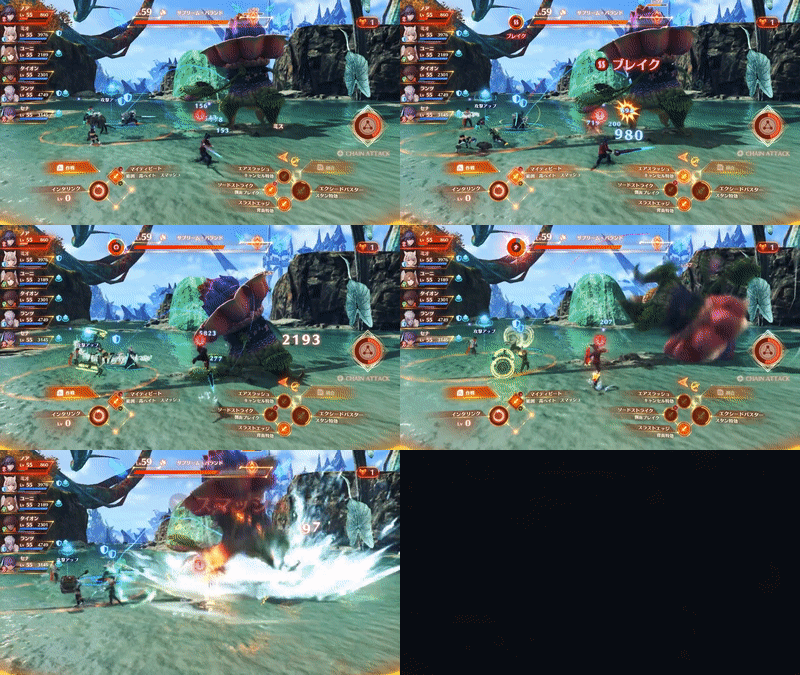
Now, let's get into the combat, because, hoo boy, is there a lot to talk about. The game employs a new variant of the series' MMO-like auto-attack system. This time around, you control six (!) party members, double the amount of both Xenoblade 1 and 2. You can now freely swap from one character to another during battle, which is a feature I've been longing for in Xenoblade since the first game. The star of the show here is, without a doubt, the new class system. Each character can learn any class, and mastering one lets you use some of its arts while playing a different class. This lets you, say, give healing arts to a tank, or some evasive arts to your healer. This unlocks a vast amount of gameplay, and you're actively encouraged to swap classes all the time. Switching characters also lets you focus on directly playing what you find fun. If you love the Swordfighter class, but want Noah to learn some moves from the Medic Gunner class, you can assign the Swordfigher class to Eunie and play as her instead. Classes are unlocked by doing hero quests, meaning that a huge amount of the game's 24 classes are completely optional.
Another wrinkle to combat is the Interlink system. As Ouroboros, your party members are able to fuse with one another to create a single, powerful mecha-monster. Your characters are able to take on these powerful Ouroboros forms at any time, and they are particularly devastating. Once you activate the form, you are essentially invulnerable, but you have only a limited span of time before you split back into your original forms. Additionally, it's not always the best idea to Interlink, since you are removing a character from the field. For example, if you are going to be temporarily removing one of your healers from the board, you best be sure your group composition can take that hit! Because of this, the Interlink system gives the battle system a welcome sense of strategy and variety.
Xenoblade 3's combat is far from flawless though. With six party members--seven if you have a hero with you--things get chaotic on the battlefield. Too chaotic if you ask me. There is something so elegant about how easy it is to read Xenoblade 1's combat. Xenoblade 2's combat was far more complex, but once you mastered it, it felt like a skillful juggling act. Xenoblade 3's combat has so much going on at any given time that it becomes pretty difficult to parse what is going on, especially if you're fighting a bigger group of enemies. While the ability to switch heroes is great, the party AI is still pretty wonky, and I found myself having to babysit tanks who don't know to get in healing circles, or healers who don't know how to stop drawing aggro.
Then there's the game's new Chain Attack mechanics, which are totally revamped. Chain Attacks consist of you choosing an attack order with a specific effect, and then choosing your characters' moves one-by-one in any order you like. Each character grants you a specific amount of Tactical Points. Once you reach 100 points, the attack order is completed, potentially letting you try again if you have enough remaining attackers. The system works well enough, but with seven characters, the length of these unskippable animations make Chain Attacks a total misery to use. They completely halt the pace of a battle, and after 60 hours, I was completely sick of it to the point where I chose not to use Chain Attacks.

PRESENTATION & AUDIO
If you've played any other Xenoblade game, there really are no surprises in this category. The music is incredible, because obviously it is. Yasunori Mitsuda, ACE and co. have teamed up to deliver yet another transcendent soundtrack that stands toe to toe with the all time greats. The overworld music often isn't as bombastic as it was in Xenoblade 2, but I feel it fits the game's tone much better this way. There isn't much more to say--just expect to be blown away by the music.
I played with the English dub, and I was pleasantly surprised. The main cast does a fantastic job, and it's pretty much on par with the dub of the original Xenoblade game. I especially liked how accents were pretty consistent with how they were used in previous games. There are spots of poor voice acting in some of the voiced side quests, but it's never as bad as Xenoblade 2's voicework could get.
Graphically, it's a bit of a mixed bag, much like in Xenoblade Chronicles 2 and Xenoblade Chronicles: Definitive Edition. Xenoblade 3 reaches for the next level in terms of visual presentation, no doubt. The world is bigger, and as such the sense of scale and distance have increased accordingly. There are more characters on screen than ever before, and the models are more detailed. Cutscene animations are way more detailed than ever before, and fights are excellently choreographed. All of this is let down by the Switch's aging hardware, which unsurprisingly struggles to keep up.
The game looks good enough while docked, and the visuals can actually be pretty crisp in handheld mode during less demanding moments, but just like Xenoblade 2, it can get pretty damn blurry when it's firing on all cylinders. Frame rate also tends to be an issue some times, although I've heard it could be due to a memory leak issue that can be fixed by restarting the game. Either way, Monolith Soft's ambition is clearly bigger than what the Switch can handle, and I hope that whatever Xenoblade game comes next can benefit from some new hardware.

CONCLUSION
Xenoblade 3 is a vast improvement on Xenoblade 2, and pretty much on par with the first Xenoblade for me. It tries and succeeds to bump up the scope of the world and gameplay mechanics, resulting in the one of the best blends of the Xenoblade formula so far. However, the pitfalls here are significant enough that I don't think the series has really reached its potential apex, and I hope Monolith Soft can continue to improve from here.
That said, I'm really happy that Xenoblade exists. Nintendo properties can be pretty risk-averse at times, but games like Xenoblade 3 that really push the boundaries of its system and its genre are what make Monolith Soft one of the best developers under the Nintendo umbrella. This game is an easy recommendation for any JRPG fan. If you're a Xenoblade veteran, you'll be enamored with this display of how far the series has come, and if you're a Xenoblade newcomer, there's never been a better time to jump in and get lost in the madness.