

Review Aleosha 3/5 · Mar 10, 2026
Wasn't worth it
Death Stranding reminds me of 1970s science fiction—the kind that embraced the strange and unknowable. In this world there are invisible creatures that age whatever they touch, and human corpses explode like nuclear bombs if they aren’t properly disposed of.
Some of its ideas are mundane in film but almost revolutionary in games. Things like body hair or tears. Most …
Death Stranding reminds me of 1970s science fiction—the kind that embraced the strange and unknowable. In this world there are invisible creatures that age whatever they touch, and human corpses explode like nuclear bombs if they aren’t properly disposed of.
Some of its ideas are mundane in film but almost revolutionary in games. Things like body hair or tears. Most developers wouldn’t bother, but Kojima clearly does. The tears here might be the most technologically advanced tears I’ve seen in a game—and perhaps will see for years.
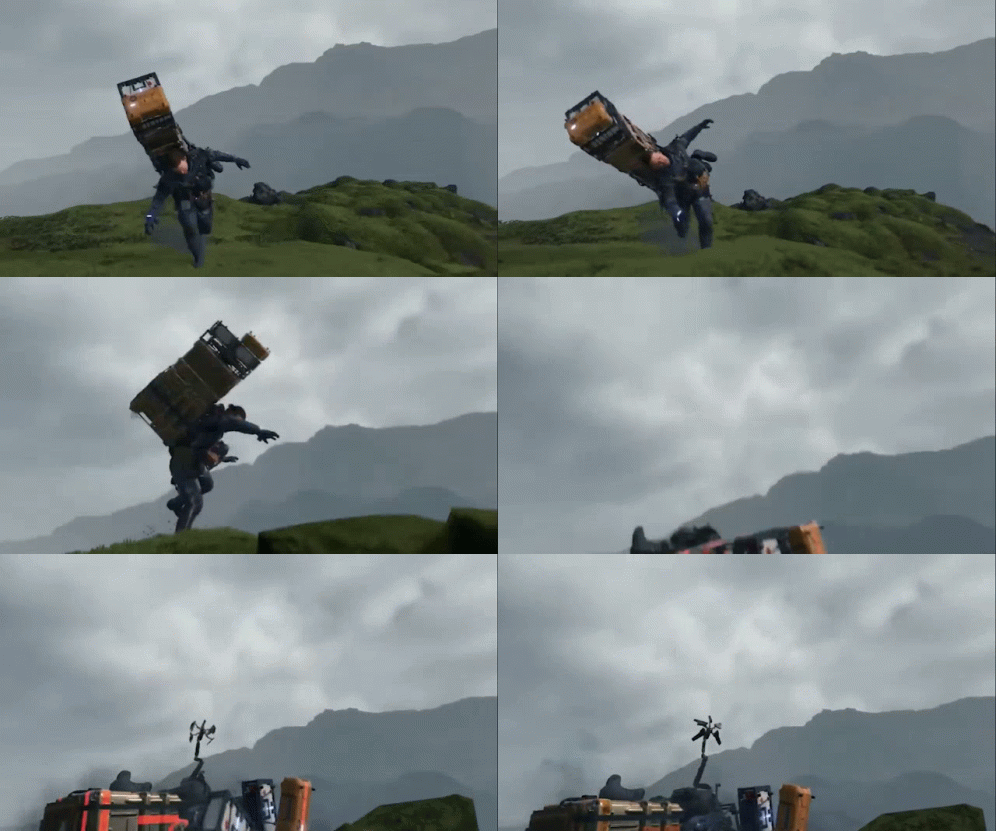
You play as Sam, a post-apocalyptic porter. His last name is Porter as well. Sam has a physical sense of weight and momentum: run downhill too fast and you’ll stumble; overload the backpack and you’ll fall flat on your back. It’s a surprisingly convincing simulation of carrying cargo across dangerous terrain.
Sam is also the son of the last president of America, who is dying of cancer. One of your first tasks is to cremate her so she doesn’t explode. Your sister then becomes the next president—apparently democracy is no longer a priority—but there’s a problem: she’s being held by an organization on the other side of the continent. So naturally, it’s up to you to cross the country and rescue her.
You’re given a BB—an artificial baby in an artificial womb. When connected, it reveals the otherwise invisible monsters you need to sneak past. It’s an innovative mechanic, though not always a convenient one. That description could apply to much of the game.
The bigger issue is that there isn’t much “game” here to begin with. Instead, Death Stranding feels like someone collected the most mundane gameplay activities imaginable and built an entire title around them.
I always avoided online interactions in the Souls games, and here we get even more of that philosophy. You’re supposed to share cargo with other players, and your reward is literally the “likes” they give you. Most of the gameplay consists of endless fetch quests.
In a way, this feels like the logical evolution of Kojima’s design direction. Metal Gear Solid: Portable Ops had many small, self-contained missions because it was a portable title. Then Metal Gear Solid V scaled that structure up: still a constant stream of missions and meta-management. In Death Stranding, the missions remain—but now they’re mostly deliveries.
You aren’t even given weapons at first. Your first “weapon” is a vial of shower water that you throw at monsters like a grenade.
So here we are: avoiding online interactions, running fetch quests, and throwing bodily fluids at enemies. What wouldn’t you do to see some of the best cutscenes the industry can produce?
The game is full of recurring motifs—bonds, knots, bridges, strands. Characters talk about making us whole again, about meeting on the beach. I finished the game still unsure what most of it was supposed to mean.
There are boss fights, though early on you only have grenades. They’re not very difficult, although some enemies can kill you instantly if you’re careless. Higgs, the leader of a terrorist group, summons many of these monsters, deliberately causing the catastrophic explosions they trigger when they devour humans.
Whenever Sam rests we see memories from the perspective of the BB. We’re told not to worry about them, which naturally raises questions. Are these really the baby’s memories? Or Sam’s? And if the latter is true, then perhaps the president wasn’t his mother after all.
Later gameplay improvements arrive slowly. In the third act you lose your bike but gain fast travel and a leg exoskeleton that lets you carry more and move faster. Eventually you unlock anti-gravity sleds that can be chained together and dragged behind you like a cargo train.
Combat tools become more inventive as well. The bolo gun is extremely effective against the game’s main human enemies—the MULEs, cargo-obsessed scavengers armed mostly with spears. The weapon fires a wide arc that instantly incapacitates them, making it possible to wipe out an entire camp with little effort.
Later you also get a gun that steals enemy cargo and another that uses blood bags as ammunition to fight the supernatural threats. It’s imaginative design, though personally I’d have preferred a more conventional arsenal.
At one point the game suddenly throws you into World War I trenches. There, finally, you get real weapons: pistols, assault rifles, shotguns. You also encounter the character played by Mads Mikkelsen, whom we’ve glimpsed during the BB sequences. He’s essentially cosplaying Apocalypse Now. The boss fight is actually quite good—he summons soldiers and you must defeat him several times before escaping the battlefield.
We later meet Mama, played by Margaret Qualley. She had a stillborn daughter and is now literally tethered to the child’s ghost, which prevents her from leaving her compound. The story becomes even stranger when we learn that the baby actually belongs to her twin sister, Lockne, with Mama acting as the surrogate. When Sam severs the supernatural cord, Mama is finally able to travel—but it turns out she had been dead all along. Reuniting with Lockne allows her to finally pass on.
It’s imaginative, undeniably so. Unfortunately the actual mission requires you to carry Mama across ten kilometers of rough terrain—about twenty minutes of real time—which makes the episode feel more exhausting than emotional.
Later chapters become even more frustrating. Your BB is temporarily taken away, making it far harder to avoid the BTs. You’re forced to shuttle back and forth between a mountaineer and a doctor located in extremely inconvenient places. Eventually I just armed myself heavily and eliminated the roaming enemies instead of sneaking around them.
Then there are environmental obstacles like snowstorms where you can barely see for minutes at a time.
The game also continues to pile on bizarre lore. Sam once had a wife named Lucy. They planned to name their son Lou—the same name Sam now gives to the BB. Deadman turns out to be a literal Frankenstein’s monster assembled from cadavers. Heartman’s heart stops every 21 minutes and must be automatically restarted. His heart is shaped like a cartoon heart. He lives next to a heart-shaped lake. His family died during heart surgery.
Even by Kojima standards, the metaphors become overwhelming.
Eventually you reach Amelie. The climactic battle looks spectacular but isn’t very engaging—you mostly shoot at a giant creature while trying not to hit Higgs as he taunts you.
Then comes a stealth boss fight with Higgs. Then a boxing match with Higgs. It’s impressive they built a boxing system just for this one encounter.
Finally Amelie reveals she was never actually trapped and essentially manipulated you into running errands across America. To conclude the story, you must travel all the way back across the continent.
You also “fight” a flying blue whale—though “fight” mostly means shooting it as it passes by.
And then there’s the ending. Not just an epilogue, but an epilogue to the epilogue’s epilogue.
The story revolves around concepts like Extinction Entities, the separation of Ha and Ka, Beaches, and chiralium. It’s certainly elaborate and carefully constructed.
I just didn’t enjoy it at all.