(x-posted from my blog)
In one article covering the release of Doki Doki Literature Club, there’s a quote from the game’s creator, Dan Salvato, where he states that the inspiration came from his “love/hate relationship with anime”. This is a somewhat common phrase that people use when they love genre works and their themes but cannot allow themselves to openly admit it to maintain a pretense of maturity/intelligence/discretion/all the above. In this view, you are only permitted to appreciate genre if you maintain. I have been unable to find any further context for this quote and by all rights I cannot speculate that Salvato approaches anime and video games in this manner, but I can say that this is absolutely how DDLC approaches its originating material.
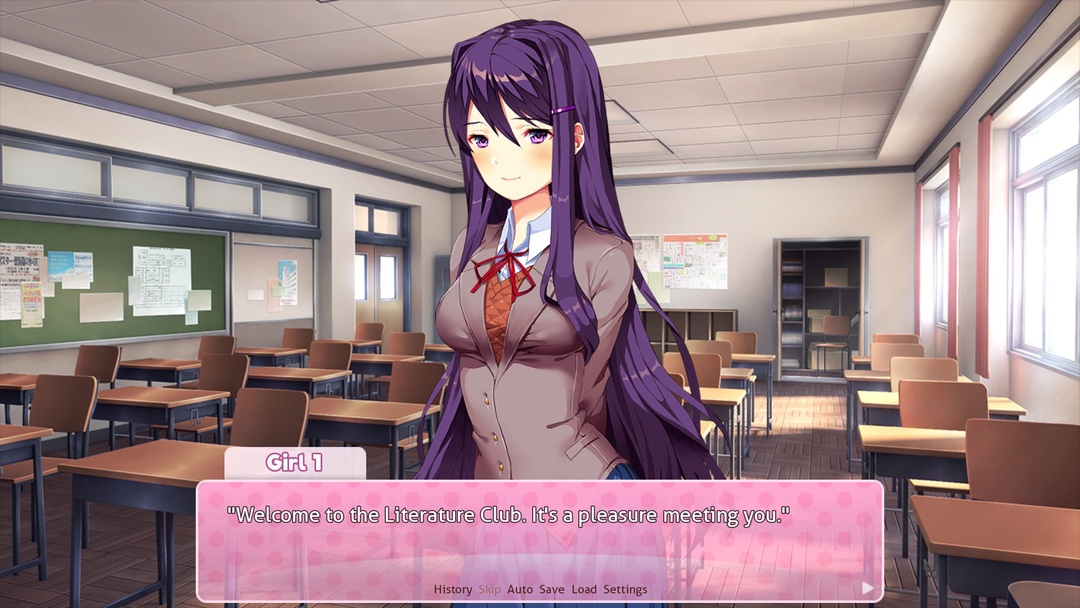
The first quarter of game plays out in strict adherence to what a non-visual novel player thinks a moe visual novel is like. Each girl conforms strictly to type — The Childhood Friend, The Shy Waif, The Tsundere — and are never allowed to be anything more. The result is an extremely dry read, a high school love comedy as if it was written by someone who neither went to high school or has experienced human affection.
Then, the game eventually gets to its true beginning. The Childhood Friend suddenly withdraws, and you go to her room to check on her, where she confesses to you about her battle with depression. It’s a very bizarre scene, because it’s the first sincere moment in the game and reads very much like the account of a person with depression, but also because she talks as if she’s rambling off an explanatory article instead of opening up to a good friend. But no matter, you assure her that you’ll be there for her. In the next scene you find her dead by hanging in her room, in a scene so thoroughly contrived I laughed out loud at it. The scene where you discover her corpse hits all the notes of the body discovery scenes in the Danganronpa games, where distorted filters, jumping scene snippets, and simple eerie music are combined not just invoke tension, but to stylize and amplify it into borderline camp and reinforce just how tasteless and grotesque the whole killing game situation is. Here, in Doki Doki Literature Club, it’s supposed to be serious and scary. What?
From there the game pace mercifully ramps up but continues piles on the contrivances and phoniness. There’s a lot of filters, screen jumps, and garbled text that are intended to give the player the creeping sense that the call is coming from inside the game, but all these effects are clearly impossible to generate in-game and are deliberately added in development, pushing the player even further away from the game. (The exception to this is the broken text encoding and missing image layers, which are definitely possible in a game that’s glitching out and which I felt were genuinely creepy.) While the big twist is conceptually clever, it fails because it’s supposed to be the most intimate moment and yet the game has absolutely done its damnedest to completely distance you from it.
I was not sure on how harsh I should be with this game, because this is Salvato’s first game (his prior work is all in modding) and the failures here all come from novice incompetence. Going back to that article I linked earlier, though, Salvato mentions how he likes games which are disturbing through atmosphere, inviting comparison by name dropping Yume Nikki and Eversion, and not “[shoving] scary-looking things in your face”. It’s ironic that Doki Doki Literature Club ended up being the opposite of what he likes. In order, it is trying to be a creepypasta game, a parody of dating sim visual novels, and a look on disturbed people, and it completely fails at all of these. You have to be willing to truly love (whether this is loving anime, or loving genre, or loving character types) before you can exploit and explore that love.